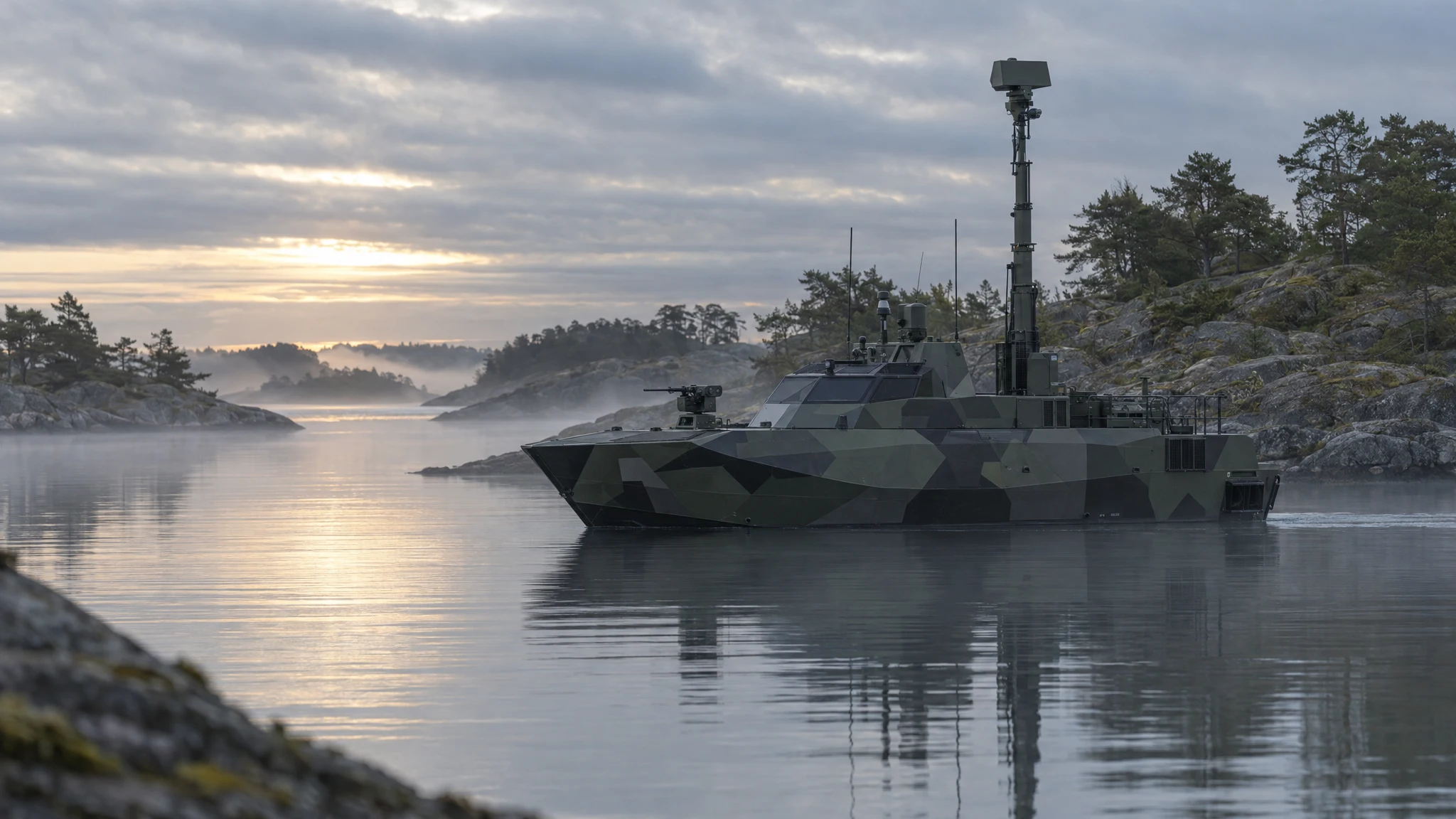
For more than three decades, the silhouette of the Swedish Combat Boat 90 has meant one thing: a squad of marines arriving fast and low between granite islands, delivered by a hull that can turn almost within its own length and stop dead from full speed. It was a taxi with teeth, built for the archipelagos east of Stockholm and later exported far beyond them. Saab now wants that taxi to become a warship in its own right, and one that may sail with nobody aboard at all.
The company has unveiled the Combat Boat 90 Capability X (CB90 CX), a larger, optionally crewed derivative of its familiar littoral craft. Rather than a better troop carrier, the CX is pitched as a modular combat node that can be configured for intelligence, surveillance and reconnaissance (ISR), anti-surface warfare, or short-range air defense (SHORAD). Sweden is the launch customer, with 36 boats under contract for the Swedish Amphibious Battalion, and Saab says production is already under way.
The thesis of this analysis is straightforward: the CB90 CX is less a new boat than a statement about where coastal naval warfare is heading. It reflects three converging pressures that have defined maritime conflict in the mid-2020s, namely the Baltic Sea's infrastructure vulnerability, the drone-saturated naval war in the Black Sea, and the missile-and-drone onslaught against shipping in the Red Sea. How well the CX answers those pressures, and how it competes in an increasingly crowded market for uncrewed and optionally crewed vessels, will say a good deal about whether European navies can adapt quickly enough to the age of distributed lethality.
From Archipelago Taxi to Multi-Mission Platform
The original CB90 was born of a very specific Swedish problem. During the Cold War, Stockholm's defense planners had to assume that a Soviet assault could come through the thousands of islands, skerries and narrow channels of the Swedish coastline. Large warships were ill-suited to those waters; what was needed was something fast, shallow-draught, and agile enough to move coastal troops between positions faster than an invader could react. The waterjet-propelled CB90, which entered Swedish service in the early 1990s, delivered exactly that.
Its combination of speed, maneuverability and the ability to operate in confined coastal waters made it an export success. Close to a dozen navies have adopted the design or its derivatives. In the United States Navy, examples serve under the designation Riverine Command Boat.
Perhaps the most striking measure of the design's influence is that Russia produced its own locally developed imitation, the Raptor class, a patrol and assault boat whose lineage is unmistakable. Raptors have since been seen operating around Crimea and in the Black Sea, where several have reportedly become targets for Ukrainian strikes, an ironic footnote for a design whose ancestry is Swedish.
The most recent Swedish iteration, the CB90 NG, refined the formula without fundamentally changing its purpose. The CX is different. Saab has kept the hull's core virtues but enlarged the platform and increased its payload capacity so that it can host substantial sensors and weapons rather than simply passengers.
The overall length grows to 59 feet, compared with 54.5 feet for the CB90 NG. Twin 1,100-horsepower engines drive waterjets to a top speed of more than 40 knots, and the boat can cover more than 300 nautical miles at that speed. Crewed, it carries up to 10 personnel. Saab also says the design is intended to function across a wider range of sea states than its predecessor, an important point for a craft that may be asked to loiter offshore rather than dash between sheltered islands.
Crucially, Sweden does not plan to retire the NG in favor of the newcomer. The two will operate side by side, with the smaller boat continuing in its traditional troop-transport and raiding role while the CX takes on combat functions. That division of labor is a quiet admission that the old mission has not disappeared; it has simply been joined by new ones that the original hull was never sized to perform.
The Autonomy Question
What most clearly separates the CX from its forebears is that it can operate without a crew. The capability derives from Saab's proprietary Autonomous Ocean Core system. The company has been sparing with detail about the precise autonomous modes available, but it has made two commitments clear.
First, human supervision will remain part of the decision-making process. Second, every CB90 CX will come with the option for autonomous operation, leaving it to the operator to decide, mission by mission, whether to put sailors aboard.
That approach, autonomy as a switchable feature rather than a separate product line, is significant. Many navies have struggled with the institutional and doctrinal leap from crewed ships to fully uncrewed fleets. Purpose-built uncrewed surface vessels (USVs) often require new training pipelines, new maintenance arrangements and new concepts of employment. An optionally crewed boat derived from a familiar hull offers a gentler on-ramp: crews can learn the platform conventionally, and commanders can gradually expand uncrewed operations as confidence and rules of engagement mature.
The insistence on human supervision also places Saab on the cautious side of an ongoing ethical and legal debate over autonomous weapons. Western defense establishments, including NATO members, have generally emphasized meaningful human control over lethal force, and a boat that can carry anti-ship missiles inevitably raises that issue. By keeping a human in or on the loop, Saab avoids the most contentious territory while still offering commanders the chief tactical benefit of autonomy: the ability to send a platform into danger without risking the people who would otherwise be aboard.
The real innovation is not that the CB90 CX can sail itself, but that a navy can choose, on any given day, whether a sailor's life is worth the extra flexibility a crew provides.
The unanswered questions are mostly technical. How resilient is the boat's command link against jamming? How much independent navigation and collision avoidance can it perform in congested waters if communications degrade?
Experience in the Black Sea suggests these are not abstract concerns. Russian forces have invested heavily in electronic warfare, and Ukrainian naval drone operators have had to evolve their communications and guidance methods repeatedly to stay effective. Any optionally crewed boat entering a contested Baltic environment will face similar pressures.
Three Configurations, One Concept
Saab has announced three initial mission configurations. Individually, each is modest. Together, they describe a concept in which combat capability is spread across many small hulls rather than concentrated in a few expensive ones.
The Sensor Boat
The ISR configuration is built around Saab's Giraffe 1X, an X-band three-dimensional surveillance radar capable of detecting and tracking both aerial and surface threats. Against air targets, its range exceeds 62 miles. To push the radar horizon outward, which matters enormously at sea level in cluttered littoral waters, the sensor is mounted on a 36-foot extending mast. Elevation is everything for maritime radar; a few extra feet can add miles of detection range against low-flying cruise missiles and drones that hug the surface precisely to exploit the curvature of the earth.
A boat like this is effectively a mobile, expendable radar picket. It can be pushed forward of more valuable assets, positioned in island gaps where fixed coastal radars have blind spots, or deployed to watch a specific piece of undersea infrastructure. If it operates uncrewed, the calculation about how far forward to place it changes substantially.
The Strike Boat
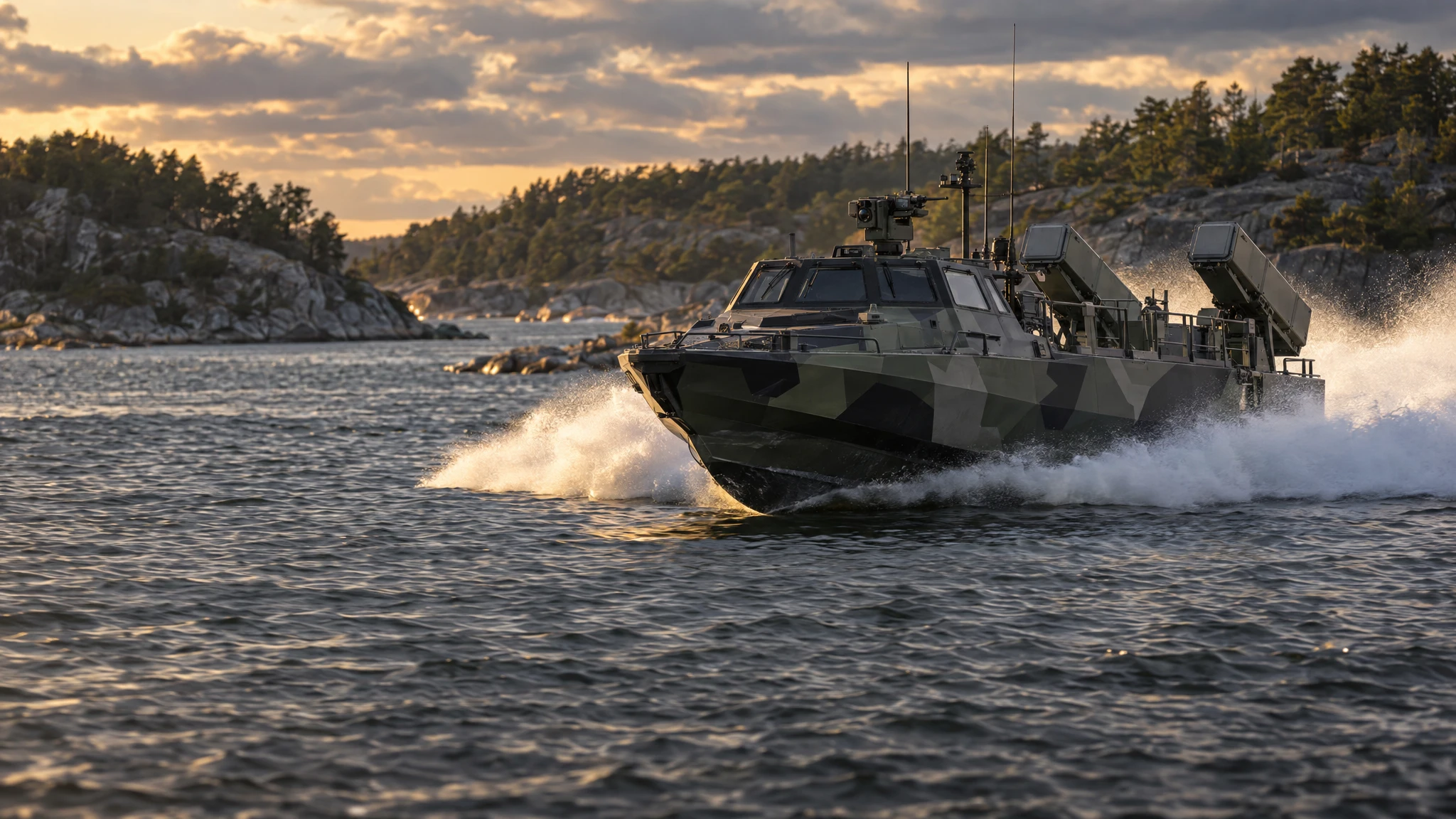
The anti-surface configuration is meant to give the CX an over-the-horizon punch against enemy vessels. Saab has illustrated this version with two MBDA Marte ER anti-ship missiles carried in angled canisters.
The Marte ER is a lightweight, long-range weapon designed for a broad range of launch platforms, from aircraft and coastal batteries to small naval vessels. It has a range of more than 62 miles, flies a sea-skimming profile, and operates on a fire-and-forget basis using an active radar seeker. It can also be used against land targets, though Saab's announcement does not highlight that capability.
Notably, Marte ER is only one option. Saab has confirmed that Sweden will arm its boats with a different missile, the identity of which has not been disclosed. That opacity is not unusual for Swedish procurement and leaves room for speculation about whether Stockholm prefers a domestic or another European weapon better integrated with its existing coastal defense architecture.
Both the ISR and anti-ship versions carry a Trackfire Remote Weapon Station, in 12.7mm or 30mm form, for self-defense.
The Drone Hunter
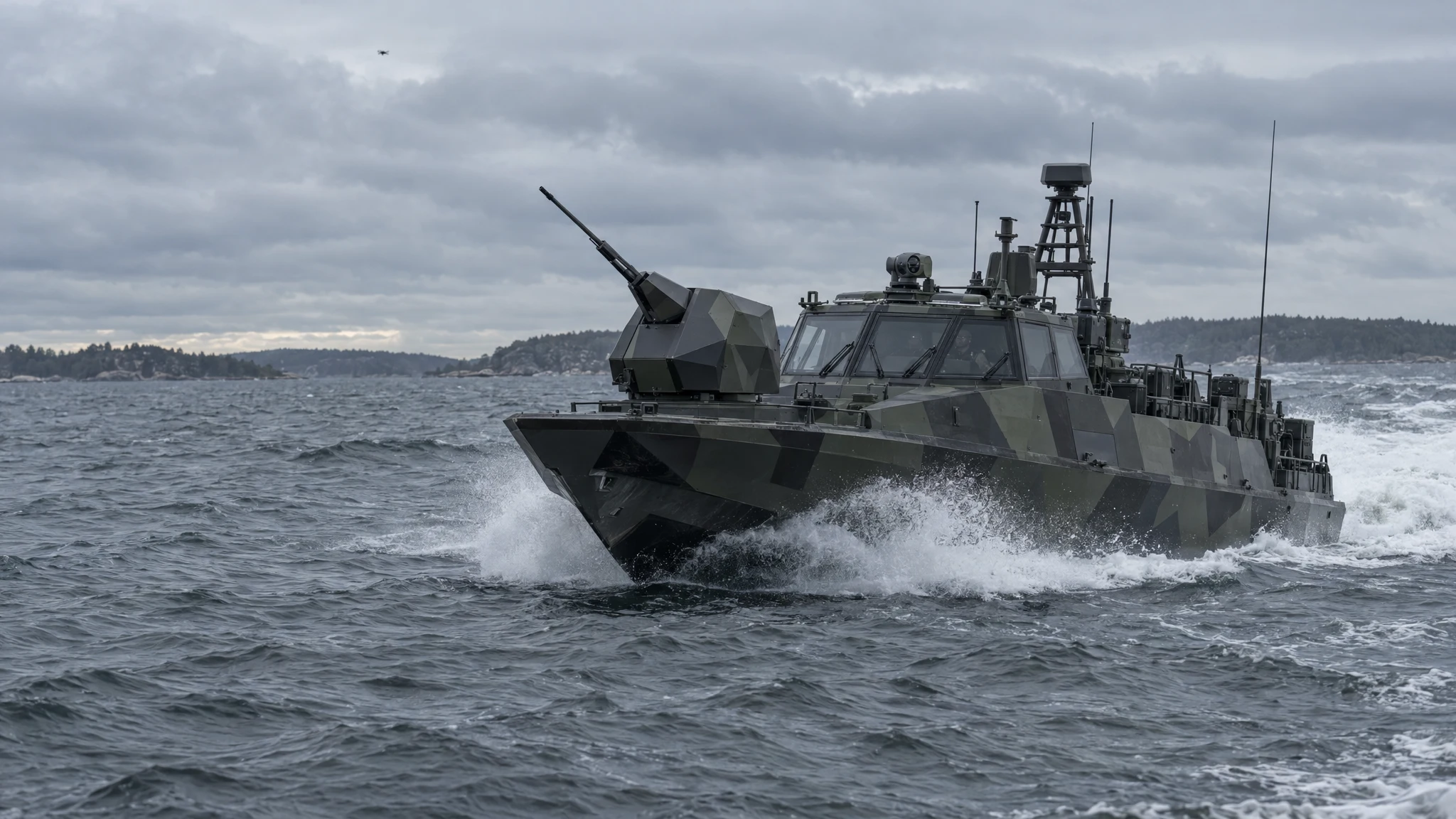
The SHORAD configuration addresses what has arguably become the defining tactical problem of contemporary naval warfare: cheap aerial and surface drones. It mounts Rheinmetall's Seasnake 30mm autocannon, giving the boat a dedicated close-in air defense role. The gun has a nominal maximum rate of fire of 1,100 rounds per minute and can engage drones and helicopters, with a secondary capability against surface targets, including USVs.
That last point deserves emphasis. The cost-exchange problem facing navies has become acute. Firing expensive surface-to-air missiles at inexpensive drones is economically unsustainable over a long campaign, a lesson made painfully clear during the Red Sea crisis. A gun-armed boat that can intercept both aerial and surface drones with relatively cheap ammunition is a partial answer to that arithmetic.
What Comes Next
Saab says it is developing further options beyond the first three configurations. These include the ability to launch drones from the CX, with both tube-launched systems and quadcopters under examination, and an optional torpedo armament. A drone-launching variant would turn the boat into a small mothership, extending its sensor reach and potentially its strike options well beyond its own radar horizon.
Why Now: Three Seas, Three Lessons
Anders Hellman, head of Saab's Docksta business unit, framed the CX in terms of distribution rather than numbers, arguing in the launch announcement that the future of naval operations lies in spreading greater combat capability across the force rather than simply fielding more platforms. He pointed specifically to recent operations in the Baltic, Black and Red Seas as the environments that shaped the design. Each offers a distinct lesson.
The Baltic: Protecting What Lies Beneath
Since Sweden and Finland joined NATO, the Baltic has often been described as an alliance lake. That phrase obscures a more uncomfortable reality.
The sea floor is threaded with gas pipelines, power interconnectors and data cables that are extraordinarily difficult to guard. A string of incidents in recent years, including damage to the Balticconnector pipeline in 2023 and a series of cable ruptures linked to vessels dragging anchors, has focused European attention on the vulnerability of critical infrastructure. Russia's so-called shadow fleet of aging tankers, used to move sanctioned oil, has added to concerns about deniable sabotage in crowded shipping lanes.
Analysts at institutions such as RUSI and the IISS have repeatedly stressed that the challenge here is persistence. Detecting suspicious behavior requires continuous presence across a large area, something navies with a limited number of frigates and corvettes cannot sustain. A fleet of mid-sized, optionally crewed boats carrying long-range radar is well suited to that kind of persistent surveillance, particularly if uncrewed operation reduces the burden on scarce personnel. Manpower, not hulls, has been the binding constraint for many European navies, and autonomy speaks directly to that.
The Black Sea: The Drone War at Sea
No conflict has done more to reshape thinking about small combatants than the war in Ukraine. Lacking a conventional fleet, Ukraine turned to explosive and multi-role USVs that have damaged or sunk a substantial number of Russian vessels and pushed much of the Black Sea Fleet away from its traditional bases in Crimea. Over time, both sides expanded the roles of uncrewed boats well beyond kamikaze attacks: strikes on shipping, attacks on coastal targets, and even air defense missions.
Reporting tracked by the Institute for the Study of War (ISW) has documented how both Kyiv and Moscow have iterated rapidly on these systems.
The lesson for Saab's customers is twofold. First, small, cheap platforms can impose disproportionate costs on larger navies. Second, those same platforms create a defensive problem that legacy warships were not designed to solve. The CX attempts to sit on both sides of that equation: it can be a distributed shooter in its own right, and in its SHORAD form it can defend against precisely the kind of swarming threats Ukraine has demonstrated.
The Red Sea: Saturation and Cost
Since late 2023, Houthi forces in Yemen have launched waves of drones, cruise missiles and uncrewed boats against commercial shipping and naval vessels. The sheer volume of these attacks placed sustained strain on the air defenses of Western warships and forced navies to confront the economics of expending high-end interceptors against low-cost threats. Studies by CSIS and others have highlighted this imbalance as a strategic vulnerability, not merely a tactical inconvenience.
A layered defense that pushes inexpensive sensors and gun-based interceptors outward from high-value ships could relieve some of that pressure. The CX's ISR and SHORAD variants are tailored to just such a role.
A Picket Line in the Gulf?
The concept has obvious relevance in waters far from Scandinavia. Consider the Persian Gulf, the Strait of Hormuz and the Gulf of Oman, where tensions with Iran have repeatedly threatened one of the world's most important energy corridors. Iran and its partners have invested heavily in drones, cruise missiles and fast attack craft precisely because those tools are well suited to the confined geography of the strait.
A screen of radar-equipped CX boats could, in principle, form a picket line across these waters, providing early warning of incoming drones and missiles while also building a picture of surface traffic. Counter-drone variants could accompany high-value units or convoys as close-in protection. Most importantly, if those boats operate uncrewed, the political and human cost of losing one becomes far lower. In waters where any crewed vessel near the strait is a potential target, that is a powerful selling point.
The caveats are significant, however. The Gulf's summer heat, humidity and dust pose maintenance challenges for small craft and sensitive electronics. Endurance of a little over 300 nautical miles at full speed means sustained picket duty would depend on careful rotation and support infrastructure. And any uncrewed boat operating in such a contested environment would need robust communications and protection against capture or spoofing.
Distributed Lethality on a Small Scale
The broader concept underlying the CX is familiar to anyone who has followed U.S. Navy and Marine Corps debates over distributed maritime operations. The idea is to spread sensors and weapons across many smaller platforms so that no single loss is catastrophic and an adversary must target many nodes rather than a few. RAND and the Atlantic Council have both explored versions of this logic, particularly in relation to island chains in the western Pacific.
Applied to the CX, a notional task group might include:
- ISR boats positioned forward or in island gaps to detect and track air and surface threats;
- Anti-ship boats dispersed among islands and inlets, ready to strike targets cued by the sensor boats;
- SHORAD boats protecting the group, and potentially nearby crewed units, against drones and helicopters;
- Future drone-launching boats extending the group's reach and providing additional targeting data.
Such a formation would be harder to locate and neutralize than a single larger warship carrying all these functions, and it would be particularly at home in the cluttered coastal geography of the Baltic, the Norwegian fjords, or archipelagic regions of Southeast Asia. The question is whether the networking that binds these boats together is as resilient as the dispersal is meant to be. A distributed force with a fragile data link is merely a scattered one.
Industrial and Market Dimensions
Saab says the first CX for Sweden is now in final acceptance trials, although no delivery timeline has been made public. The company plans to build the CX alongside the CB90 NG and will use a new production site to meet anticipated demand. That investment signals confidence that the CX will find export customers, and it fits a broader pattern of European defense firms expanding capacity as governments raise spending in response to Russia's war against Ukraine.
Commonality with the CB90 NG is a deliberate commercial advantage. Existing operators already have training, logistics and maintenance systems built around the CB90 family. Adding a larger, more capable sibling that shares much of that support base is an easier procurement decision than introducing an entirely unfamiliar platform. For navies that operate CB90 derivatives, the CX offers an incremental path toward autonomy and distributed fires.
Yet the competitive landscape is crowded and moving quickly. Purpose-built USVs are proliferating, from Ukrainian designs refined in combat to American, Israeli, Turkish and Asian offerings ranging from small explosive boats to larger reconfigurable platforms. Some of these are cheaper; others are being adapted for an expanding range of missions at a pace that traditional shipbuilders may struggle to match.
Saab's bet is that a proven, combat-credible hull with optional autonomy will appeal to customers who want flexibility without abandoning the crewed model entirely. Buyers seeking truly attritable, low-cost mass may look elsewhere.
Risks and Open Questions
Several uncertainties hang over the program:
- Autonomy maturity. Saab has not detailed what the Autonomous Ocean Core can do on its own. The difference between remote operation and genuine supervised autonomy matters greatly in a contested electromagnetic environment.
- Survivability. A small boat carrying a tall radar mast and missile canisters is not stealthy. Its protection will rely on speed, dispersal and expendability rather than armor.
- Cost. If the CX ends up carrying sophisticated radars and missiles, its per-unit price may undercut the logic of losing one without concern. Expendability is a function of price as well as crewing.
- Doctrine. Sweden's Amphibious Battalion will need to develop concepts for employing armed, optionally crewed boats alongside traditional assault craft, a significant cultural shift for a force built around moving troops.
- Weapon choice. The undisclosed Swedish missile selection leaves the exact strike capability of the national fleet unclear.
Strategic Implications for NATO's Northern Flank
For NATO, Sweden's accession transformed the defense of the Baltic region. Swedish territory, including Gotland, now anchors allied planning for reinforcing the Baltic states and containing Russian forces around Kaliningrad. In that context, a fleet of 36 multi-mission boats capable of persistent surveillance, anti-ship strike and drone defense is a meaningful contribution to the alliance's littoral posture, even if each boat is individually small.
The CX also offers a template other allies might follow. Several NATO navies face the same mix of constrained budgets, limited manpower and an expanding list of tasks, from infrastructure protection to counter-drone defense. A family of optionally crewed boats that can be reconfigured as threats evolve aligns with recommendations from defense analysts urging European navies to invest in affordable mass alongside their high-end platforms.
Policy Recommendations
Drawing on the program's strengths and gaps, several steps would maximize the value of platforms like the CX:
- Invest in resilient networking, including anti-jam communications and onboard autonomy capable of continuing missions when links degrade.
- Develop allied doctrine for mixed crewed and uncrewed littoral task groups, ideally exercised in the Baltic with Nordic and Baltic partners.
- Prioritize low-cost interceptors, including guns and programmable ammunition, to address the cost-exchange imbalance revealed in the Red Sea.
- Integrate the CX into infrastructure-protection architectures alongside seabed sensors, aerial surveillance and coastal radars.
- Maintain clear human-control policies for lethal engagements to preserve legal and political legitimacy as autonomy expands.
Conclusion
The CB90 earned its reputation by doing one thing exceptionally well: moving troops quickly through waters where bigger ships could not follow. The CB90 CX keeps that pedigree but asks the hull to do something altogether more ambitious, to see, to shoot and to defend, potentially without a single person aboard. It is a product of lessons written in the Black Sea, the Red Sea and the cable-strewn floor of the Baltic.
Key takeaways are clear. Sweden is buying 36 of these boats and will operate them alongside, not instead of, the CB90 NG. The platform's modular ISR, anti-ship and SHORAD configurations, with drone launch and torpedo options to follow, embody the shift toward distributed naval combat power.
Its optional autonomy offers a pragmatic bridge between crewed fleets and the uncrewed future. Whether it thrives will depend on the robustness of its autonomy and networking, its cost relative to fast-moving USV competitors, and the speed with which navies can build doctrine around it. If those pieces fall into place, the humble archipelago taxi may prove to be one of the more consequential small warships of the decade.

Reader discussion
No comments yet. Start the discussion.