For most of the jet age, the price of admission to high-performance air combat has been a strip of concrete. Fighters need runways, runways need fixed locations, and fixed locations end up on an adversary's target list.
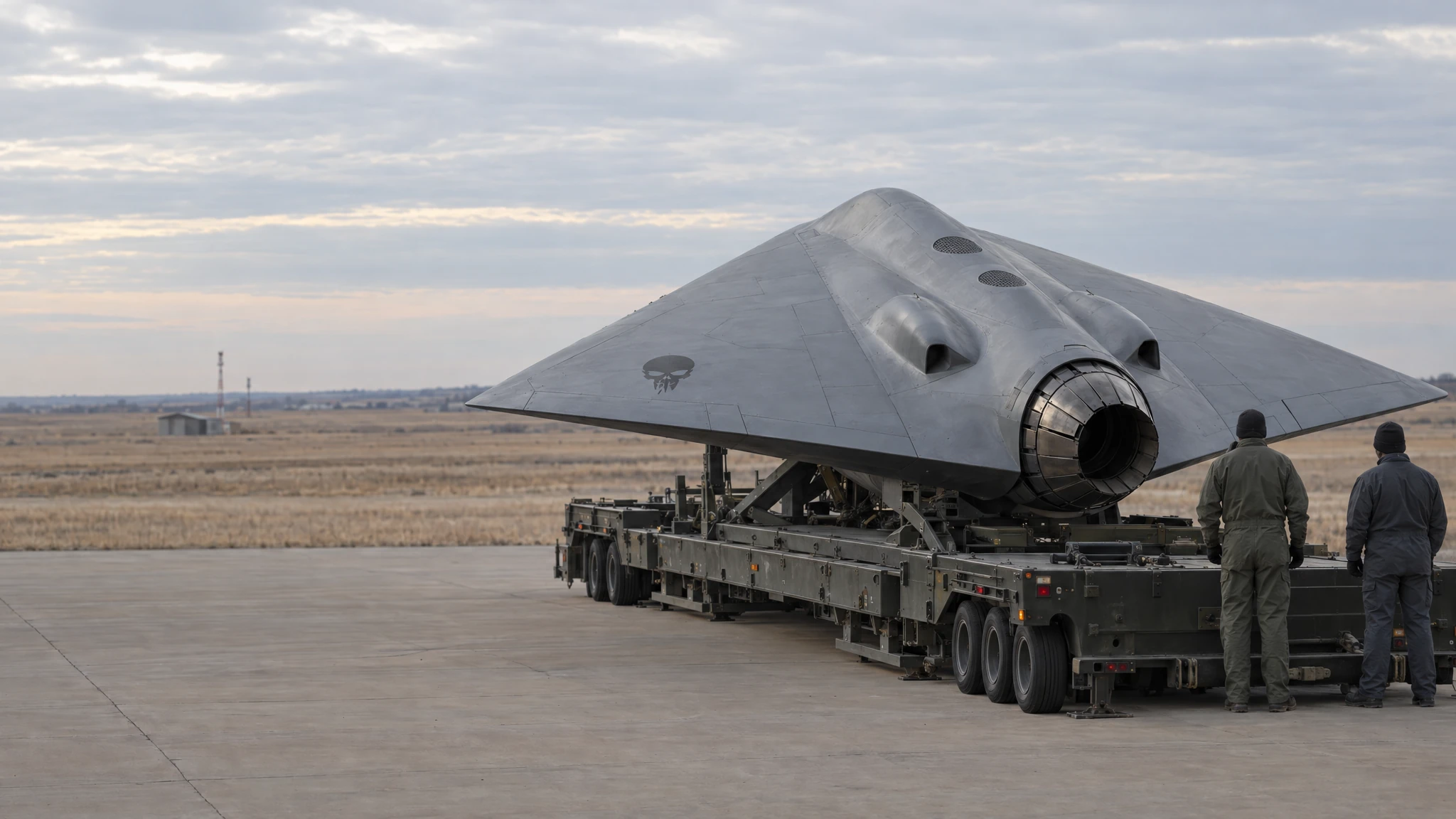
On November 3, 2026, Shield AI showed the first full-scale airframe of an aircraft built on the opposite premise. X-BAT 001 is a tailless, jet-powered, stealthy uncrewed combat aircraft meant to rise from a trailer, stand on its tail, and land the same way. The company released footage of the prototype as it was being moved from its headquarters in Frisco, Texas, to its flight test site in Newton, Kansas. The two locations are known internally as X-Forge 1 and X-Forge 2.
The pictures show a polished, purposeful-looking machine. What matters more is the bet behind it. The U.S. Navy has already put $200 million into the effort, and Shield AI has committed the same amount of its own money. Both are wagering that a vertical-takeoff jet drone can go from bare airframe to a limited operational capability by the end of the decade.
Several serious engineering efforts over seven decades have tried and failed to make tail-sitting jets practical. The unveiling of X-BAT 001 is therefore a milestone, but the real test begins now: the program has to show that this time the physics, the software, and the operating concept work together.
This article looks at what the prototype reveals, what it leaves unanswered, and why the strategic logic of the Pacific is driving the Navy toward an aircraft that many aerospace engineers would have dismissed a decade ago.
A Design That Keeps Moving
X-BAT was first shown publicly in 2025, and it has changed considerably since then. The original configuration used a “cranked kite” planform. By April 2026, when Shield AI displayed a half-scale model at the Navy League's Sea-Air-Space exposition, the outline had become an arrowhead. That shape has a straight, sharply swept leading edge, a common feature in designs that prioritize radar signature reduction across a broad frequency range.
X-BAT 001 broadly follows that newer arrowhead form, which also appears in Shield AI's recent computer renderings. The full-scale airframe does differ from earlier depictions in several visible ways, and these differences hint at the engineering compromises behind the program.
The Exhaust Nozzle Moves Aft
The most obvious change is at the tail. On the prototype, the thrust-vectoring nozzle sticks out well past the trailing edges of the wings. Earlier models and renderings tucked it further into the rear fuselage.
A protruding nozzle is a reasonable choice on a test vehicle, where engineers want room for adjustment and instrumentation. It is also a reminder that the hardware currently flying the propulsion system is a heritage component, not a signature-optimized production part.
Shield AI has said openly that the prototype nozzle would not include low-observable features and that this would change after early testing. Even so, the experimental nozzle looks reasonably well integrated with the airframe for a vehicle at this stage. The overall shaping of X-BAT 001 is also cleaner than first-of-type prototypes usually are.
New designs often come with a clutter of antennas, air data probes, and test fixtures that are later removed. Some of these may still be added before flight testing, but the airframe as shown suggests the outer mold line already takes signature management seriously.
Mysterious Bulges and Screened Openings
Less easily explained are two prominent bulges near the rear of the central body, one on each side of the dorsal spine. Neither appeared on earlier models or renderings. Each has a small opening at the front. The spine also carries two circular, mesh-covered openings, and what may be small fans are visible inside them.
Shield AI declined to explain these features. A plausible guess is that they relate to the propulsion and control system. The thrust-vectoring nozzle handles only pitch and yaw. The company has said roll control will come from engine bleed air routed to thrusters in the wings.
A tail-sitting jet has to stay controllable in all three axes while hovering, when conventional control surfaces have little or no airflow over them. The plumbing, cooling, and air management required for that are considerable. The new features on X-BAT 001 could be part of that system, or they could be thermal management hardware for a heavily loaded engine bay. Without comment from the company, both remain informed speculation.
Rounded Panel Lines and a Unit Patch
The upper surfaces also show panel lines with rounded edges, unlike the saw-toothed panel edges on earlier models and renderings. Saw-tooth edges are a familiar way to scatter radar returns away from the emitter, so the change is worth noting. It could reflect prototype-specific manufacturing choices, a change in signature philosophy, or simply the gap between a marketing model and a functioning airframe.
On a lighter note, the top of the left wing carries an insignia with a skull and other motifs. Shield AI says it honors all four branches of the U.S. military.
The company's message is that none of these details is final. A spokesperson described X-BAT 001 as a development aircraft whose design will evolve through testing and refinement.
The X-35 Analogy and What It Implies
Armor Harris, Shield AI's Senior Vice President and General Manager of its aircraft division, has suggested a frame for reading the prototype. In an interview with The War Zone in October, he compared the relationship between the full-scale prototypes and the eventual production aircraft to that between Lockheed Martin's X-35 demonstrators and the F-35. The X-35 proved the basic configuration and the difficult short-takeoff/vertical-landing propulsion concept. The production F-35 that followed looked similar but differed in many details.
The analogy fits in several ways. Like the X-35B, X-BAT's main technical risk lies in the propulsion path that lets a fighter-class aircraft operate vertically. Harris stressed that the prototypes are not subscale stand-ins. In his words, the vehicle is full-scale, with the outer mold line, the F110 engine, and “the full propulsion path, everything in it.”
The analogy also carries a warning. The gap between the X-35's first flights in 2000 and the F-35's initial operational capability was well over a decade, and the program was repeatedly troubled by weight growth, software problems, and cost overruns. Shield AI is aiming to compress a broadly similar path from demonstrator to combat capability into about three years. Even if X-BAT's crewless design and smaller scope simplify things, the comparison shows how ambitious that target is.
Reviving a Thirty-Year-Old Nozzle
X-BAT's thrust-vectoring nozzle has an unusual history. X-BAT draws on the Axisymmetric Vectoring Exhaust Nozzle, or AVEN, which GE developed in the 1990s for an experimental thrust-vectoring F-16. That program showed that a round, vectoring nozzle on a fighter-class engine could greatly improve agility at high angles of attack. The technology never went into frontline F-16 service, and the original test nozzle spent decades in storage.
Shield AI has brought that hardware back into use in its development work. In July 2026, Shield AI and GE Aerospace announced that they had completed engine light-off testing with AVEN integrated on a GE engine, calling it a critical step toward vertical flight. The F110 engine family, which powers many F-16s and F-15 variants, provides a mature and widely supported core.
This kind of reuse is attractive to a company trying to move fast. Engineering problems that were solved in the 1990s do not have to be solved again, and a mature engine reduces both technical and logistical risk.
The trade-off is that a 1990s nozzle was not designed for a stealthy tailless aircraft, and certainly not for the sustained high-thrust, low-airspeed conditions of tail-sitting flight. The production nozzle will need to keep AVEN's control authority while adding the shaping and thermal treatments that low observability requires. That work is still to come.
Landing Gear Is Optional
The other half of the vertical-flight equation is software. Hovering a jet on a column of thrust, then moving to wing-borne flight and back, is a hard guidance, navigation, and control problem. The aircraft passes through flight regimes where it is aerodynamically unstable and has little margin for error. Shield AI is relying on experience from V-BAT, its much smaller tail-sitting drone powered by an internal combustion engine, which has been used in both military and commercial service.
If the approach works, the design gains a great deal. A vehicle that takes off and lands on its tail does not need landing gear. That removes weight, internal volume, and mechanical complexity, and it eliminates gear doors that cut into a stealthy skin. X-BAT is designed to launch and recover from a trailer-based system that can operate on land or on any ship with enough deck space, with a small footprint in either case.
Shoot and Scoot in the Air Domain
Harris has called the launch and recovery vehicle critical to the whole weapon system, because it lets the aircraft survive on the ground. He compared X-BAT on its trailer to an enemy missile transporter-erector-launcher, a target that is hard to find because it keeps moving. An X-BAT mounted on its trailer can do the same, he argued, which makes it hard to track, hard to find, and hard to destroy.
The comparison is deliberate. Mobile missile launchers have been notoriously hard to hunt since the “Great Scud Hunt” of the 1991 Gulf War, when coalition air forces struggled to locate and destroy Iraqi launchers despite overwhelming air superiority. X-BAT's concept turns that problem around. The United States would be the side fielding hard-to-find, dispersed launch platforms, and a peer adversary would bear the burden of locating them.
The Pacific Problem X-BAT Is Meant to Solve
The Navy is willing to fund such an unconventional aircraft because of the base-vulnerability problem that has dominated American defense analysis of a potential conflict with China.
Wargames have repeatedly shown that the main threat to U.S. airpower in the Western Pacific is on the ground, not in the air. The Center for Strategic and International Studies, in its widely cited 2023 series of Taiwan conflict wargames, “The First Battle of the Next War,” found that a large share of U.S. aircraft losses came from missile strikes on airfields, not air-to-air combat. RAND Corporation analysts have spent years documenting how the People's Liberation Army Rocket Force's growing arsenal of conventional ballistic and cruise missiles threatens the relatively small number of large, fixed air bases the United States relies on in Japan, Guam, and elsewhere.
The Pentagon's main responses have been dispersal concepts. The Air Force calls its version Agile Combat Employment, and the Marine Corps' Expeditionary Advanced Base Operations seeks to spread forces across many smaller, austere sites. These concepts are still limited by the fact that conventional fighters need runways, even if those runways are shorter or more numerous. A fighter-class drone that needs only a trailer and a level patch of ground could, in principle, be dispersed much more widely than any runway-dependent aircraft.
The strategic case for X-BAT is not that it outperforms crewed fighters in the air. The case is that it lets combat airpower come from places an adversary cannot readily list, target, and suppress.
Multiplying Flight Decks at Sea
The maritime version of the argument may matter even more to the Navy. The service's eleven aircraft carriers are extremely capable and very scarce. Each represents a huge concentration of value, and each is an obvious priority target for Chinese anti-ship missiles. Shield AI proposes carrying X-BATs on their trailers, possibly dozens at a time, aboard ships that are not carriers, including amphibious warfare ships and expeditionary sea base vessels.
Harris put the pitch in terms of numbers. Spreading X-BATs across these other hulls, he said, would significantly increase the effective number of carrier air wings the Navy can deploy. The company also notes that this would add air combat capacity without taking deck space from crewed aircraft on the carriers themselves.
If that works, the operational effect would be large. A distributed fleet where many ships can launch strike-capable jets complicates an adversary's targeting much more than one built around a few flattops. This matches the Navy's broader Distributed Maritime Operations concept, which tries to spread lethality across the force instead of concentrating it.
Major practical questions remain open. These include deck space, jet blast management on ships not built to handle it, fuel and munitions storage, maintenance at sea, and the effects of salt spray and ship motion on a precision vertical landing. None of these is trivial, and none has yet been shown at scale.
More Than a Loyal Wingman
X-BAT is designed as a multi-mission tactical aircraft. It would carry weapons in internal bays and on underwing hardpoints, along with sensors, electronic warfare packages, and other mission systems. Shield AI's Hivemind autonomy software would let the aircraft carry out its assigned tasks with a high degree of independence.
Harris has been explicit about how X-BAT differs from the U.S. Air Force's Increment 1 Collaborative Combat Aircraft, the uncrewed jets being developed under that program by General Atomics and Anduril. In a statement on November 3, he described those aircraft as much smaller and focused only on air-to-air missions. By contrast, he said, X-BAT is twice their size, can conduct air-to-ground strikes, and carries many more onboard sensors. He added that the thrust-vectored F110 gives X-BAT a much more fighter-like flight envelope than the smaller aircraft powered by Williams-type engines.
That positioning is commercially sensible as well as technically meaningful. The uncrewed combat aircraft market is crowded, and the U.S. services are trying to balance affordability against capability. Increment 1 CCAs were deliberately designed to be cheaper, in some cases close to expendable.
X-BAT, with a fighter engine and a multirole mission set, sits at the more capable and presumably more expensive end. Whether the Navy and other customers will accept that cost depends heavily on whether runway independence delivers the operational advantages Shield AI promises.
Distinct From the Navy's Carrier CCA
The Navy is running X-BAT under a program called Runway Independent Maritime Expeditionary Strike, or RIMES. It is separate from the Navy's own effort to field carrier-based CCA-type drones. The distinction shows that the service is pursuing two complementary paths. One brings uncrewed teammates into the existing carrier air wing. The other aims to put strike airpower on ships and shore sites that have never hosted it.
Money, Partners, and Urgency
The financial commitment is significant for a program at this stage. In 2026, Shield AI received $200 million in Navy funding for RIMES, some of it through the Office of the Under Secretary of War for Acquisition and Sustainment. The company has matched that amount with internal funds. Shared public-private funding of this kind has become a hallmark of the Pentagon's attempts to work with venture-backed defense firms that are willing to put their own capital at risk in exchange for a faster path to production.
The organizations involved say a lot about the intended pace. A Navy spokesperson told The War Zone that the Department of the Navy Rapid Capabilities Office, working with the Defense Innovation Unit, is “aggressively accelerating” RIMES development and testing to deliver a runway-independent, long-range maritime strike capability to the fleet. The same spokesperson was careful on timelines, saying specific dates for operational capability would depend on operational evaluations, flight-test performance, and fleet requirements.
The gap between that urgent language and the noncommittal timeline is telling. The Navy clearly wants this capability soon and has set up the program to move faster than traditional acquisition. It has also left itself room to slow down or change direction if testing goes badly.
A Graveyard of Tail-Sitters
Shield AI has acknowledged that history is not on its side. In the early 1950s, the U.S. Navy sponsored two turboprop-powered tail-sitting fighters, the Convair XFY-1 “Pogo” and the Lockheed XFV-1 “Salmon.” The Pogo did complete transitions between vertical and horizontal flight, a real achievement for its time.
Pilots, however, found landing extremely hard, because they had to look back over their shoulders while lowering a hovering aircraft onto its tail. The concept was abandoned. The Ryan X-13 Vertijet, a jet-powered tail-sitter that hung from a ground-based rig, also showed vertical flight was possible but never became an operational program.
X-BAT's designers can fairly argue that the main barrier then was human, not aerodynamic. The pilot's workload in a tail-sitting landing was nearly impossible to manage. Modern flight control computers and autonomy software remove that barrier entirely, because no human has to look over a shoulder.
The remaining problems are still serious: precise thrust management, roll control in a hover, recovery onto a moving ship, and the thermal and structural loads of sustained vertical operation. They are problems of engineering, not human endurance, and in that respect the gamble differs from those of the 1950s.
The Road From Crane to Combat
Shield AI has described a stepwise test plan for the prototypes. Over the past year, Harris said, the company has carried out wind tunnel, engine, and thermal testing aimed at retiring the program's major risks before committing to a production design.
Testing of X-BAT 001 will move through several stages:
- Horizontal engine runs with the vehicle lying on its launch and recovery trailer.
- Vertical engine runs with the vehicle raised to its tail-sitting position and powered up.
- Tethered free-flight testing with the aircraft hung from what Harris described as one of the largest cranes in the world, now being set up at the Kansas test site.
- Untethered flight once the crane is removed and the aircraft flies on its own.
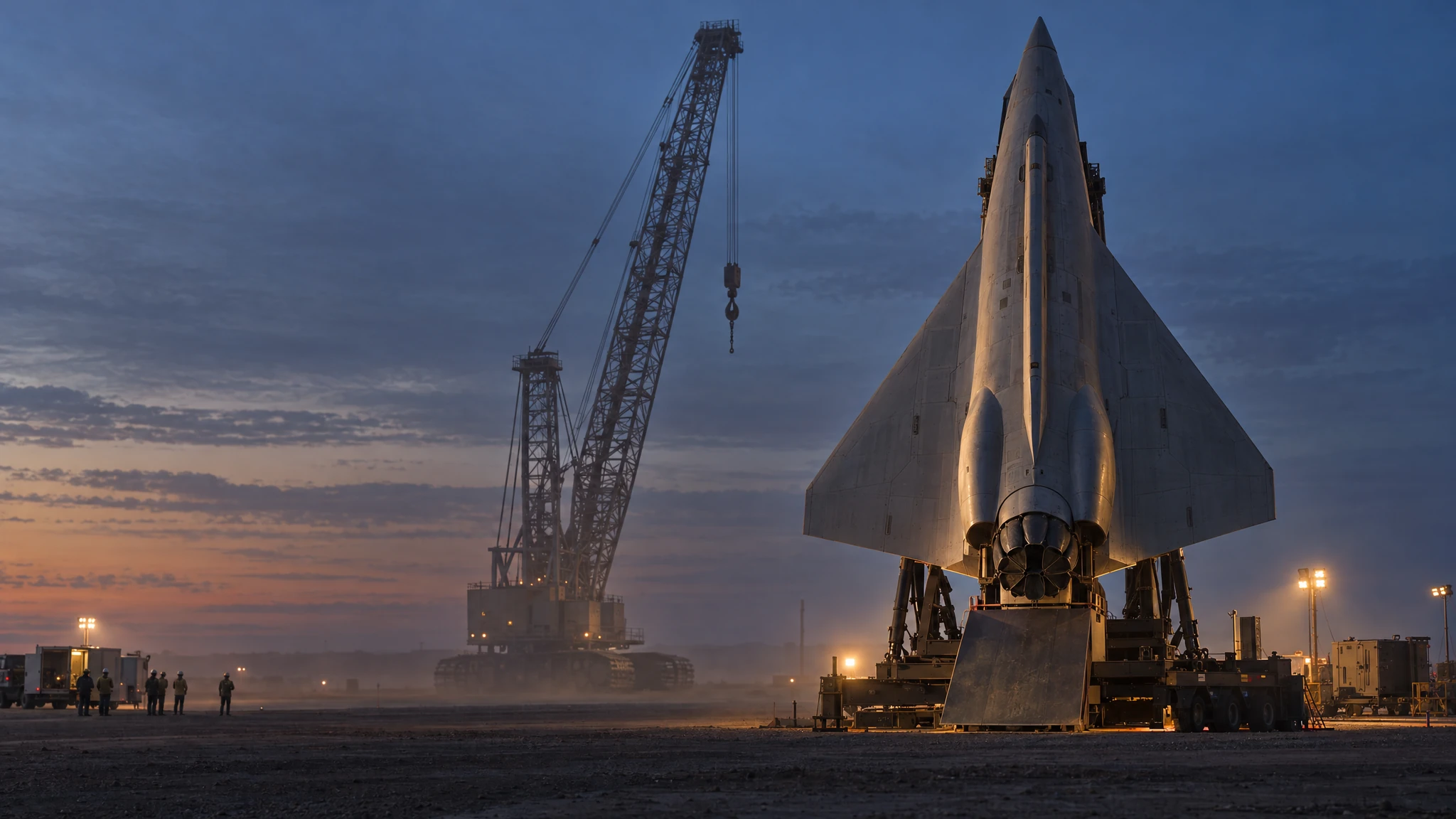
The crane-suspended phase is a sensible way to reduce risk. It lets engineers verify the control laws in real hover conditions while the tether protects against loss of the vehicle, a practical consideration when only two full-scale prototypes are planned. The approach recalls the tethered and rig-mounted testing used for earlier vertical-flight aircraft, including the X-13.
An Extraordinarily Compressed Schedule
Shield AI's stated goals are to fly a fully missionized X-BAT in 2028, start series production in 2029, and reach at least a limited operational capability that same year. Getting from a first full-scale airframe in late 2026 to a production aircraft with real combat utility in roughly three years would be an extraordinary achievement by any historical measure.
Several factors could help. The engine is mature, the core nozzle technology has decades of heritage, the company already flies tail-sitting drones in V-BAT, and autonomy software lets it avoid many costly steps of human-rated aircraft development. The funding structure and Rapid Capabilities Office sponsorship are also designed to cut bureaucratic delay.
Several factors could slow the program down:
- Vertical flight transitions are notoriously difficult.
- The stealth-optimized production nozzle has not been built.
- Shipboard integration is unproven.
- Weapons integration and certification on a new airframe usually take years, not months.
Each of these could cause the slips that have affected nearly every advanced aircraft program in recent decades.
Strategic Implications and Scenarios
The program's outcome matters beyond Shield AI's balance sheet. Three broad scenarios are possible.
Scenario One: The Concept Works
If X-BAT achieves reliable vertical operations and reaches the fleet near its target dates, the effect on U.S. force posture in the Indo-Pacific could be substantial. Combat airpower spread across amphibious ships, sea bases, and mobile shore sites would greatly complicate Chinese targeting and weaken the logic behind Beijing's large investment in missiles aimed at fixed bases. Allies such as Japan, Australia, and the Philippines could see opportunities in an aircraft that does not depend on scarce runways. Success would also show that venture-backed defense firms can produce fighter-class combat aircraft outside the traditional prime contractors.
Scenario Two: Delayed but Viable
The more likely outcome may be that the core concept is proven but the schedule slips, perhaps by several years, as the program works through the stealth nozzle, shipboard operations, and weapons integration. In that case X-BAT could still mature into a valuable capability, though later than hoped. Its value would then depend on how fast the threat environment changes and whether other approaches to the base-vulnerability problem mature first.
Scenario Three: Physics Wins
Tail-sitting jet flight could also prove too hard to operationalize within acceptable cost and risk. If so, X-BAT would join the Pogo, the Salmon, and the Vertijet as an impressive demonstrator that never reached service. Even then, the investment would not be wasted. Work on thrust vectoring, autonomy, and mobile launch infrastructure would carry over into other programs.
What Policymakers Should Watch
Several near-term indicators will show which path X-BAT is on:
- Pace of the crane-to-flight sequence. How quickly Shield AI moves from tethered hover to untethered transition flight will be the clearest early signal of whether the 2028 and 2029 targets are realistic.
- Production nozzle progress. Replacing the heritage AVEN hardware with a low-observable design that keeps control authority is a key technical risk.
- Shipboard demonstrations. Launching and recovering from a ship at sea, not a stationary land trailer, will test the maritime concept at its core.
- Follow-on funding. Whether the Navy expands RIMES funding beyond the initial $200 million will show how confident the service is.
- Allied interest. Interest from Indo-Pacific partners could broaden the program's industrial base and lower unit costs.
For Congress and Pentagon leaders, the main recommendation is to fund aggressively while holding the program to clear, test-based milestones. The cost-sharing structure already does some of this by giving Shield AI a direct stake in success. Overseers should resist two opposite temptations. One is to cancel at the first test setback. The other is to rush into production commitments before the vertical-flight concept has been fully proven.
Conclusion
X-BAT 001 is a carefully finished prototype of a deeply unconventional idea. Its rounded panel lines, unexplained dorsal bulges, and extended nozzle all show an aircraft still taking shape, and the company says openly that the design will keep changing. What has held steady from the 2025 reveal through the April model to the November airframe is the underlying thesis. In a conflict with a peer adversary that has a large missile arsenal, survivable airpower may depend less on how an aircraft performs in the air than on how hard it is to find and destroy on the ground.
The Navy has accepted that argument enough to commit $200 million and the involvement of its rapid acquisition offices. Shield AI has matched that money with its own. Neither the funding nor the strategic logic changes the engineering reality that tail-sitting combat jets have defeated capable designers for seventy years.
The Kansas test site, its giant crane, and the first untethered flight will settle what PowerPoint slides and polished videos cannot. How quickly X-BAT 001 moves through that sequence will show whether this program changes how navies think about airpower or adds another tail-sitter to the list of failed attempts.

Reader discussion
No comments yet. Start the discussion.