
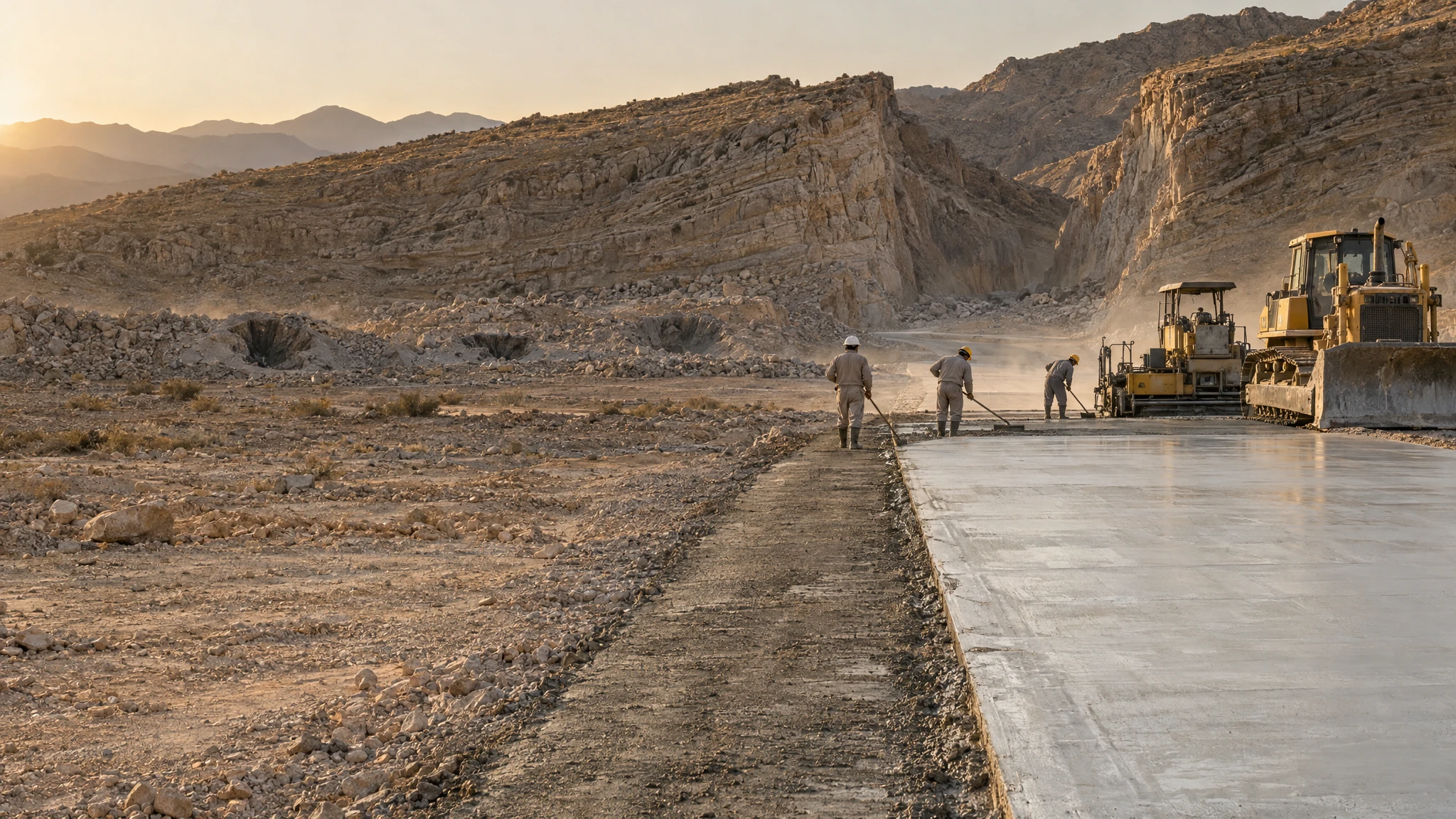
Iran's air force has been declared dead many times this year. The President of the United States has said so at campaign rallies, the Secretary of Defense from the Pentagon podium, and the commander of U.S. Central Command before Congress. Yet in Hormozgan province, on a valley floor beneath the folded ridges of the Zagros foothills, bulldozers and paving crews keep working on a base built to keep that air force alive. Commercial satellite imagery from late September shows Iran pouring fresh concrete at Eagle 44, its showcase underground airbase, after the site was hit at least three times by American and Israeli strikes since February.
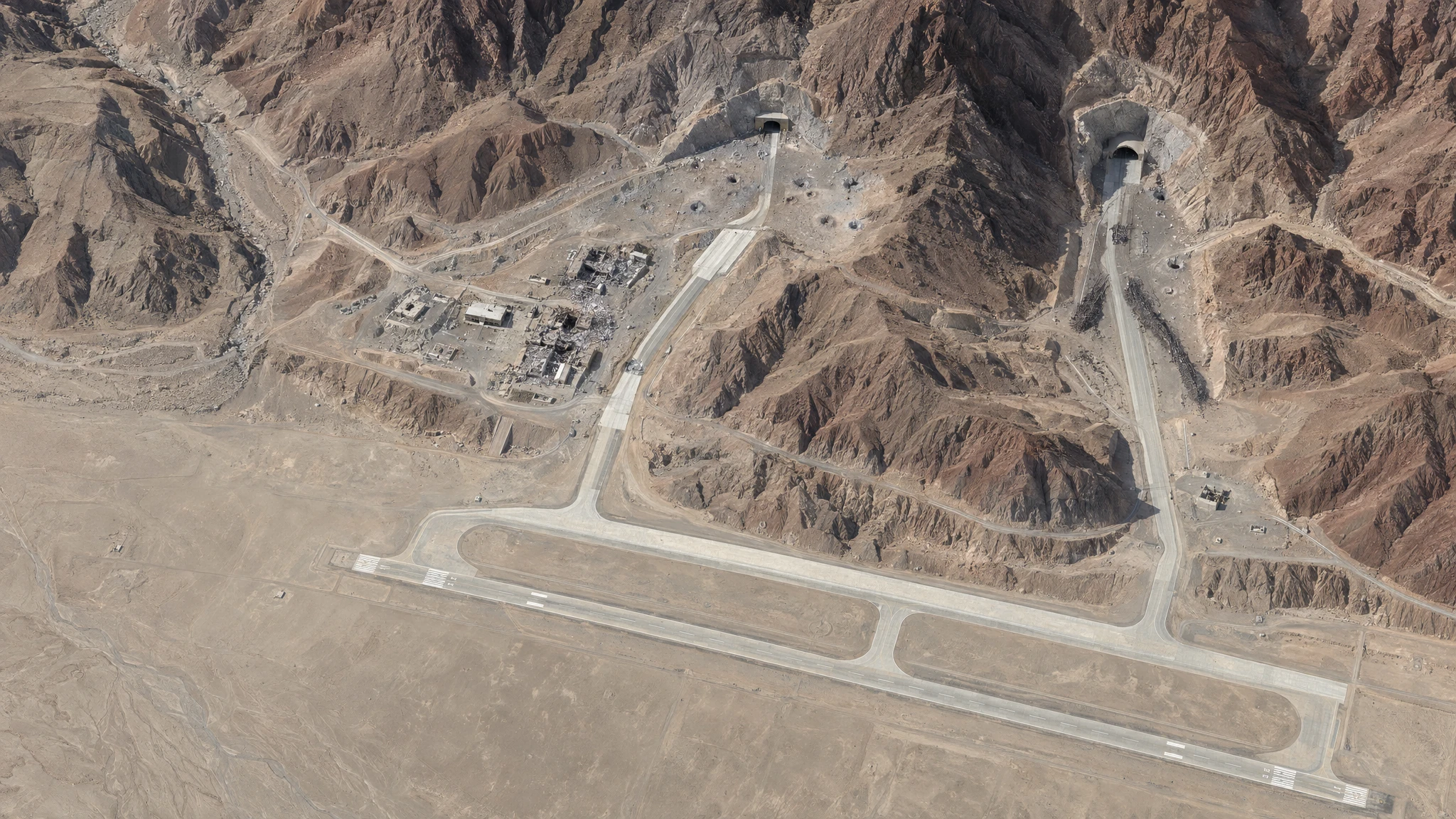
The imagery, collected by Planet Labs on September 29 and first published by The War Zone (TWZ), shows a newly finished stretch of taxiway, wreckage pushed off the pavement, and the main runway cleared of the obstacles Iran had placed there to stop hostile aircraft landing. Several support buildings are still in ruins.
Iran is spending money and labor at a remote mountain installation during a blockade, under heavy sanctions and with damage to repair across the country. That spending says more about how Tehran sees the war than any official statement.
This article argues that the gap between Washington's victory claims and the reconstruction visible from orbit is more than an argument over battle damage. It goes to how hardened, dispersed military infrastructure absorbs airpower, and to what Iran plans to do with whatever survived.
A Mountain Built for Survival
Iranian state media unveiled Eagle 44 in February 2023. Its Persian name, Oghab 44, marks the 44th anniversary of the 1979 revolution. The launch was staged for effect.
Senior officers toured the tunnels while cameras showed Islamic Republic of Iran Air Force (IRIAF) F-4D/E Phantom IIs being loaded with AGM-65 Maverick air-to-ground missiles, laser- and electro-optically guided bombs, unguided bombs, and domestically built anti-ship missiles. One-way attack drones sat in the background of several shots, a sign that the facility was meant to hold more than manned jets.
At the time the IRIAF flew roughly 60 Phantoms, by far its largest fleet of combat jets. These aircraft were designed in the 1950s and kept flying for decades through cannibalization, reverse engineering and sanctions evasion. Nobody outside Iran's military knows how many are still airworthy today.
The IRIAF runs the base, not the Islamic Revolutionary Guard Corps Aerospace Force. That matters. The Guard has controlled most of Iran's ballistic missile and drone arsenal, and the regular air force has often been treated as a relic of the Shah's era, kept on mainly for prestige. Eagle 44 was Tehran's way of telling foreign and domestic audiences that the regular air force still had a combat role, especially in the maritime approaches to the Gulf.
The base sits about 100 miles northwest of the Strait of Hormuz. State media called it one of the army's most important air bases, home to fighters carrying long-range cruise missiles and built deep inside the earth.
Maj. Gen. Mohammad Bagheri, then Chief of Staff of the Armed Forces, attended the unveiling and warned that any attack on Iran, including by Israel, would draw a response from Eagle 44 and the country's other air bases. Bagheri did not live to see that tested. He was killed in the opening strikes of Israel's Operation Rising Lion in June 2025, the start of what became known as the Twelve-Day War.
Anatomy of the Complex
The site was built over many years. Tunneling started in 2013. Work on the 2.7-mile main runway began about eight years later, on the flat ground north of the mountain.
Two taxiways cut through a smaller intermediate ridge, linking the runway to four portals into the main tunnel system, which are arranged in two pairs less than half a mile apart. Only one of those taxiways is currently in use.
Inside, the 2023 footage showed at least one blast door and side galleries branching off the main tunnel, where fighters and drones could be parked out of sight and protected from blast. On the western side, beside the unfinished taxiway, is a compound of support buildings. Their exact functions are unknown. Any working airbase, though, needs maintenance shops, crew quarters, fuel and munitions storage, security forces, and the communications needed for air traffic control and command and control.
The design follows a logic Iran adopted after watching the 1991 and 2003 campaigns against Iraq, when coalition air forces wrecked hardened aircraft shelters above ground within days. Iran's answer was to go deep. It built the so-called "missile cities" for the Guard and underground air facilities for the regular forces.
For years, analysts at institutions such as the International Institute for Strategic Studies (IISS) and the Center for Strategic and International Studies (CSIS) have described this tunneling as central to Iran's deterrence. The aim is to make a disarming first strike impossible, so that some retaliatory capability always survives.
Three Rounds of Strikes
The United States and Israel launched Operation Epic Fury on February 28, opening a large air campaign against Iran from the west and south. Eagle 44 was well within reach of the coalition's southern forces: carrier air wings in the northern Arabian Sea, the guided-missile destroyers escorting them, U.S. Air Force tactical and strategic aircraft, and Army assets in the region.
The first round did little visible damage. Low-resolution imagery reviewed by TWZ through March 16 showed the base had been targeted, but with limited effect. That fits a familiar pattern in campaigns against hardened sites.
Early waves usually go after air defenses, command nodes, and launchers in the open. Tunneled facilities are left for later, when attackers have more time and better intelligence.
The second round came at the end of March and did much more. According to The New York Times, high-resolution imagery showed craters on the taxiways near the tunnel portals and one building flattened. Iran had also placed small mounds along the runway, apparently to stop enemy aircraft from landing, which suggests Tehran was worried about a heliborne or airborne raid. Damage assessments indicated the strikes were meant to cut the tunnels off from the runway, trapping whatever was inside rather than destroying it.
Who carried out that attack is still unclear. The Times did not say whether U.S. or Israeli aircraft were responsible, and Israeli officials declined to comment. The division of labor in the campaign points to Washington. U.S. forces handled most of the pressure on Iran's southern flank, while Israel concentrated on the west.
A ceasefire was reached in April and did not hold. After it collapsed, the United States imposed a second blockade, and U.S. Central Command, headquartered at MacDill Air Force Base in Tampa, Florida, and responsible for running the war day to day, launched a new series of strikes across Iran on July 15. Eagle 44 was hit again.
Satellite imagery firm Soar Atlas identified four aimpoints on July 16, with fresh cratering on the taxiways and damage to other infrastructure. Soar Atlas assessed that the buildings struck were linked to the base's construction unit. TWZ has not independently verified that assessment.
Neither the Pentagon nor CENTCOM has named Eagle 44 in any public briefing or release. Iran has not acknowledged that the base was hit at all. Both sides have reasons to stay quiet.
Washington has little to gain from drawing attention to a target it has struck repeatedly without closing it. Tehran prefers not to confirm that its flagship facility is vulnerable.
What the September Imagery Shows
The September 29 Planet Labs imagery is the clearest public picture so far of the base after the July strikes. It shows that reconstruction began after that round and is still going on.
The Runway Reopened
The obstacles that had blocked the main runway are gone. That is a deliberate choice. Iran is giving up a passive defense against an airborne assault in exchange for being able to fly from the base again. The likely reading is that Tehran now considers a raid less likely than before, or that it values being ready to generate sorties more than the extra protection.
A Second Artery Through the Ridge
The most important change is on the western taxiway. A new section running into the pass-through in the intermediate ridge has been finished, with its final concrete surface visible. On the far side of the pass, work on the next segment has started: compacted, stabilized subgrade has been laid but not yet paved. Further south, in front of the western portals, craters from earlier strikes are still visible.
Once finished, the second taxiway would connect the western galleries directly to the runway. Today, all aircraft movements share one route, which limits how fast the base can launch and recover aircraft. A second route would allow more sorties and more complex launch sequences.
It would also add redundancy, which may matter more. If one taxiway or tunnel is cratered, aircraft could still get out through the other. Iran appears to have taken the lesson of the March strikes, which tried to seal the base by cutting its links to the runway, and to be responding by adding more links.
Wreckage Pushed Aside
On the main eastern taxiway, two dark streaks that appeared after the July strikes run off the edge of the pavement. They are probably debris from equipment hit in the attack. The streaks are about as wide as the wreckage, which suggests crews bulldozed it off the taxiway to reopen it.
Nothing indicates the equipment was recovered. It was simply moved out of the way. That is triage: getting the movement surface working quickly matters more than salvage.
Buildings Left in Ruins
The support compound beside the western taxiway still looks badly damaged. Two buildings are clearly destroyed and a third is damaged, and none has been rebuilt. That matches reporting by the Times and Soar Atlas that the strikes reduced the base's construction capacity.
It also shows Iran's priorities. With limited resources, Tehran is fixing the pavement that connects the tunnels to the runway and leaving the buildings for later.
The Portals
All four tunnel entrances appear intact. The satellite's viewing angle makes it impossible to tell whether they are open or sealed. No impact points are visible on the mountain itself, and there is no obvious damage to the portals.
Damage farther inside a sealed tunnel, however, might not show up in overhead imagery. Public data cannot answer what is inside, or how many fighters Iran still has.
The Limits of Bunker-Busting
Eagle 44 shows a basic problem in modern air warfare. Air forces can hit almost any surface target precisely, but deep underground facilities still largely resist destruction. The United States and Israel have a range of penetrating munitions that could be used to collapse the portals, which are the obvious weak point of any tunnel complex.
Collapsing them would not destroy what is stored inside, but it would trap it for a while. The narrow pass-through tunnels in the intermediate ridge are also easy targets, and hitting them would stop fixed-wing aircraft from reaching the runway.
The main storage caverns are another matter. The GBU-57 Massive Ordnance Penetrator (MOP), the largest bunker buster in the U.S. inventory, might reach deeper into the complex. But there are very few of them, and only the Air Force's B-2A Spirit stealth bomber can deliver them. Using MOPs on an air force base when nuclear and missile infrastructure is competing for the same small stockpile would be an unlikely choice.
That is why the coalition appears to have gone for denial rather than destruction: cratering taxiways, flattening support buildings, and targeting the construction crews who make repairs possible. RAND Corporation studies of airbase attack and defense have long made a related point from the defender's side. Runway and taxiway damage is temporary, and the outcome often depends less on the attacker's firepower than on how quickly the defender can repair. On the evidence of the September imagery, Iran has learned that lesson well.
The contest at Eagle 44 is not about whether the mountain can be destroyed. It cannot, at any reasonable cost. It is about whether Iran can repair the base faster than the coalition is willing to keep striking it.
A Nationwide Pattern of Repair
Eagle 44 is not the only site being repaired during the pause in fighting. CNN reported that by the end of May, Iran had cleared 50 of the 69 tunnel entrances struck at 18 underground facilities, including some of the Guard's missile cities. The number is probably higher now. In July, The Wall Street Journal reviewed imagery from Planet Labs, Airbus, and Vantor showing rebuilt entrances near Kangavar, new excavation at Dezful, and repair work near Kermanshah.
Israeli officers have been open about how quickly this is happening. Brig. Gen. Ran Kochav told the Journal that Iran has very impressive industrial and reconstruction capacity and that it had refilled its stockpiles.
Other Western assessments say much the same. Earlier this month, a Western official told Bloomberg that Iran remains well stocked with ballistic missiles and some anti-ship missiles and can add more quickly. In May, a U.S. official said Iran had beaten every timeline the U.S. Intelligence Community had set for its reconstitution.
The Official Narrative
These assessments contrast sharply with what the administration has said publicly. In April, Secretary of Defense Pete Hegseth said Iran's air force had been "wiped out" and its missile program "functionally destroyed," with launchers, production facilities and stockpiles depleted. A week later he acknowledged that Iran was "digging out" launchers, missiles and bombed facilities, but said it had no ability to replenish its offensive or defensive capabilities.
In May, CENTCOM commander Adm. Brad Cooper told lawmakers that before Epic Fury the Iranian air force flew between 30 and 100 sorties a day, and that the figure was now zero. This week, at a campaign rally in Kansas on Monday, President Donald Trump said Iran had no air force and that its "229 beautiful fighter jets" were scattered across Iran's runways.
The two accounts can partly be reconciled. Cooper's figure covers sorties actually flown, and it is plausible that Iran's manned air force is grounded in practice, whether by losses, lack of spare parts, or a decision to keep surviving aircraft hidden.
A grounded air force is not the same as a destroyed one. A base like Eagle 44 exists precisely so that a force can stop flying, survive, and come back later. The repeated claims of total destruction are hard to square with Iran's decision to keep paving taxiways at a base supposedly guarding nothing.
Why Tehran Keeps Building
Several explanations, not mutually exclusive, could account for Iran's investment in Eagle 44.
- Aircraft remain inside. The simplest explanation is that the tunnels still hold usable aircraft, possibly a reduced Phantom fleet kept back for a final strike role against shipping or Gulf targets. Iran's long history of keeping old airframes flying makes this plausible.
- The base is a missile and drone store. Whatever the state of the fighter fleet, the galleries can hold one-way attack drones and could be filled with cruise or ballistic missiles. In that case the runway matters less than the portals and the access roads, and the taxiway work would be about moving vehicles and launchers rather than jets.
- Sea denial near Hormuz. The base's position about 100 miles from the Strait of Hormuz fits Iran's main source of leverage. With a U.S. blockade in place, any platform able to fire anti-ship missiles into the Gulf or Gulf of Oman is strategically valuable. The 2023 footage of Phantoms carrying domestically produced anti-ship missiles shows this was part of the plan from the start.
- Political symbolism. Eagle 44 was presented as proof that the regular air force still counted. Abandoning it would admit defeat in front of a domestic audience the regime is trying to reassure. Rebuilding shows the opposite.
- Positioning for the next round. Iran appears to expect more fighting. The second taxiway, which adds redundancy against exactly the strikes used in March and July, suggests planners are getting ready for another campaign rather than for a lasting peace.
Whatever the main reason, the choice stands out. Tehran is short of resources, under blockade, and repairing damage across the country. That it has kept work going here says the facility matters to the regime.
Strategic Implications
For Washington
The reconstruction is a problem for U.S. messaging and for U.S. planning. Declaring the Iranian air force eliminated raises the political cost of later admitting that hardened sites need to be hit again. Each repaired taxiway at Eagle 44 also makes a fourth round of strikes more likely if fighting resumes. The longer-term question is whether a strategy of repeatedly cratering infrastructure that Iran can repair can produce lasting results, or whether it has simply become a costly cycle of strikes and repairs.
For Israel
Kochav's comments point to Israeli concern that Iran's reconstitution is outpacing the damage inflicted. Analysts at the Atlantic Council and similar institutions have long warned that campaigns against Iran's military infrastructure buy time rather than settle the problem. Each pause gives Tehran room to dig, repair, and restock.
For the Gulf
For Gulf states within range of anything launched from Hormozgan, including the United Arab Emirates, a working Eagle 44 is a concrete threat. A base that can launch aircraft, drones, or missiles toward the Strait of Hormuz affects shipping insurance, energy markets, and the security of coastal infrastructure, whether or not its Phantoms ever fly again.
Scenarios Ahead
Three broad outcomes are possible over the coming months.
- Continued lull, continued building. If the current pause holds, Iran will probably finish the western taxiway, rebuild some support buildings, and restore Eagle 44 as a two-route base. The facility would come out of the war more resilient than it went in.
- Renewed strikes on a familiar pattern. If CENTCOM resumes operations, Eagle 44 will probably be hit again, with the new taxiway segments and the ridge pass-throughs as obvious aimpoints. That would set Iran back, but the record so far suggests the setback would be temporary.
- Escalation to deep penetration. A larger campaign could see heavier penetrating munitions used against the portals. Given how few MOPs exist and how many higher-priority targets compete for them, this is the least likely outcome unless intelligence shows the caverns hold strategic weapons.
Policy Considerations
Several lessons follow for decision-makers in Washington and allied capitals:
- Public claims about an adversary's losses should match what commercial satellites can show, because imagery from firms like Planet Labs is now available to anyone.
- Campaigns against underground infrastructure need a plan for the defender's ability to repair, which means sustained surveillance and decisions about when re-striking is worth the cost.
- The main threat from Iran's tunnel network may not be manned aircraft at all, but the missiles and drones those tunnels can hide. Intelligence collection and targeting priorities should reflect that.
Conclusion
Eagle 44 is a small but useful indicator of where the war stands. Air strikes have cratered its taxiways, destroyed its support buildings, and probably taken some of whatever it holds out of action for a time. They have not destroyed the mountain or Iran's will to dig it out.
The clearest evidence of the base's continued value comes from the September imagery: new concrete, a cleared runway, and wreckage pushed aside. Washington has said there is nothing left for the base to protect, yet Iran continues to rebuild it.
Key takeaways:
- Satellite imagery from September 29 shows active reconstruction at Eagle 44 after at least three rounds of strikes in 2026.
- Iran is prioritizing a second, redundant taxiway, a direct response to coalition efforts to seal the tunnels off from the runway.
- Damaged support buildings remain unrepaired, suggesting construction capacity is limited and that Tehran is focusing on movement surfaces.
- Nationwide repairs, including 50 of 69 struck tunnel entrances cleared by late May, point to fast Iranian reconstitution.
- Western intelligence assessments increasingly contradict U.S. officials' public claims that Iran's air and missile forces have been eliminated.


Reader discussion
No comments yet. Start the discussion.