
A war can become strategically unwinnable before it becomes politically stoppable. That may be the trap facing Vladimir Putin in Ukraine. By the account of recent events presented in October 2026, Russia’s battlefield gains have slowed sharply, economic pressures are mounting, and Washington has offered Moscow an unusually favorable opening for negotiations. Yet none of those conditions guarantees a settlement. If the Kremlin believes that ending the war would expose the costs of failure at home, continued fighting may look less dangerous to Putin than signing an agreement that makes those costs visible.
This is the central paradox of the conflict’s current phase: the incentives that ought to encourage compromise may also make compromise harder. A ceasefire could limit Russian losses and preserve territory, but it would leave Ukraine independent, armed and oriented toward the West. For a Russian leader who has invested his authority in the war’s declared objectives, that outcome could be portrayed as a retreat rather than a victory. The result may be an extended, unstable deadlock—not because either side expects a decisive breakthrough, but because Moscow sees more immediate political risk in stopping.
The argument is necessarily conditional. Battlefield estimates, economic indicators and reports of possible conscription are not equivalent in certainty, and a leader’s private calculations cannot be observed directly. But the pattern described in recent reporting merits serious attention. If Putin’s overriding concern is regime security, then the question is no longer simply what deal is available. It is whether he can accept one without making the war’s failure harder to conceal.
A stalemate is a condition, not a settlement
In the account of the latest diplomatic exchanges, U.S. Secretary of State Marco Rubio characterized the conflict as a dangerous stalemate. The Kremlin also acknowledged the impasse. U.S.-Ukraine discussions in Miami were described as productive, but they did not produce a breakthrough. The language of diplomacy can suggest movement even when the underlying positions remain far apart: meetings take place, statements are issued, and the military contest continues.
A stalemate does not mean that the front is motionless or that the two sides have equal resources. It means that neither can readily convert its available power into a decisive political outcome. Local advances can continue while the strategic balance remains largely unchanged. The reported Russian net gain of 104 square kilometers from January to late May 2026, compared with more than 1,600 square kilometers during the corresponding period a year earlier, indicates a severe decline in the pace of territorial movement. Those figures describe ground gained, not the full military balance, but the contrast is notable.
That distinction matters because the public may mistake slow movement for an approaching end. A battlefield that yields little territory can still consume personnel, equipment and money. Long-range attacks can damage infrastructure far from the front, while both armies adapt tactics and seek weaknesses. A conflict can therefore be strategically stuck yet operationally dangerous. The reported Russian strike that killed 20 people in Zaporizhzhia the day after the Miami talks underlines how little diplomatic activity, by itself, guarantees protection for civilians.
Analysis by organizations such as the Institute for the Study of War, RUSI, RAND, CSIS, IISS and the Atlantic Council is useful precisely because it distinguishes tactical developments from larger questions of force generation, endurance, deterrence and political objectives. No single map update can establish whether a war is nearing resolution. The relevant test is whether either side believes it can improve its eventual position by continuing to fight.
Why a favorable negotiating moment may not be enough
The case for a deal rests partly on timing. The source account portrays Donald Trump’s administration as a more accommodating negotiating partner for Moscow than a future U.S. government is likely to be. It says Washington has cut off aid to Ukraine, that Trump has repeatedly blamed Kyiv for the war, and that sanctions on Russian diesel were lifted until April in an effort to reduce U.S. fuel prices ahead of the midterm elections. If Putin expects a successor administration to take a harder line, he might appear to have reason to secure concessions now.
On paper, a settlement could allow Russia to retain much of the territory it controls and seek a commitment that Ukraine will not join NATO. Such terms would be a major setback for Kyiv’s long-standing security aspirations, but they could also give Moscow a way to halt the fighting without recovering all the territory it claims or achieving the broad political transformation of Ukraine implied by the Kremlin’s maximalist language. A limited agreement is not the same as a Russian victory. It could nevertheless be sold domestically as proof that the war secured tangible gains.
The problem is that the apparent value of a deal depends on what Putin believes he must explain afterward. A government focused on ending the costs of war might accept a compromise that preserves territory and reduces the danger of escalation. A government focused on demonstrating that the war was justified may regard the same compromise as evidence that the original goals were out of reach. The gap between those two calculations is where negotiations can fail even when both parties understand the costs of continued fighting.
There is also a basic asymmetry in what the sides would need from an agreement. Ukraine would be asked to accept limits on its future choices while relying on security arrangements that have, in the reported account, yet to become concrete guarantees. Russia, by contrast, could seek to lock in control of occupied land and gain relief from military pressure. For Kyiv, a ceasefire without enforceable safeguards could become an interval in which Russia rebuilds. For Moscow, an agreement that leaves Ukraine sovereign and capable of defending itself may fall short of the political objective the Kremlin has made central to the war.
The domestic cost of calling the war finished
Putin’s reluctance to settle may be rooted less in a belief that Russia can conquer all of Ukraine than in fear of what a visibly limited result could do to his authority. The war has lasted nearly five years, according to the timeline in the source material, and imposed hundreds of thousands of casualties. Russia has also committed substantial economic and political resources to the campaign. If the final arrangement leaves Ukraine independent, armed and aligned with Western institutions, Russian citizens could ask what those sacrifices achieved.
That question is not guaranteed to produce mass protest or a sudden change of government. Authoritarian systems can restrict public debate, shape narratives and distribute the costs of war unevenly. The Kremlin has means to present a ceasefire as a victory, emphasize territory held, and claim that Russia resisted the West. But the need to manage such a narrative is itself a political constraint. A ruler who has defined success in expansive terms may have difficulty persuading the public that a much narrower outcome was the plan all along.
History offers cautionary examples, although it cannot supply a mechanical forecast. Russia’s defeat by Japan in 1905 helped trigger revolution. Military collapse during the First World War contributed to the fall of Nicholas II in 1917. Germany’s defeat in 1918 ended the Kaiser’s rule and was followed by the “stab-in-the-back” myth, which falsely recast military defeat as betrayal at home. These cases differ sharply from contemporary Russia, but they illustrate a recurring danger: military failure can become a crisis of legitimacy when leaders and political movements have tied national prestige to victory.
Political scientist Hein Goemans has examined how leaders’ fears of punishment after defeat can encourage them to continue wars after the strategic case for fighting has weakened. The logic is grim. If stopping means exposure, humiliation or loss of power, then further combat can seem like an attempt to postpone the reckoning—or to gamble on an unexpected reversal. That does not prove Putin is following this logic. It does explain why a rational calculation of military costs may not lead to a rationally timed peace.
When a leader treats the end of a war as a test of personal survival, military stalemate can become politically self-reinforcing: each lost opportunity to stop makes the next settlement harder to defend.
Why mobilization is both an option and a danger
Russia could try to alter the balance by expanding its supply of manpower. The source account cites rumors that Putin may impose a society-wide draft later in 2026. That possibility should be treated as unconfirmed, not as a decision already made. A broader call-up might provide more troops, but the political price could be high, particularly if it reaches communities and social groups that have experienced less of the war directly.
The Kremlin has incentives to avoid making the conflict feel universal. A society-wide draft could bring the war into households that have so far been insulated from its most direct burdens. It could also expose tensions over who serves, who is exempt and who bears the financial and human costs. The same measure that increases military manpower may weaken the domestic arrangement that has allowed the government to sustain the campaign without mobilizing the entire population in an openly comprehensive way.
Manpower alone would not resolve the war’s central strategic problem. More troops can help hold a line or support attacks, but they do not automatically generate the equipment, training, leadership, logistics and coordination required for a breakthrough. Nor do they guarantee that territorial gains can be converted into a political settlement on Moscow’s terms. A draft could deepen the commitment to continue without changing the underlying prospect of victory.
That trade-off helps explain why mobilization is not a simple indicator of Russian strength. A decision to call up far more citizens might signal that the state remains willing to pay a higher price, but it could also indicate that existing methods of recruitment and force replacement are insufficient for the Kremlin’s objectives. The strategic question is not only how many soldiers can be assembled. It is whether the political system can bear the consequences of assembling them.
Economic strain does not automatically produce peace
The economic picture described in the source material adds to the pressure on Moscow. Ukrainian drone attacks are said to have degraded Russian refining capacity to the point that the government banned diesel exports in July. Growth is reported to be near zero, while taxes are rising. These indicators suggest mounting constraints, but they should not be mistaken for proof of imminent economic collapse or a direct route to negotiations.
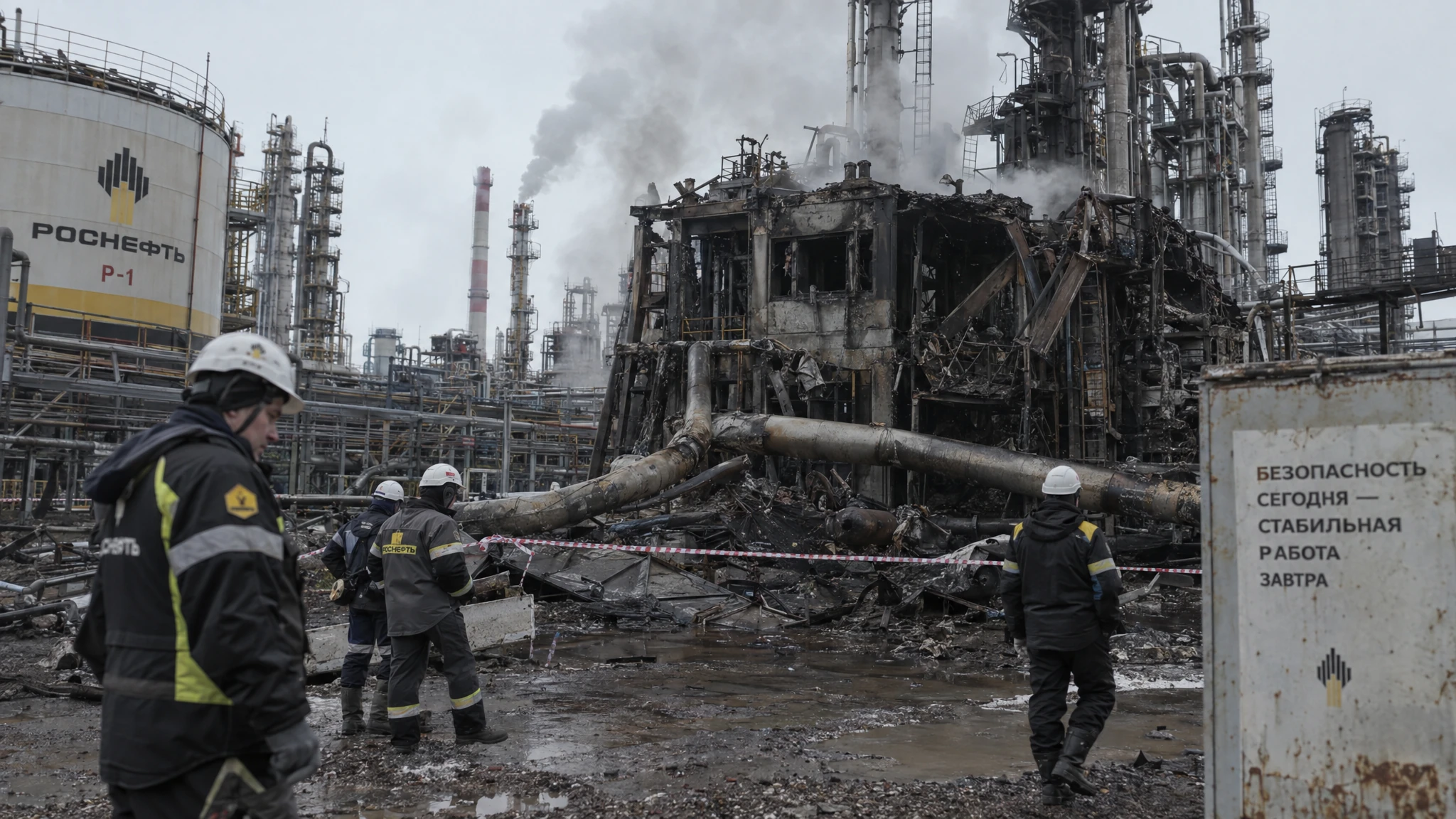
War economies can remain functional under considerable strain. Governments can redirect resources, restrict choices and shift costs among households, businesses and regions. A slowdown may reduce the room available for civilian investment without immediately depriving the state of the ability to finance military operations. Likewise, damage to refineries can disrupt fuel supply and exports, but the strategic effect depends on the scale and duration of the damage, available stocks, repairs and the state’s ability to move resources across the country.
Energy policy also connects domestic economics to external diplomacy. The reported U.S. decision to ease restrictions on Russian diesel until April, in an effort to lower American fuel prices before midterm elections, illustrates how sanctions can be affected by domestic political calculations. Sanctions are not a single switch that either ends or sustains a war. They are part of a larger contest over revenue, access to technology, enforcement, market alternatives and the willingness of governments to absorb short-term costs.
For Washington, easing a measure may provide immediate relief to consumers while weakening the credibility of a broader pressure campaign. For Moscow, even temporary relief may reinforce the view that Western resolve is limited by electoral cycles and economic discomfort. That perception could reduce the incentive to compromise. But it would be equally mistaken to assume that maintaining sanctions alone can compel a settlement. Pressure works best when connected to clearly stated objectives and a credible diplomatic path—not when it is treated as a substitute for strategy.
The Korean analogy—and where it breaks down
A prolonged armistice on the Korean Peninsula offers one possible way to think about what might follow a battlefield stalemate. The front in the Korean War had settled into a largely static contest by mid-1951, yet fighting continued for about two years before the 1953 armistice. That agreement stopped large-scale hostilities without concluding a formal peace treaty. More than seven decades later, the absence of a peace treaty remains part of the peninsula’s unresolved security order.
The analogy is useful because it shows that an armistice can become durable without resolving the political dispute that produced the war. It also warns against treating a ceasefire as a final settlement. A pause in fighting may reduce immediate casualties and create space for diplomacy, but it can leave the underlying conflict intact. Over time, temporary arrangements can harden into institutions, habits and expectations that are difficult to replace.
Yet Ukraine’s circumstances differ in important ways. The source account contrasts the presence of American troops reinforcing South Korea’s frontline with the absence of an equivalent foreign tripwire in Ukraine. It also notes that Kyiv’s prospective security guarantees remain unresolved. A ceasefire without a credible deterrent could leave Ukraine exposed to renewed attack, while an agreement that introduces foreign forces or binding guarantees could be unacceptable to Moscow. The structure of any armistice would therefore be central to whether it reduces danger or simply defers it.
The physical and military geography is different as well. The Korean border has, over time, become a defined and heavily monitored line. Ukraine’s front is not necessarily on a path toward comparable stability. The source material anticipates continuing drone and missile attacks against cities, refineries and electricity infrastructure. Even if ground fighting slowed, attacks from a distance could preserve the capacity to impose costs and keep civilians under threat.
The analogy should therefore be used as a warning, not a template. Korea demonstrates that a ceasefire can last without peace; it does not establish that Ukraine would experience the same kind of frozen conflict, the same deterrence arrangements or the same degree of border stability. For policymakers, the lesson is to design any pause around enforcement, resilience and clear consequences for violations rather than assume that the mere cessation of major combat will make the conflict self-sealing.
Ukraine’s security dilemma after a ceasefire
Any settlement would have to confront a basic security dilemma. Ukraine needs sufficient protection to prevent a ceasefire from becoming an invitation to renewed aggression. Russia is likely to oppose arrangements that would make Ukraine’s defense stronger or bind outside powers to intervene. The space for compromise may lie in mechanisms that are credible to Kyiv without being framed as a direct military alliance—but credibility cannot be achieved through reassuring language alone.
Possible elements could include sustained military assistance, air-defense capacity, intelligence cooperation, training, stockpiles and a clear process for responding to violations. These measures are not interchangeable, and each raises questions of cost, duration and political commitment. A guarantee that is not backed by resources or a decision-making process may fail to deter. A promise that requires immediate military intervention may be difficult for governments to make and harder to sustain across elections.
There is also a distinction between a ceasefire line and an accepted border. A ceasefire can leave territorial claims unresolved while stopping active fighting. That may be the only practical route to reduce violence in the near term, but the ambiguity creates continuing risks. Kyiv would have to consider whether the arrangement preserves its sovereignty and capacity to recover territory diplomatically in the future. Moscow would have to decide whether it can tolerate a neighboring state that remains independent and militarily capable.
These are not merely technical questions for negotiators. They shape the political meaning of an agreement. If Ukrainians believe a pause is a temporary staging ground for another invasion, support for it may be fragile. If Russians believe the agreement merely delays the fulfillment of maximalist goals, the same problem arises on the other side. A durable arrangement would require each government to accept constraints it cannot easily portray as a final victory.
What Washington and Europe can influence
If the prediction of a prolonged deadlock is correct, Western policy should be built around endurance rather than the expectation of a near-term diplomatic breakthrough. Europe would need to plan for sustained financial and military support to Ukraine. That does not mean assuming the war must continue indefinitely. It means avoiding a strategy in which Kyiv’s ability to defend itself depends on short-term political attention or improvised funding decisions.
Washington, meanwhile, faces a choice about the relationship between concessions and leverage. If sanctions relief is granted without a corresponding change in Russian conduct, Moscow may conclude that waiting is more rewarding than negotiating. If pressure is maintained without a realistic diplomatic framework, it may raise costs without creating a path to an outcome. A coherent policy would specify what actions could earn relief, how compliance would be monitored, and what would happen if commitments were broken.
European governments should also consider the political durability of their own commitments. Multiyear assistance plans, coordinated procurement and investment in defense production could help reduce the risk that support rises and falls with each political cycle. Such steps would not guarantee Ukrainian victory or force Putin to negotiate. They could, however, influence the Kremlin’s expectation of how long Kyiv can resist and how much it might gain by simply waiting for Western fatigue.
Diplomacy remains necessary even when prospects are poor. Channels can clarify positions, reduce the chance of miscalculation and test whether limited agreements are possible on issues such as civilian protection or infrastructure. But dialogue should not be confused with progress. The Miami discussions, described as productive but inconclusive, show why public assessments need to distinguish a meeting’s tone from its results. The measure of diplomacy is not whether officials keep talking; it is whether their positions, incentives or risks change.
Three paths from the current impasse
The first plausible path is continued attrition. Russia and Ukraine would keep fighting while neither secures a decisive advantage. The front could shift locally, attacks on infrastructure could persist, and both governments would seek to outlast the other’s resources and external support. This is not a stable equilibrium. It is a costly process in which political events, production, manpower and foreign decisions could alter the balance.
A second path is an armistice without a comprehensive peace. Under this outcome, a monitored pause could reduce large-scale combat while leaving sovereignty, territory and alliance questions unresolved. The Korean experience demonstrates that such a structure can endure, but it also shows that the absence of a peace treaty can preserve a long-term security confrontation. For Ukraine, the quality of deterrence and the rules for addressing violations would matter as much as the ceasefire itself.
A third path is a more substantial negotiated settlement. That would require both sides to conclude that the risks of continuing exceed the risks of compromise. For Putin, that calculation might change if military costs rise, economic constraints become more serious, or the expectation of future gains weakens. For Ukraine, the calculation would depend on whether an agreement can protect its population and preserve meaningful sovereignty. External governments could influence the terms and incentives, but they cannot simply order the parties to accept a bargain they consider more dangerous than war.
These scenarios can overlap. A period of attrition might eventually produce an armistice, which could later support negotiations on a broader agreement. Conversely, a ceasefire might break down if either side believes the other is using the pause to prepare for renewed fighting. The relevant policy task is not to choose one forecast and treat it as certain. It is to prepare for each, while reducing the incentives for escalation and avoiding unsupported promises about how quickly the war can end.
The decisive calculation may be political, not territorial
The reported slowdown in Russian territorial gains, the strain on refining and economic growth, and the possibility of broader mobilization all point to pressure. None alone proves that Moscow is nearing a breaking point. Nor do they establish that Putin has decided to reject a settlement. They instead highlight a more difficult possibility: that a leader may recognize the limits of military progress and still refuse to stop because the political meaning of stopping appears worse.
That is why a favorable moment in Washington may not produce peace. Trump’s approach, as described in the source account, could give Putin an opportunity to seek terms more advantageous than those available under a future administration. But opportunity matters only if the Kremlin values a deal more than it fears the domestic consequences of accepting one. The war may continue not because Russia can win decisively, but because its leadership believes that an incomplete outcome would expose the gap between its promises and its achievements.
For Ukraine and its partners, the implication is sobering but not fatalistic. A prolonged conflict is not inevitable, and a future negotiation could still alter the trajectory. But planning for a settlement that has not materialized is no substitute for preparing to sustain Ukraine’s defense and deter renewed attacks. The central strategic test is whether the costs of continuing can change the Kremlin’s calculation without making escalation more likely.
The war ends when the parties judge that stopping is safer than fighting—or when events force that judgment upon them. If Putin sees a negotiated outcome as a threat to his political survival, battlefield stalemate may endure well beyond the current diplomatic window, potentially through the end of Trump’s term in January 2029 and perhaps longer. That is not a prediction of inevitability. It is a warning that the obstacles to peace may lie not only in the terms on the table, but in the domestic consequences of signing them.


Reader discussion
No comments yet. Start the discussion.