
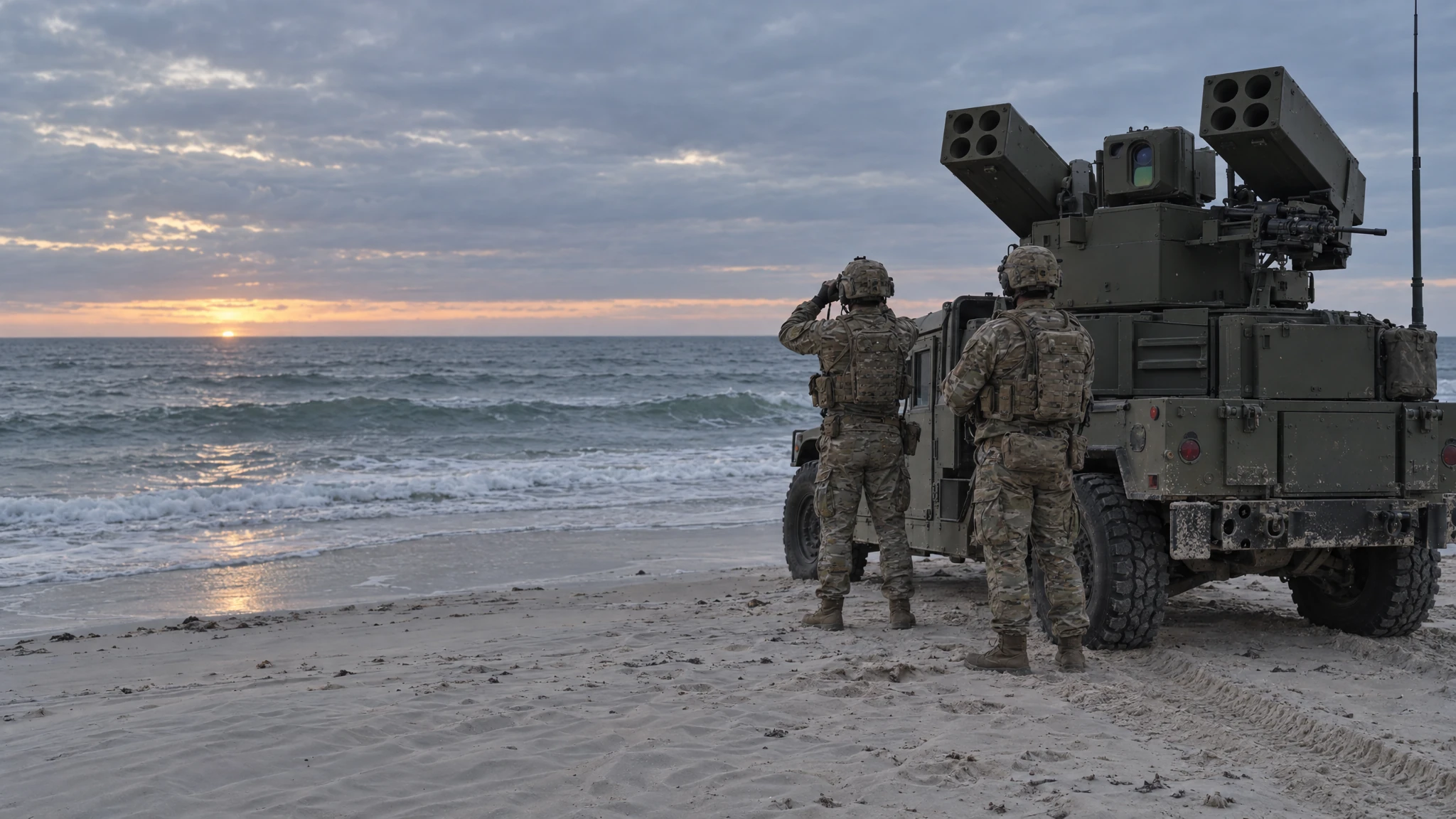
From the Palm Beach side of Lake Worth Lagoon, the shape on the water does not look like a pleasure craft. A floating platform sits off the shoreline of Mar-a-Lago carrying two boxy Army Humvees. Each mounts a rotating turret flanked by missile pods.
A third vehicle of the same kind is parked on the sand. A few miles inland, at Donald J. Trump International Airport, at least two more are positioned near the runways. These are AN/TWQ-1 Avengers, short-range surface-to-air missile systems built to protect maneuvering combat units from low-flying aircraft and, increasingly, from drones. For roughly the past two weeks they have formed an armed perimeter around the private residence of the President of the United States.
The arrival of battlefield air defenses at one of the country’s best-known resort addresses is easy to read as spectacle. It is more useful to read it as a measurement. It shows how far the threat picture around Donald Trump has shifted in 2026. Three separate pressures have converged:
- The United States is effectively at war with a regime that has spent six years promising revenge on Trump personally.
- Cheap, precise unmanned aircraft have spread worldwide.
- The restricted airspace over Palm Beach has been violated more than 160 times.
Taken together, the Avengers at Mar-a-Lago are less an anomaly than a sign of what protecting a head of state now requires.
What Is Actually Deployed, and What Officials Will Say
The official account is short. The North American Aerospace Defense Command (NORAD) and U.S. Northern Command (USNORTHCOM) said they had placed ground-based air defense assets and counter-drone capabilities in and around Mar-a-Lago. They did so at the request of the U.S. Secret Service and under their own command authorities.
The commands described the equipment as a complementary technological layer meant to strengthen protection. They cited operational security in declining to say what systems were involved or where they sat, and referred further questions to the Secret Service.
The Secret Service, for its part, described itself as working in a heightened threat environment. It said it continually adapts its protective methods by adding new tools and technologies, and it confirmed that NORAD and NORTHCOM are supplying counter-unmanned aircraft system support. Neither agency offered a specific reason for the timing.
The identity of the weapons comes from imagery, not official disclosure. Getty Images photographs show the Avengers on the lagoon platform and the beach, and others have been seen at the airport, about three miles west of the estate.
NORAD did confirm one element on the record. It has sent its Counter-Unmanned Aircraft System Fly-Away Kits, which are packages designed for rapid deployment against drone threats or incursions already underway. According to the command, these kits combine:
- Passive and active sensors, including electro-optical and infrared cameras that can visually identify small aircraft by day and night;
- Ku-band radar, a frequency band suited to detecting small, slow targets that conventional air-surveillance radars often filter out as clutter;
- Electronic support measures, which listen for the radio links drones use for control and video;
- Optional electronic warfare equipment to jam or disrupt those links.
The result is a layered architecture. The fly-away kits find, classify and track. Electronic warfare offers a non-kinetic way to defeat a threat. The Avengers are the last resort, able to physically destroy an aircraft that cannot be talked down, jammed or otherwise diverted.
The Avenger in Brief
The Avenger is a mature system. Its turret carries two launch pods, each holding four FIM-92 Stinger infrared-homing missiles, for eight ready rounds per vehicle. The Stinger was originally designed to bring down helicopters and low-flying jets. It has since been upgraded to engage small drones, whose limited heat signatures and erratic flight paths challenged earlier seekers.
The system was conceived for point defense of mobile forces in the field. Since the September 11 attacks, however, it has quietly taken on a substantial homeland defense role. One Avenger is reportedly fixed to a rooftop near the White House as part of the capital’s air defense, which is a reminder that what looks unusual in Palm Beach has long been routine in Washington.
The Iran Factor and a Six-Year Grudge
The most obvious driver of the deployment is the war with Iran. In February, Trump ordered a joint U.S.-Israeli attack on the Islamic Republic under the name Operation Epic Fury. The opening strikes destroyed much of Iran’s senior leadership. Supreme Leader Ayatollah Ali Khamenei was killed on February 28, the first night of the campaign.
Months later the confrontation has not ended. Trump is now reported to be considering a renewed round of strikes, possibly as soon as next week.
The idea of Iranian retaliation against Trump himself goes back well before 2026. It dates to January 2020, when a U.S. drone strike in Iraq killed Major General Qassem Soleimani, commander of the Islamic Revolutionary Guard Corps’ Quds Force. Iranian officials responded with public vows of revenge, some of them naming Trump.
On January 21, 2020, an account associated with Khamenei, @khamenei_site, posted an image that strongly suggested a drone strike on Trump while he played golf, framed as “vengeance” for Soleimani. Twitter suspended the account roughly 15 hours after the image appeared.
That post now reads less like rhetoric than like a stated plan. It combined a specific weapon type, a specific venue and a specific target, at a time when Trump was out of office and the threat could be treated as theater.
The killing of Khamenei changes the situation in two ways. First, it removes the ceiling that the old Supreme Leader’s own caution may have imposed on direct action against a sitting American president. Second, it adds a new and personal grievance for whoever now holds power in Tehran or controls the Revolutionary Guard’s external operations. Revenge for a fallen leader is a powerful political currency in a regime trying to show it still exists and can still strike.
The Avengers at Mar-a-Lago are best understood not as a response to a single warning, but as a hedge against an adversary that has motive, capability, and a documented fixation on precisely this kind of attack.
Intelligence Points to Active Plotting
There is also evidence that the threat is current. Axios reported that an October 23 memo to Secretary of State Marco Rubio described U.S. intelligence findings that Iran had “substantially increased” efforts to target American diplomats and officials in the Middle East and elsewhere. The memo said some lethal plots had reached “advanced stages.”
The memo concerned officials broadly rather than the president specifically. Its timing, however, closely tracks the roughly mid-October appearance of the Avengers in Palm Beach. Officials have not drawn that connection publicly, and it would be speculative to claim a direct causal link.
The broader point holds regardless. American intelligence assesses Tehran’s external targeting apparatus as active, ambitious and not deterred by the losses Iran has suffered.
Iran’s record supports that concern. Western security services have long tied Iranian networks to assassination and kidnapping plots against dissidents, journalists and officials across Europe and North America. Analysts at institutions such as the Center for Strategic and International Studies (CSIS) and the Institute for the Study of War (ISW) have tracked Iran’s use of proxies and criminal intermediaries as a defining feature of its operations abroad.
A regime that relies on deniable networks for ground-level plots may find a remotely piloted aircraft especially attractive. Drones can be launched from a distance, bought commercially, and operated by people with little or no visible link to Tehran.
Why Drones Change the Calculus
Most of the specialized equipment sent to Mar-a-Lago is aimed at drones, and that choice reflects one of the clearest military lessons of this decade. The wars in Ukraine and the Middle East have shown that small unmanned aircraft, many built from commercial parts, can find and kill specific people and destroy high-value equipment at very low cost.
First-person-view (FPV) drones, flown by an operator watching a live camera feed, have become one of the leading causes of casualties on Ukrainian battlefields. Drones guided through thin fiber-optic cables, which emit no radio signal to jam or detect, have emerged as an answer to electronic warfare, the very defense that counter-drone kits depend on most.
Iran sits near the center of this spread. It has used one-way attack drones heavily in its own operations, supplied them to partners and proxies across the region, and shared designs with Russia for use against Ukraine. Its long-range kamikaze drones are a particular concern in Florida for reasons of geography.
Mar-a-Lago sits on a narrow barrier island between the Atlantic Ocean and Lake Worth Lagoon. The sea offers an attacker the most plausible launch approach. A drone could be released from a vessel offshore and fly low over the water, where it would be hard to pick out from wave clutter, before turning toward a target only seconds from the coastline. Placing two Avengers on a floating platform in the lagoon and another on the beach is consistent with a defense oriented toward the water.
The Problem of Seconds
Point defense against drones is fundamentally a race against time. A small drone approaching at low altitude may be detected only shortly before it reaches its target. Every step in the chain — detection, classification, decision and engagement — has to happen within that window.
Research on counter-drone operations from RAND and the Royal United Services Institute (RUSI) has repeatedly stressed that sensors and command authority usually matter more than weapons. A missile is useless if the drone is spotted too late or if no one has authority to fire. The value of the fly-away kits’ Ku-band radar and infrared sensors lies precisely in stretching that warning window.
The Stinger also brings a capability that counter-drone electronics lack. It can engage crewed aircraft. A light plane loaded with explosives, or a hijacked general aviation aircraft, would be no less dangerous than a drone and arguably more so. The Stingers on the Avengers therefore cover threats ranging from a hobbyist quadcopter to a small airplane.
A Restricted Sky That Keeps Getting Breached
The air defenses supplement, rather than replace, the main layer of protection over Palm Beach: NORAD-enforced temporary flight restrictions (TFRs). A standing TFR over Mar-a-Lago remains in force through October 20, 2027. Additional, tighter restrictions are imposed whenever Trump is in residence.
Those restrictions have proven porous. A Federal Aviation Administration filing in federal court dated August 11, first reported that month by the Palm Beach Daily News, stated that more than 160 aircraft and drones had violated the airspace over Palm Beach since the restrictions took effect in October 2025. Nearly all such incursions involve careless or confused pilots, not hostile intent.
Yet each one forces defenders to make a judgment under time pressure. The sheer number shows how hard it is to keep busy coastal airspace, ringed by airports and full of recreational flyers, clean.
The most recent publicly disclosed breach came on October 24. According to a NORAD release, an F-16 intercepted a general aviation aircraft over Palm Beach at about 12:20 p.m. after it entered the restricted zone over Mar-a-Lago. The fighter performed what NORAD calls a standard “headbutt” maneuver, flying across the civilian plane’s path to get the pilot’s attention.
The pilot then established radio contact and left the restricted airspace in compliance with instructions. As intercepts go, it was uneventful.
It also illustrates the problem. A fighter jet can escort a slow Cessna out of the sky. It is much less suited to catching a drone the size of a suitcase skimming over the lagoon.
The Hidden Cost of Fighter Cover
Combat air patrols (CAPs) by fighter aircraft are standard during presidential travel. They often continue for extended periods while Trump stays at Mar-a-Lago. These patrols consume large amounts of resources: fuel, aircrew hours, maintenance and aerial refueling support, all drawn from a fighter force that also has training and deployment obligations.
Ground-based systems such as the Avenger and the fly-away kits offer a cheaper, persistent alternative for the lowest and closest layer of defense. That could relieve some pressure on fighter squadrons, while the jets remain essential for intercepting crewed aircraft at greater range.
Not the First Time Since Summer
The Palm Beach deployment is at least the second time since August that Avengers have been publicly linked to Trump’s protection. Avengers were observed on August 9 at Trump’s golf course in Bedminster, New Jersey, while he attended the final round of the LIV Golf Bedminster tournament. A week earlier, on August 1, White House aide Margo Martin posted a video of Trump greeting soldiers in New Jersey, with an Avenger visible behind them.
At the time, NORAD said that when Avengers support the Secret Service in protecting the president, they are operated by the 263rd Army Air and Missile Defense Command. The command declined to say whether the same unit is staffing the Florida systems.
The pattern is nonetheless clear. Air defense has moved from an exceptional measure to a recurring feature of Trump’s security at his private properties, especially golf courses. That is a striking parallel with the 2020 Khamenei image, which depicted exactly such a setting.
A President Who Has Already Been Targeted
Trump’s security posture cannot be separated from his recent history. On July 13, 2024, at a campaign rally in Butler, Pennsylvania, a gunman opened fire on Trump, then the Republican presidential nominee. Trump was wounded, bloodied and rushed from the stage. The shooter, Thomas Matthew Crooks, a 20-year-old from Bethel Park, Pennsylvania, was killed.
The episode exposed serious failures in the Secret Service’s protective planning and led to sustained congressional scrutiny and institutional soul-searching. Other threats and attempts against Trump unrelated to Iran have followed.
Butler matters to the current deployment for institutional as well as symbolic reasons. An agency that has been publicly criticized for failing to anticipate a sniper on an unsecured rooftop has strong incentives to lean forward against the next foreseeable threat vector. A drone flown over a golf course or a waterfront estate is precisely the kind of scenario that, if it materialized unaddressed, would be judged in hindsight as obvious. Bringing in Army air defense is in part an effort to close that gap before it can be exploited.
Domestic political conditions add further pressure. The midterm elections may be raising security concerns in a polarized environment where threats against public officials have increased sharply in recent years. The Avengers are not designed to counter a lone gunman. Their presence, however, signals a protective apparatus that is adopting a far broader definition of risk.
Questions the Deployment Raises
The deployment raises three sets of questions: the risks of firing missiles over a residential coastline, the expanding military role at home, and the sustainability of the mission.
Firing Missiles Over a Residential Coastline
Missile air defense in a densely built, civilian-heavy area raises practical concerns. Palm Beach is a residential community with heavy boat traffic, neighboring homes, and an international airport nearby. A Stinger engagement over the lagoon or the beach would produce falling debris from the target and possibly from the missile itself.
A false identification, such as mistaking a lost recreational drone or a confused private pilot for an attacker, could carry severe consequences. This is one reason the layered approach matters.
The sensors and electronic warfare tools are meant to resolve most incidents long before anyone considers firing. The Avenger exists for the narrow set of cases where nothing else works. The rules of engagement governing that decision are, understandably, not public, and they are perhaps the most consequential unknown in the entire arrangement.
The Military Role at Home
The deployment also highlights how much the line between domestic protection and military operations has moved since 2001. NORAD and NORTHCOM have long held homeland air defense authorities, and Avengers around the capital are a precedent dating back two decades. Extending those capabilities to a president’s private residences and golf courses, however, normalizes a continuous military presence at locations that are not government facilities.
Civil-military specialists, including scholars associated with the Atlantic Council and CSIS, have argued for clearer frameworks covering counter-drone authority on U.S. soil. Legal authority to detect, track and disable drones has historically been divided among agencies and constrained by aviation and communications law. The Mar-a-Lago deployment, conducted under NORAD and NORTHCOM authorities at the Secret Service’s request, is a working example of how that patchwork functions in practice.
Sustainability and Opportunity Cost
Short-range air defense is among the U.S. Army’s most stretched capabilities. The force largely let SHORAD units shrink after the Cold War and has spent recent years rebuilding them as drone threats grew. Every Avenger crew stationed at a Florida waterfront is a crew not training for or deploying to theaters where drones are actively killing soldiers.
Stinger inventories have also faced pressure, given large transfers to Ukraine and production lines that are only now expanding. Analysts at the International Institute for Strategic Studies (IISS) and CSIS have documented the strain on munitions stockpiles across Western militaries. A long-term protective mission at multiple presidential properties carries real costs for readiness.
Where This Goes Next
Several scenarios seem plausible for the coming months.
- Escalation-driven expansion. If Trump authorizes renewed strikes on Iran, as he is reportedly considering, the threat assessment will almost certainly worsen. Air defense could then become standard at every location he visits for an extended period. Avengers could be joined by more advanced counter-drone systems, including directed-energy or high-power microwave weapons that the military has been testing.
- Institutionalization. Even without new strikes, the combination of Iranian motive, drone proliferation and repeated airspace violations may turn the current arrangement into a permanent feature of presidential protection. That would mirror the way post-9/11 measures in Washington became permanent fixtures.
- Drawdown after a lull. A diplomatic de-escalation with Tehran, or a measurable decline in intelligence on active plots, could allow the most visible military assets to be withdrawn. Sensors and electronic warfare tools would likely stay, quieter and cheaper to maintain.
Which path prevails depends largely on decisions in Washington and Tehran that have little to do with Palm Beach. Since February, the war has shown how strategic choices in one capital ripple back onto the home front of the other.
Policy Considerations
The deployment suggests several lessons for policymakers, whatever one thinks of its scale.
- Clarify counter-drone authority. Congress and the executive branch should establish clear, durable legal authority for detecting and defeating drones over protected sites. Improvised arrangements under military command authorities should not become the default.
- Invest in fiber-optic and autonomous drone countermeasures. Jamming-based defenses lose much of their value against drones that need no radio link. Kinetic and directed-energy options, along with better passive sensors, deserve priority funding.
- Rebuild SHORAD capacity. If homeland protective missions are to grow, the Army needs enough short-range air defense units and munitions to meet them without degrading combat readiness.
- Tighten airspace enforcement and outreach. More than 160 violations since October 2025 point to the need for better pilot education, clearer notification systems and stronger enforcement. Every innocent breach that defenders must evaluate is noise in which a real threat could hide.
Conclusion
The Avengers on the shores of Lake Worth Lagoon are the most visible element of a broader and largely hidden effort to protect a president whose list of enemies has grown longer and more capable. Their presence reflects a sober set of facts.
Iran’s regime has openly fantasized about killing Trump with a drone on a golf course. It has now lost its Supreme Leader to an American-Israeli strike. And U.S. intelligence assesses its external plotting as accelerating. Meanwhile, the tools for such an attack have never been cheaper or easier to obtain, and the airspace that is supposed to keep them out has been breached repeatedly.
Officials have chosen not to explain the deployment in detail, and for good operational reasons. The equipment communicates enough on its own.
Protecting a head of state now extends upward into the low-altitude sky and outward over the water, against threats that could arrive in seconds from a distance. The Avengers in Palm Beach mark the point at which that reality moved from a war zone to a president’s doorstep, and the conditions that brought them there show little sign of easing.


Reader discussion
No comments yet. Start the discussion.