
Iran’s latest defensive preparations point to a conflict in which the most consequential blows may fall far from the country’s nuclear facilities. A report published by 19FortyFive says Tehran has strengthened security around sensitive sites and borders while encouraging public weapons training and demonstrations of regime support. It also describes Iranian warnings that a renewed U.S. attack could trigger retaliation across the Middle East.
Those claims, if accurate, suggest a strategy built less around defeating American forces in a conventional contest than around raising the costs of another campaign. Iran’s capacity to challenge U.S. aircraft directly is limited, according to the account. But missiles, drones, pressure on shipping, and threats to energy and civilian infrastructure could widen the consequences of any strike. The distinction matters: military superiority can make an operation feasible without making its aftermath predictable or inexpensive.
The evidence needs careful handling. The source article attributes several details to reporting by The Wall Street Journal and satellite imagery reviewed by the Institute for Science and International Security, but it does not provide the underlying reports or imagery analysis. The public claims described here should therefore be treated as reported developments, not as independently established facts. The broader strategic question remains clear even with that caveat: what can Iran do to deter an attack when it cannot reliably stop one?
Fortification is a signal as well as a shield
The 19FortyFive account says Iran has added earthworks around Natanz and Pickaxe Mountain, where nuclear infrastructure is located deep underground. It attributes the observation to satellite imagery analyzed by the Institute for Science and International Security and says The Wall Street Journal reported that the mounds were intended to complicate a ground assault or occupation.
Earthworks can impede movement, obscure access points, and make ground operations more difficult. They do not, by themselves, establish that a site can withstand a sustained air campaign. Nor does a visible construction project reveal how much protection lies underground, what equipment is present, or whether the defenses are designed to frustrate aerial attacks, ground forces, or both. The account itself recognizes that distinction: any ground operation against hardened facilities would likely follow a major air phase, and surface defenses may have limited value against aircraft-launched or ground-launched missiles.
That does not make the measures meaningless. A defensive obstacle can complicate an opponent’s planning even if it cannot prevent an attack. It may force military planners to consider additional surveillance, time, forces, or contingency plans. More importantly, construction can communicate resolve. A government that visibly invests in protecting sensitive facilities is telling both domestic audiences and foreign capitals that it expects danger and intends to endure it.
Such signalling has limits. If the fortifications are presented as proof that the sites are secure, they risk inviting a test of that claim. If they are presented as evidence that Iran expects attack, they may reinforce perceptions in Washington that Tehran is preparing for confrontation. Defensive steps can therefore have a double effect: improve survivability at the margins while intensifying the political security dilemma that makes another strike more likely.
The central question is not whether fortifications make Iran invulnerable. It is whether they can complicate an operation enough to alter an adversary’s calculation—and whether Tehran’s other forms of retaliation would make the price of striking prohibitive.
Deterrence without air superiority
The source account describes an uneven military balance. It says U.S. combat forces have suffered losses since hostilities began, but argues that American fighters and bombers—including fifth-generation stealth aircraft used in dangerous missions—retain an overwhelming advantage over Iran in the air. It also judges that Iran has few effective means to stop air- or ground-launched missiles.
Those are broad assessments rather than a detailed order of battle. The account provides no figures for losses, sortie rates, missile inventories, or damage to either side’s forces. It would be misleading to convert its characterization into a precise measure of combat power. Still, the strategic implication is plausible: when one side cannot reliably deny an adversary access to the air, it may look for other ways to shape the adversary’s decision.
Iran’s options, as presented in the article, include threatening targets beyond its borders and increasing the risks to commercial movement and energy infrastructure. These tools would not necessarily reverse the military balance. Their purpose could instead be to impose political, economic, and diplomatic costs that a stronger military cannot eliminate through battlefield success alone.
That is a familiar feature of asymmetric deterrence. A state with fewer conventional options may seek to make conflict costly across several arenas at once. A missile or drone threat can force defenders to protect more sites. A danger to ports and airports can affect civilian travel and logistics. A perceived threat to oil infrastructure can unsettle markets even before any physical damage occurs. And pressure on shipping can increase insurance and freight costs, spreading the consequences to companies and governments that are not parties to the fighting.
None of these effects is automatic. A threat may be deterred, intercepted, or judged too risky to carry out. A strike that fails could weaken the credibility of future warnings; a successful attack could provoke retaliation and widen the conflict. Tehran would have to weigh those risks against the pressure it faces from U.S. military power. Washington, in turn, would have to judge not only whether it could strike a target but how Iran might respond and whether partners in the region could contain the fallout.
Regional targets are the strategic pressure point
The report says Iranian political and military leaders have signalled that a new round of fighting could bring attacks across the region. It identifies Saudi energy facilities and civilian transport hubs—including ports and airports—as potential targets. The account also refers to a Houthi attack on King Khalid International Airport in Riyadh over the preceding weekend, presenting it as a preview of the destruction that could occur.
That reported incident should not be treated as independently verified on the basis of the article alone. The text does not offer details about the weapon, damage, casualties, or the evidence tying the attack to a particular chain of command. The Houthis are described as an Iran-backed rebel group fighting for control in Yemen, but that relationship does not, by itself, prove that Tehran directed a specific operation. Attribution requires evidence, and political association is not a substitute for it.
Even with those reservations, the target set identified in the article highlights the vulnerability of regional infrastructure. Airports and ports are highly visible nodes in civilian life and commerce. Energy facilities carry economic and strategic significance beyond their immediate location. An attack or credible threat against such sites could force governments to devote resources to protection, disrupt routine movement, and put pressure on leaders to respond. The consequences could be substantial even if an attacker cannot sustain a campaign or achieve a decisive military result.
For Saudi Arabia and other states in the region, the problem is not simply whether their air defences can intercept incoming weapons. It is whether they can protect a dispersed network of critical facilities while keeping public confidence, commercial activity, and diplomatic coordination intact. Protection is especially difficult when the potential threat includes different kinds of weapons and when warnings are uncertain. Defenders must decide where to concentrate limited attention before they know which site, if any, will be targeted.
For Washington, regional exposure creates a second-order constraint. A decision to attack Iran would not be confined to the aircraft and weapons used in the initial operation. The United States would also need to consider the security of its partners, the vulnerability of regional bases and infrastructure, the risks to commercial traffic, and the possibility that a limited exchange could grow. Deterrence depends partly on whether those partners believe they will be protected—and whether Iran believes that protection will not prevent it from imposing costs.
Hormuz makes a military crisis an economic one
The report places shipping and oil flows at the centre of the wider risk. It says the U.S. Navy has largely broken Iran’s grip on the Strait of Hormuz and that minesweeping has helped restore passage from the Persian Gulf toward the Gulf of Oman. It also describes smaller cargo ships moving through the strait with transponders switched off and ship-to-ship oil transfers taking place outside it. According to the article, oil flows have exceeded 80 percent of their prewar level, but shipping and insurance costs remain elevated and Iranian attacks on passing vessels have recently increased.
The scale of the chokepoint helps explain why even partial disruption has consequences well beyond the Gulf. The U.S. Energy Information Administration describes the Strait of Hormuz as a major oil transit route, through which roughly one-fifth of global petroleum liquids consumption moved before the conflict described in the source. That baseline should not be confused with a current measure of traffic: wartime flows can change quickly, and the account does not provide a date-specific shipping dataset.
Recovery to more than four-fifths of prewar flows, if the source’s figure is accurate, would indicate substantial adaptation—not a return to normal. Shipping companies may reroute, alter schedules, or accept additional risk. Tankers and smaller vessels may use less transparent practices to complete voyages. Insurers can price uncertainty into coverage, while shipowners and traders must decide whether the expected returns justify the exposure. A waterway can remain technically open and still operate under conditions that make commerce slower, more expensive, and less reliable.
Those costs also complicate the meaning of military success. Restoring passage is not identical to restoring confidence. Mine clearance may reduce one danger, but it does not necessarily prevent missile, drone, or other attacks. Naval escorts can reassure some operators while tying up forces and leaving other parts of the maritime system exposed. A prolonged period of risk can affect energy markets even when physical volumes continue to move, because buyers and sellers must plan for the possibility of sudden interruption.
The price of Brent crude, a global benchmark, is described in the article as having fallen from its high earlier in April after hostilities began, while remaining above prewar levels. Without a specific price or date series, the report supports only that general comparison. The wider point is that oil markets respond not only to barrels actually lost but to expectations about future supply. Threats to infrastructure or shipping can therefore transmit pressure before they reduce production.
For governments outside the region, this creates an uncomfortable choice. Publicly visible military measures may help keep routes open, but they also risk becoming part of the confrontation. Restraint may reduce the immediate chance of escalation but leave commercial operators facing greater uncertainty. The objective is not merely to protect ships in a crisis; it is to keep the prospect of retaliation from making every passage through a strategic chokepoint a political calculation.
Domestic mobilisation can serve several purposes
The source says Iran’s population is being encouraged to participate in free government weapons training and to attend public demonstrations supporting the regime. These claims describe a domestic mobilisation effort, but they do not establish how many people have taken part, whether participation is voluntary, or how the public views the campaign. A government-organized demonstration is evidence of an official message, not a reliable measure of national consensus.
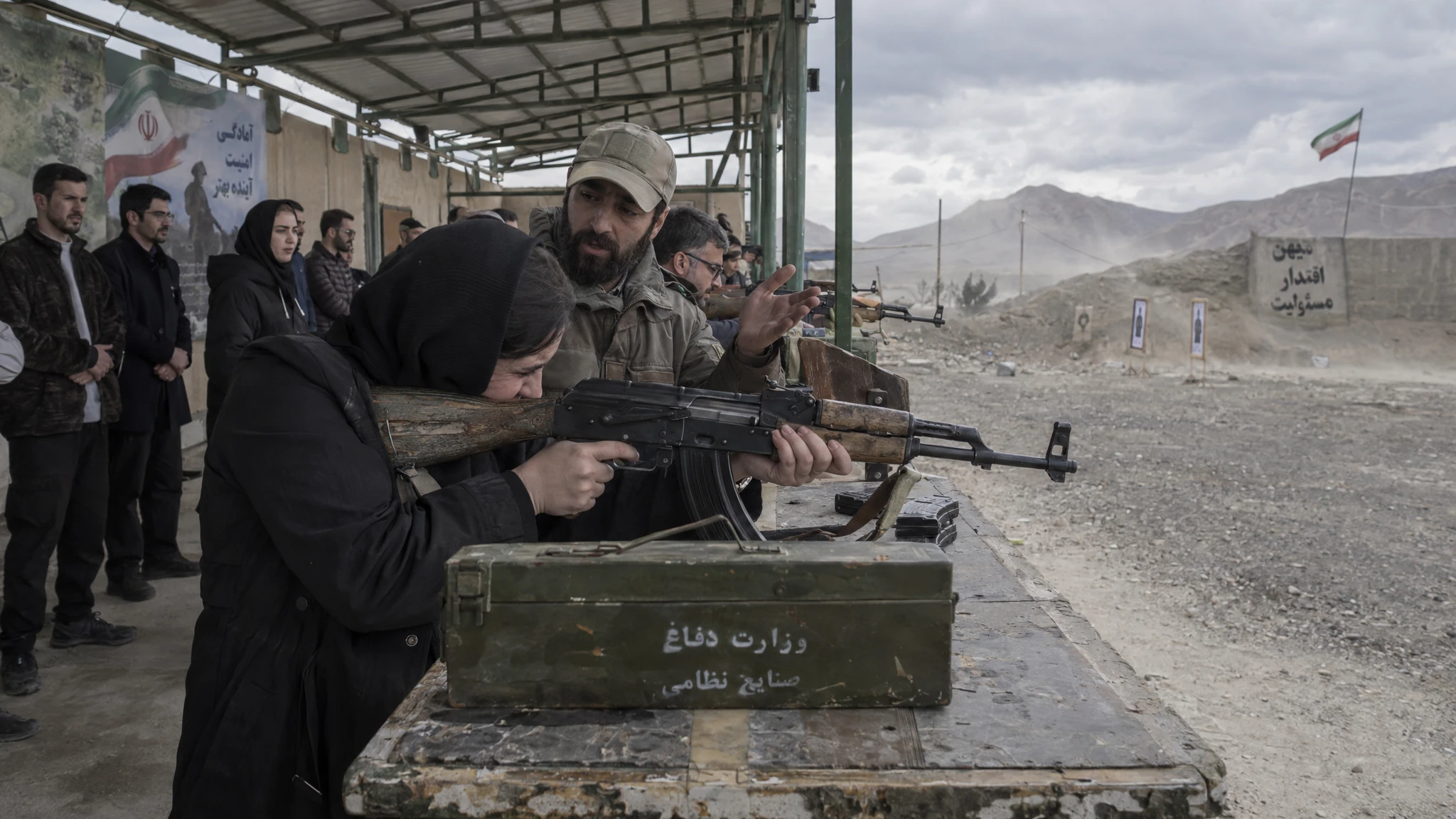
Such initiatives can serve different purposes at once. Weapons training can be presented as civil preparedness, a show of national resistance, or a way to strengthen internal security. Public rallies can project unity to foreign audiences and reinforce the authorities’ narrative at home. In a period of external threat, leaders may seek to frame political loyalty and national defence as inseparable.
Yet mobilisation is not the same as military capability. Training civilians does not substitute for integrated command, reliable communications, trained personnel, or the specialized systems needed to defend nuclear sites and critical infrastructure. Nor does public participation reveal whether citizens support the state’s policies or simply respond to pressure, incentives, or the circumstances of a highly controlled political environment.
The distinction matters for external observers. Images of rallies and training exercises can tempt governments to infer either strong popular backing or imminent escalation. Neither conclusion follows automatically. The more cautious reading is that authorities want to demonstrate social readiness and discourage the impression that a strike would produce a swift political collapse. Whether that message reflects genuine resilience is a separate question, and one difficult to answer from public events alone.
External support is possible, but not established here
The 19FortyFive article says Iran may have used the pause in fighting to strengthen drone and missile capabilities, potentially with assistance from Russia and China. It does not identify a specific transfer, system, agreement, or intelligence finding. That qualification is important. The possibility of cooperation should not be turned into a factual claim that either government provided particular weapons or operational support during the reported pause.
Foreign partnerships can matter through more than the transfer of finished weapons. They may involve components, technical knowledge, diplomatic support, economic links, or exchanges that help a country sustain military programmes under pressure. But identifying the form, scale, and timing of any such support requires evidence. Without it, the responsible conclusion is limited: the report raises the possibility of outside assistance, but does not demonstrate it.
For policymakers, the question is still consequential. If outside support helps Iran replenish capabilities, a pause in active combat may not translate into a lasting reduction in risk. If it does not, Tehran may face tighter constraints on rebuilding stocks or improving systems. Either way, officials should distinguish between a capacity that has been observed and one that is inferred from geopolitical relationships. Overstating the evidence can distort threat assessments; ignoring credible support would create a different blind spot.
Washington faces a decision under political and operational pressure
The account says President Donald Trump had effectively ruled out renewed fighting ahead of the U.S. midterm elections the following month, while the Pentagon was preparing options for the president. As of October 2026, that timeline places the reported political pause in the weeks before the November midterms. The article offers no direct statement from the White House or Pentagon, however, and its characterization should be read as reporting rather than as a formal policy commitment.
Preparing options is not the same as deciding to use force. Military planning can provide leaders with choices, clarify risks, and support deterrence. It can also create momentum: once an operation has been developed, its apparent feasibility may draw attention away from the political objectives it is meant to serve. A sound decision process must test whether each military option advances a defined end state, not simply whether forces can execute it.
That test is particularly important when the stated concern involves nuclear facilities. A strike may damage infrastructure without resolving the underlying political dispute or determining what happens to nuclear-related capabilities over time. Underground construction, dispersed assets, and uncertainty about the full extent of a programme can complicate assessments of what a military operation would accomplish. Even a tactically successful attack might leave policymakers facing the same strategic problem under more dangerous conditions.
The other side of the calculation is the cost of inaction. If U.S. leaders believe Iran is preparing attacks on regional partners or threatening commercial movement, they may judge that deterrence requires a visible response. But a response designed to prevent one danger could create incentives for a different form of retaliation. The core policy challenge is therefore not a simple choice between strength and restraint. It is how to communicate credible limits while preserving a path away from a broader conflict.
Regional governments have a stake in shaping that calculation. Their priorities may include protecting infrastructure, maintaining oil exports, avoiding attacks on population centres, and preventing a crisis from becoming a prolonged regional war. Their cooperation with Washington can improve warning and defence, but public association with U.S. military action may expose them to retaliation. That tension argues for close consultation rather than treating regional partners as a backdrop to decisions made in Washington.
Three paths beyond the current pause
The reported developments point to several possible trajectories, none of which can be treated as certain.
- Managed deterrence: Both sides retain military readiness but avoid fresh attacks. Iran’s fortifications and public messaging signal resolve; U.S. preparations signal that renewed action remains possible. Regional shipping and energy activity continue under elevated costs and security precautions. This outcome would reduce immediate danger without resolving the underlying confrontation.
- Limited exchange with wider consequences: A new strike or attack leads to a bounded round of retaliation against military or infrastructure targets. Leaders attempt to contain the exchange, but regional partners, commercial operators, and markets react to the possibility that the conflict could expand. Even if violence subsides, insurance and transport costs may remain high.
- Escalation through miscalculation: An attack causes unexpected damage, attribution is disputed, or a response is interpreted as preparation for a larger campaign. Each side then takes steps it describes as defensive, while the other sees evidence of impending aggression. In this scenario, the combination of uncertainty, threatened infrastructure, and political pressure narrows room for de-escalation.
The first path is not necessarily stable. A pause can give leaders time to communicate, but it can also permit both sides to restore capabilities and harden positions. The second could remain limited, though the vulnerability of civilian and economic targets makes containment difficult. The third is the most dangerous precisely because it does not require either government to want a regional war. It can emerge from the interaction of uncertainty and threat perceptions, incomplete information, and decisions taken under time pressure.
What a more durable policy would require
For Washington and its partners, the immediate priority is to separate verified warning from inference. Satellite imagery can establish visible construction but not necessarily its purpose or effectiveness. Public statements can reveal intent to signal, but not the exact operational plan. Reports of attacks require independent confirmation, and attribution should distinguish between a group’s political alignment and evidence of direction or control.
Second, regional defence should be planned around the protection of systems rather than a handful of emblematic sites. Ports, airports, energy installations, maritime approaches, and military facilities form an interconnected network. A disruption at one node can increase pressure on others. Governments should coordinate warnings, share information, and clarify responsibilities without implying that every defensive step is preparation for offensive action.
Third, any military option should be evaluated against a political objective and a credible account of what follows the strike. Decision-makers should ask what outcome they expect, how they would measure it, what Iran could do in response, and what arrangements might prevent renewed fighting. The answers should account for shipping and energy security as well as battlefield effects. An operation that can be carried out is not automatically an operation that improves security.
Finally, communication channels matter most when public rhetoric is sharpest. Clear private signals can reduce the risk that defensive measures are mistaken for an imminent attack. They cannot remove the underlying conflict, and they do not guarantee restraint. But where both sides possess ways to impose costs beyond the immediate battlefield, the ability to clarify intentions may be a practical component of deterrence rather than a concession.
The balance of risk remains regional
The reported fortifications around Iran’s nuclear sites may make some ground operations more difficult, but they do not settle the larger contest. The source article portrays the United States as holding a substantial advantage in air power and missile reach. Iran’s potential response, by contrast, lies in widening the consequences: threatening regional infrastructure, putting pressure on shipping, and making energy flows less predictable.
Those claims require independent verification, especially the specific account of the airport attack, the scale of restored oil traffic, and any assistance from Moscow or Beijing. The broad strategic logic is more robust than any one operational detail. A military imbalance can coexist with powerful means of retaliation, and those means can create economic and diplomatic effects that are difficult to contain.
For now, the key measure of stability is not whether either side can claim superiority. It is whether each can convince the other that escalation will fail to produce a better outcome. Iran’s reported preparations are intended to show that an attack would not end with the destruction of a target. Washington’s challenge is to assess that warning without treating every threat as proof of an inevitable strike—and to ensure that any military choice serves a political purpose that can survive the first exchange.


Reader discussion
No comments yet. Start the discussion.