
For roughly three weeks this autumn, two small spacecraft moved together around the planet. One was a Western commercial radar satellite whose imagery has reportedly helped Ukraine find Russian targets. The other was a Russian military spacecraft whose designers have never publicly explained its purpose.
On October 19, 2026, at about 16:07 UTC, the gap between them may have shrunk to roughly 26 meters, or about 85 feet. In low Earth orbit, where objects travel at several kilometers per second, that is about as close as one satellite can get to another without touching it.
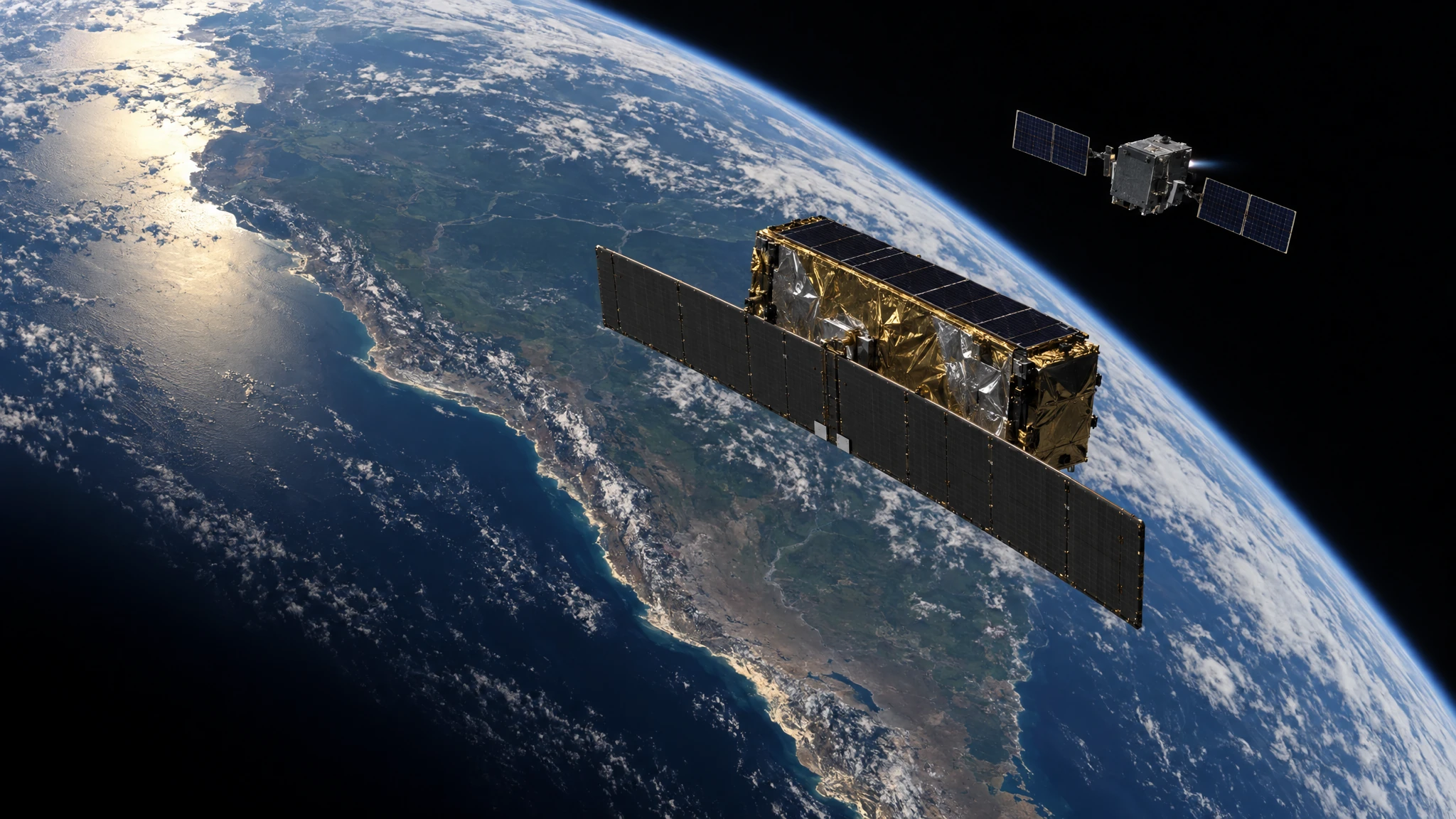
The Russian satellite is Kosmos 2612, sometimes written Cosmos 2612 or K2612. Its target was ICEYE-X36, a synthetic aperture radar (SAR) satellite built by the Finnish-founded company ICEYE and now registered in the United States. Kosmos 2612 has since raised its orbit and is drifting away.
The episode is not over in any strategic sense, though. Several independent trackers and analysts call it the first uninvited rendezvous between two active satellites in low Earth orbit. That makes it a practical test of how Russia might pressure, inspect, or eventually disable the commercial space infrastructure that has become a large part of Ukraine's military advantage.
This article argues that the Kosmos 2612 operation matters less for what it did to ICEYE-X36, which so far appears to be nothing physically harmful, than for what it showed. Russia can now find a specific commercial satellite, match its orbit, and hold position beside it for an extended period. A spacecraft that can do that can also take many other actions. Western governments, insurers, and satellite operators now have to plan around that fact.
Reconstructing the Approach
Kosmos 2612 did not arrive suddenly. It worked its way into position through a long series of orbital adjustments, and amateur and commercial trackers followed most of them.
A Six-Satellite Launch in April
The story starts in April 2026. A Soyuz-2.1b rocket lifted off from the Plesetsk Cosmodrome in northern Russia carrying six military satellites, designated Kosmos 2609 through Kosmos 2614. Reporting dates the launch to April 17, while some tracking analyses log it as April 16.
Moscow has said nothing substantive about what the satellites are for. Their behavior since launch suggests they are maneuverable "inspector" spacecraft, a class of vehicle able to approach other objects and operate close to them.
Within weeks, five of the six (Kosmos 2610, 2611, 2612, 2613, and 2614) had shifted into orbital planes used by several ICEYE satellites. The space situational awareness firm COMSPOC, working from LeoLabs tracking data, published a timeline in July laying out this pattern. Three of the Russian spacecraft made close passes by ICEYE-X36 specifically during that early phase, but none of them stayed with it.
ICEYE did not stay still either. CEO Rafal Modrzewski told Reuters that the company moved its satellite, and that the move was followed by further Russian maneuvers. That exchange matters. It shows Russia was willing to keep adjusting to a target that was trying to avoid it, which is how a pursuer behaves, not how a satellite on a coincidental crossing path behaves.
The September 30 Campaign
The decisive phase started on September 30. Over the following two weeks, Kosmos 2612 carried out a new series of burns that put it back into the same orbital plane as ICEYE-X36 and at nearly the same altitude. Clayton Swope, deputy director of the Aerospace Security Project at the Center for Strategic and International Studies (CSIS), and research assistant Chantal Li documented this sequence in an analysis published days before the closest approach.
Dr. Marco Langbroek is a lecturer in space situational awareness at the Faculty of Aerospace Engineering at Delft University of Technology. He said he had first doubted that ICEYE-X36 was a deliberate target. The maneuvers that began on September 30 changed his view.
In his reading, they were plainly designed to match the two spacecraft's orbital periods, altitudes, and eccentricities, which is the full set of conditions needed to hold position next to another satellite rather than pass it. On October 17, using the latest orbital elements, he estimated the Russian craft was within one to two kilometers of ICEYE-X36 and could close to within meters in a matter of hours. He called it a rendezvous and proximity operation, or RPO, "without consent."
Astrophysicist Jonathan McDowell, formerly of the Harvard-Smithsonian Center for Astrophysics, reported the same day that new two-line element sets showed Kosmos 2612 had maneuvered on October 16. In his assessment it was now stationkeeping within five kilometers of the ICEYE spacecraft. He said that, to his knowledge, it was the first rendezvous in low Earth orbit between two active satellites in which one owner had not agreed to the encounter. He later clarified the distinction. Close passes have happened many times before. What was new was matching the velocity vector, so that the two objects travel together.
Closest Approach and Departure
Data from the public tracking sites satellitemap.space and orbitalradar.com put the tightest pass at about 26 meters around 16:07 UTC on October 19. LeoLabs, which operates a global network of ground-based radars, was more cautious. The company told The War Zone it could neither confirm nor refute the figures published elsewhere. It did say it had high confidence the two objects came within approximately 500 meters of each other, and it emphasized the word "approximately."
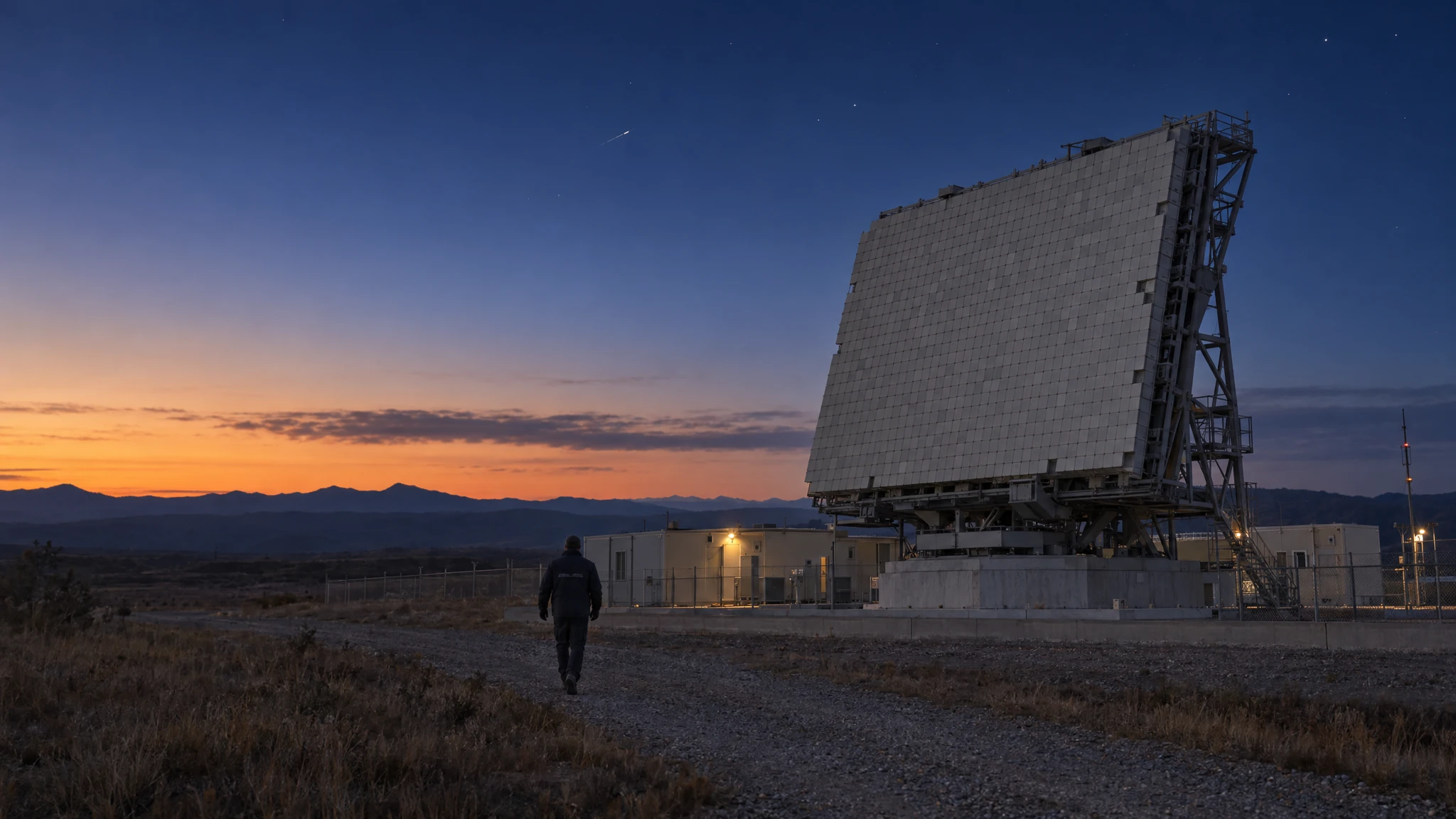
LeoLabs described the overall sequence this way. Kosmos 2612 closed from hundreds of kilometers away to extreme proximity, maneuvered around ICEYE-X36, stayed nearby for a prolonged period, and then began to separate. The company's latest observations showed the two spacecraft diverging sharply, which it said confirmed that the close-proximity phase had ended. Independent analyst Adam Cohen modeled an impulsive burn to connect Kosmos 2612's earlier and later orbital elements. His result was consistent with that picture: the Russian craft had moved to a larger orbit that would carry it away from ICEYE-X36 unless it maneuvered again.
The difference between a fly-by and a rendezvous is the difference between a car passing you on the highway and a car that matches your speed and drives alongside your window for an hour.
Why 500 Meters Is Alarming
By everyday standards, half a kilometer, or even 26 meters, does not sound threatening. Orbital mechanics changes that. At low Earth orbit velocities, a small timing error or unexpected maneuver can turn a close approach into a collision in seconds. Operators who do not coordinate with each other normally treat separations of a few kilometers as cause for concern and often schedule avoidance burns when the predicted miss distance gets that small.
The 2020 benchmark gives a sense of scale. That year, the Russian satellite Kosmos 2542 moved to within roughly 150 to 300 kilometers of USA 245, an American KH-11 reconnaissance satellite. That was enough to become a major international story and to draw public statements from senior U.S. Space Force leaders. Kosmos 2612's approach to ICEYE-X36 was, by the most conservative estimate, hundreds of times closer.
Adam Marsh, LeoLabs' vice president for technical solutions, told Breaking Defense it was the most advanced and potentially dangerous uncooperative RPO the company had seen. LeoLabs' written assessment noted that adversarial, or "red-on-blue," encounters of this kind are relatively uncommon in low Earth orbit. It described the activity as the opposite of a routine conjunction: a controlled approach, shifts in relative position, loitering at close range, more small maneuvers, and then a controlled exit.
The Target and Why It Matters to Moscow
ICEYE-X36 was probably not chosen at random.
Radar That Sees Through Darkness and Cloud
ICEYE specializes in SAR imaging from small satellites, and ICEYE-X36 went into orbit in 2024. SAR does not depend on sunlight or clear skies. It sends out microwave pulses and builds an image from the returns, so it can collect at night and through cloud, smoke, and haze. The images do not look like optical photographs, and some details that are obvious in visible light are harder to pick out. In exchange, collection is persistent and dependable, which is very valuable over a battlefield with frequent cloud cover and constant attempts at concealment.
Ukraine has used ICEYE imagery for years, including for targeting. There have been unconfirmed reports that ICEYE-X36 operates more directly under the control of the Ukrainian government. Langbroek noted that although the satellite was built in Finland, its ownership has transferred, as has happened with other ICEYE spacecraft. It is now registered in the United States and may be owned by or leased to Ukraine. Those arrangements have not been publicly confirmed, but they explain why Moscow would focus on this particular satellite.
A U.S.-Registered Target
The registration adds legal and diplomatic complications. Under the Outer Space Treaty and the Registration Convention, the state of registry has jurisdiction and some responsibility for a space object. By approaching a U.S.-registered satellite, Russia was testing more than Ukraine's commercial supply chain. It was also testing how Washington responds when a satellite on its registry is shadowed by a Russian military spacecraft. Russia could approach a satellite that may serve Ukraine while staying well short of anything clearly hostile against an American asset.
An ICEYE spokesperson for the company's U.S. division told The War Zone that the company was aware of the situation and tracking it closely. The spokesperson added that ICEYE's constellation architecture is designed for continuity and resilience. That reflects an important point about commercial SAR constellations: they are spread across dozens of small satellites, so losing or degrading one does not end the service. The Kosmos 2612 operation shows, however, that each individual satellite in such a constellation can be singled out.
The Inspector Satellite Lineage
Kosmos 2612 belongs to a long line of Russian spacecraft that Western officials have watched with growing concern.
Matryoshka Satellites
In November 2019, Kosmos 2542, the satellite that later shadowed USA 245, released a smaller spacecraft, Kosmos 2543. On July 23, 2020, U.S. Space Command said it had observed Kosmos 2543 releasing a further object and described the event as a test of a space-based anti-satellite weapon. In an interview with Time, Gen. John "Jay" Raymond, then Chief of Space Operations, said American forces had seen similar "nesting doll" satellites, a reference to Russian matryoshka dolls, displaying the characteristics of a weapon system as early as 2017.
There is also an unconfirmed detail from that period that resembles the ICEYE case. Before Kosmos 2542 was publicly identified as shadowing USA 245, there were reports that the American spy satellite had changed its orbit, possibly in response to Kosmos 2543. If accurate, the pattern in 2020 and 2026 is the same: Russian inspectors pursue, Western satellites move away, and the inspectors adjust.
Inherently Dual-Use
Russia officially describes inspector satellites as tools for examining its own spacecraft when they malfunction. U.S. officials have argued for years that the same capability can be used as a weapon, and the ICEYE episode supports that view. A spacecraft that can approach a target and hold close position opens up several ways to attack it:
- Projectile release, as the 2020 Kosmos 2543 test is believed to have demonstrated.
- Grappling or towing, using a robotic arm to damage a satellite or pull it out of its operational orbit.
- Aerosol or chemical spraying to degrade optics, sensors, or solar arrays.
- Close-range electronic warfare, jamming uplinks, downlinks, or sensors from very close range.
- Direct collision, using the inspector itself as a kinetic interceptor on command.
Even without any attack, close proximity is useful for intelligence. Imaging a satellite from nearby, recording its emissions, and observing how it is tasked can reveal its capabilities, weaknesses, and patterns of use. LeoLabs' assessment noted that what Kosmos 2612 did requires planning, maneuverability, precise navigation, and substantial propellant. It added that the activity may indicate onboard sensors able to measure the relative position of another spacecraft, which is itself a sign of technical maturity.
Coercion Without Contact
The episode also shows how much can be achieved without touching the target. A credible threat close by causes harm of its own.
Fuel as a Strategic Resource
Satellites carry a fixed supply of propellant and use it to hold their orbits, avoid debris, and reposition. Every unplanned evasive burn shortens a satellite's working life. An adversary that keeps forcing a target to maneuver is effectively draining that life without firing anything. As debris builds up in low Earth orbit and routine avoidance burns become more frequent, the margin for this kind of harassment gets smaller. The United States and others are developing on-orbit refueling partly to address this problem, but the technology is not yet widely available, and certainly not to small commercial SAR satellites.
Denying the Collection Window
An imaging satellite only produces value when it passes over the right area at the right moment. A satellite pushed out of its planned orbit may miss collection opportunities, or collect from worse angles, until it returns to position. For a constellation supporting a country at war, even short disruptions can matter, especially if they coincide with major ground operations. Proximity operations therefore give Moscow a way to influence the information Ukraine receives without carrying out an attack that would draw a strong Western response.
The most effective counterspace weapon may be the one that never fires, because the threat alone forces the target to give up position, fuel, and time.
Signaling to the Market
There is also an economic effect. Commercial operators depend on investors, insurers, and government customers who expect predictable conditions. A demonstrated willingness to shadow commercial satellites raises perceived risk for the whole sector. It pushes companies to consider whether supplying a belligerent like Ukraine is worth having their hardware targeted. This kind of indirect pressure suits Russia's broader hybrid warfare approach, which seeks to raise costs for those supporting Kyiv while staying below thresholds that would provoke a direct military response.
The Attribution Problem
Space makes it unusually hard to establish who is responsible for an incident. Satellites fail, sometimes catastrophically, and the reasons are not always clear even to their operators. 2026 has already produced several unexplained breakups:
- In January, a Russian inspector satellite launched in 2014 appeared to break apart unexpectedly.
- Around July 20, the Chinese reconnaissance satellite Yaogan 50-02, launched about four months earlier, broke up in orbit. U.S. Space Forces–Space has since cataloged 62 pieces of debris from it.
- On September 13, at about 21:13 UTC, the Cold War-era U.S. Farrah III reconnaissance satellite, also known as USA 32, fragmented in low Earth orbit. U.S. Space Forces–Space confirmed the breakup.
None of these events has so far been tied to hostile action, and accidents such as battery failures or residual propellant explosions remain the most likely explanations. Together, though, they show the problem. If a satellite that had been closely shadowed later broke apart, it could be very difficult to prove whether it had been attacked or had simply failed. U.S. officials have also said American space assets are routinely subjected to "reversible attacks," meaning interference that causes no permanent damage. Effects that leave no lasting trace are harder to attribute and easier to deny.
LeoLabs' assessment states the uncertainty carefully. It says the intent behind Kosmos 2612's behavior is unclear, and that the event and the capabilities shown do not establish hostile intent. It adds that the deliberate nature of the activity, the fuel it required, and the proximity to a Western commercial imaging satellite make it strategically important. In its view, the demonstrated capabilities could support intelligence collection, on-orbit inspection, coercive signaling, interference, or preparation for future counterspace operations.
CSIS's Swope offered a similar range of possibilities in comments to The War Zone. The goal, he said, could have been anything from intimidation to destruction or sabotage of a U.S.-registered satellite. He suggested the operation might simply be paused, and noted that several other Russian satellites that shadowed ICEYE-X36 in May could also be brought into action.
A Changing Strategic Environment in Orbit
The Kosmos 2612 operation is happening as the military use of space is changing quickly.
The End of American Monopoly
For decades the United States held an unmatched position in space-based intelligence, early warning, navigation, and communications. That advantage has been shrinking. China has greatly expanded its reconnaissance and other constellations. Commercial providers such as ICEYE now sell services that only major powers could field a generation ago. Ukraine, which has no significant national constellation, has been able to rent orbital surveillance from private companies. That shift is a major source of Ukrainian resilience, and it is also a weakness that Moscow appears to be probing.
Washington's Turn Toward Openness
U.S. policy has shifted as well. In September, American officials made the significant disclosure that unspecified U.S. weapon systems are now in orbit, described as defensive and intended to counter growing threats from Russia and China. Both of those countries have developed and fielded a range of anti-satellite capabilities, from ground-launched interceptors to co-orbital systems like the inspectors described here. The disclosure fits a broader U.S. military trend of planning for proactive operations and possible direct conflict in orbit, and of discussing counterspace capabilities more openly than before.
The timing of the Kosmos 2612 approach, weeks after that disclosure, invites the interpretation that it was partly a response: a demonstration that Russia also has close-proximity capabilities and will use them against assets linked to the West. No public evidence shows that Moscow intended the operation that way.
Importing Terrestrial Brinkmanship
Dangerous maneuvering near rival forces is common on Earth. Military aircraft intercept each other closely over international waters, and warships shadow one another and carry out unsafe approaches in contested seas. Extending this behavior into orbit was predictable, given how much modern warfare depends on space for early warning, targeting, weapons guidance, and real-time communications. The difference is that space has far fewer established procedures for handling such encounters. At sea, the 1972 U.S.-Soviet Incidents at Sea Agreement set rules to reduce collision risk. Nothing comparable and binding exists for rendezvous and proximity operations in orbit.
Scenarios for What Comes Next
Several paths seem plausible from here, and they are not mutually exclusive.
Scenario One: Repeated Harassment
The most likely near-term outcome is more of the same. The other inspectors from the April launch remain in orbits that let them reach ICEYE satellites, and Kosmos 2612 could maneuver again. Repeated approaches would keep draining target propellant, complicate collection planning, and keep commercial operators uneasy, all without crossing a clear threshold.
Scenario Two: Normalization and Escalation by Degrees
Each approach that goes unanswered makes the next one seem more ordinary. Over time, uninvited rendezvous could become a routine part of competition in orbit, with close-range jamming, sensor dazzling, or other reversible interference added gradually. This path carries the greatest risk of miscalculation, because the boundary between harassment and attack would become harder to see.
Scenario Three: A Deniable Kinetic or Damaging Event
Less likely but more serious, a shadowed satellite could suffer an unexplained failure or breakup. Given how hard attribution is, such an event could leave Western governments arguing over whether a deliberate attack had taken place, while the debris would endanger satellites of every nationality, Russian ones included.
Policy Recommendations
Analysts at institutions including CSIS, RAND, and the Royal United Services Institute have for years urged governments to get ahead of the counterspace challenge. The ICEYE episode suggests several priorities:
- Expand commercial space situational awareness. Much of what is publicly known about this event came from private trackers like LeoLabs and COMSPOC and from independent analysts. Governments should treat this capability as strategic infrastructure, fund it, and build mechanisms for sharing it with allies and commercial operators.
- Clarify protections for commercial assets. Washington and its allies need to state clearly how they will respond to interference with commercial satellites that are registered with them or support allied operations. Ambiguity invites testing.
- Develop norms for proximity operations. A framework requiring notice before close approaches, similar to maritime incident-prevention agreements, would not stop a determined adversary, but it would make violations easier to identify and call out.
- Invest in resilience and maneuverability. Proliferated constellations, as ICEYE has noted, reduce the impact of losing any single spacecraft. On-orbit refueling and more capable propulsion would reduce the effectiveness of fuel-draining harassment.
- Publicize attribution where possible. Releasing tracking evidence quickly, as independent analysts did in this case, limits an adversary's ability to rely on deniability.
Conclusion: A Threshold Crossed
Kosmos 2612 has moved away from ICEYE-X36, and the Western satellite appears to be intact. But the operation established something. A Russian military spacecraft located a specific commercial radar satellite tied to Ukraine's war effort, followed it through the operator's attempts to evade, matched its orbit, and held position beside it at a distance measured in hundreds of meters at most and possibly tens of meters. Several of the most experienced observers in the field describe this as the first uninvited rendezvous between active satellites in low Earth orbit.
The main points are these:
- Russia's inspector program has shown it can carry out precise, sustained proximity operations against a specific target that is trying to avoid it.
- Commercial satellites supporting Ukraine are now direct objects of Russian counterspace activity, and U.S. registration did not deter the approach.
- The threat of interference, which consumes fuel, disrupts collection, and unsettles markets, can impose costs without any visible attack.
- Attribution in orbit remains very difficult, which favors the side willing to operate in gray zones.
- With the United States acknowledging weapons in orbit and Russia and China fielding their own counterspace systems, the margin for miscalculation is narrowing.
What happened above South America and elsewhere along these satellites' paths this October has made space look less like a background support domain and more like an active area of competition. Whether that competition stays limited to shadowing and signaling or turns into open conflict will depend on whether governments establish rules, deterrence, and resilience before the next approach comes closer.


Reader discussion
No comments yet. Start the discussion.