
KYIV — Russia’s parliamentary election ended with the Kremlin projecting control. It also ended with Moscow absorbing the largest Ukrainian drone assault reported against the capital since Vladimir Putin launched his full-scale invasion in 2022. That collision between political theater and deep-strike warfare captures the central reality of the war in September 2026: Russia can stage normality at home while Ukraine demonstrates that the conflict is no longer safely contained within Ukrainian territory.
Ukrainian forces sent roughly 1,600 drones toward the Moscow region overnight, according to Moscow mayor Sergei Sobyanin, with about 450 directed at the capital. At least two people were reported killed in Moscow. Images showed severe damage to a multi-storey residential building on the city’s outskirts and a large fire at what appeared to be an oil refinery. The claims, including the reported death toll and the scale of damage, came primarily from Russian officials and require independent verification.
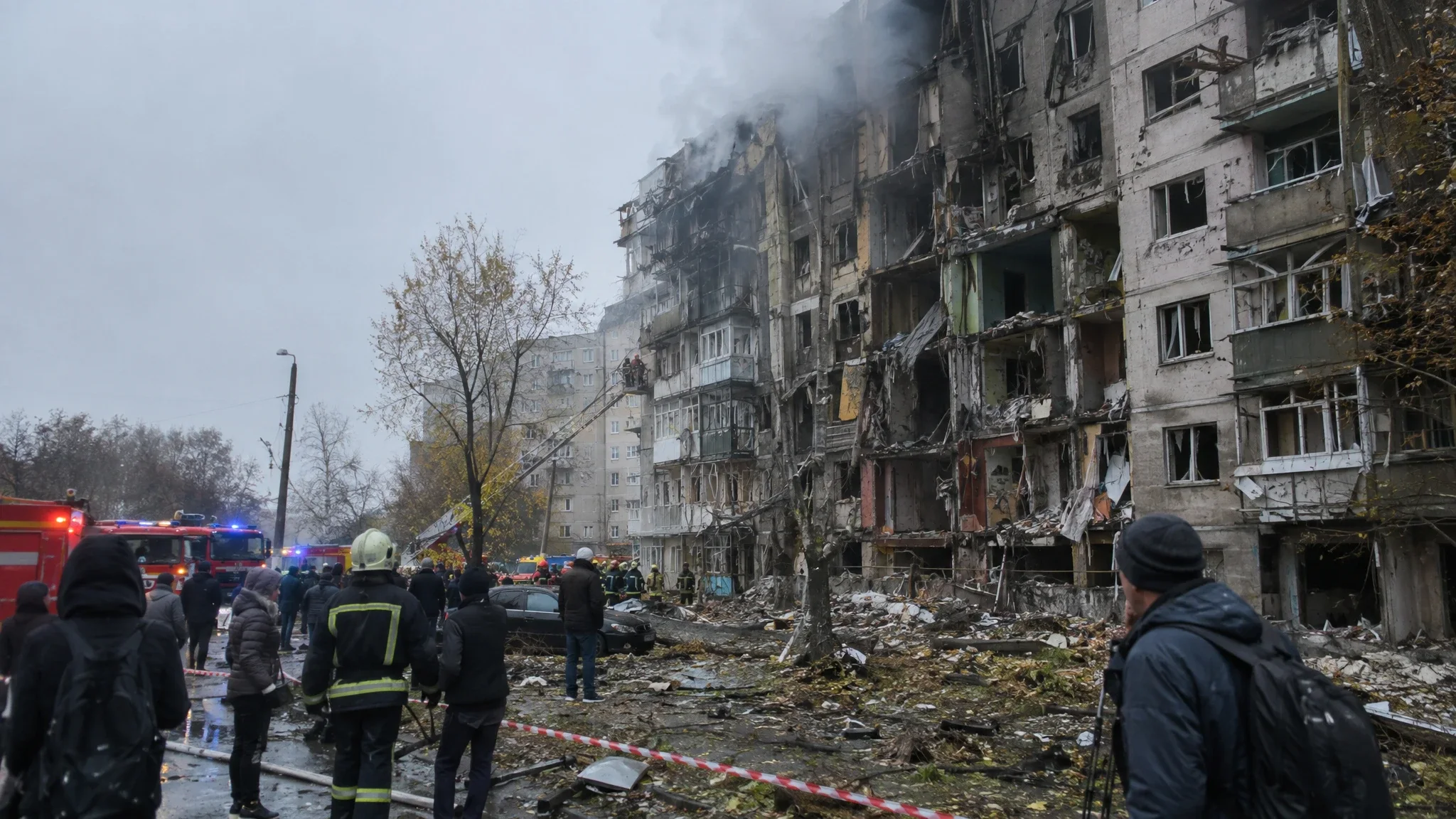
President Volodymyr Zelenskyy nevertheless presented the operation as a significant Ukrainian success. He said Kyiv’s long-range response had produced a “very significant impact” in the Moscow region and identified domestically produced systems known as Pelican and Flamingo among the weapons used. Earlier descriptions had treated Pelican as a short-range ballistic missile, while later accounts described it as a winged drone. Zelenskyy also said Ukrainian Flamingo cruise missiles had been employed against targets deep inside Russia.
The immediate military effect matters. The political effect may matter more. Ukraine has shown that it can impose costs on the Russian capital during a moment chosen for maximum symbolic exposure: the final day of a tightly controlled national vote. Moscow’s response—an explicit promise to intensify attacks on Kyiv—also reveals the Kremlin’s preferred answer to strategic embarrassment: retaliation against the Ukrainian population and infrastructure, framed as punishment for attacks on Russian civilians.
The central lesson is not that one night of drones will decide the war. It is that Ukraine’s expanding long-range strike capacity is changing the geography of risk, forcing Russia to defend the political center of its power rather than treating the battlefield as a one-way zone of violence.
A strike aimed at Russia’s sense of immunity
For much of the war, the Kremlin has attempted to maintain a separation between Russia’s domestic political life and the violence inflicted on Ukraine. Russian cities have been presented as protected rear areas, while Ukrainian towns and critical infrastructure have endured repeated missile and drone attacks. The Moscow operation challenged that arrangement directly.
The reported volume was extraordinary. A figure of 1,600 drones, if confirmed, would represent an exceptionally large wave even by the standards of the increasingly intensive air campaign. Sobyanin said approximately 450 were aimed at Moscow itself, suggesting that the assault was not merely a broad attack on military or industrial sites across the region. It was also designed to test the capital’s layered air defenses, disrupt transport and public activity, and communicate that distance from the front no longer guarantees safety.
That does not mean every drone reached its intended target. Large salvos are often designed to saturate defenses, exhaust interceptors, confuse radar operators and expose gaps that can be exploited by follow-on weapons. Some systems may be decoys; others may be intercepted, diverted or brought down far from their original aim points. The military value of such an operation therefore cannot be measured simply by the number of explosions visible on social media.
Yet the psychological and strategic value can be substantial even when physical damage is limited. Moscow must now devote more resources to protecting administrative centers, energy facilities, transport nodes and industrial sites. Air-defense units positioned around the capital are unavailable elsewhere. Security procedures intensify, civilian confidence weakens and officials are forced to explain why an allegedly secure capital can be reached at scale.
The reported damage to a residential building carries a particular political risk for Kyiv because attacks near civilian areas can produce casualties and complicate international support. Ukraine’s case is strongest when it distinguishes military targets from indiscriminate violence and explains the legal basis for each operation. Moscow has already sought to reverse that moral framing by describing the attack as aggression against civilian targets while preparing its own escalation.
Why the election timing mattered
The drone assault coincided with the last day of Russia’s parliamentary elections, a vote that was designed to reinforce the appearance of political continuity. Preliminary results released early Monday showed United Russia, the Kremlin’s dominant party, holding nearly 58% of the party-list vote after roughly 58% of precincts had been counted. The contest was conducted in an environment largely devoid of meaningful opposition to Putin’s policies.
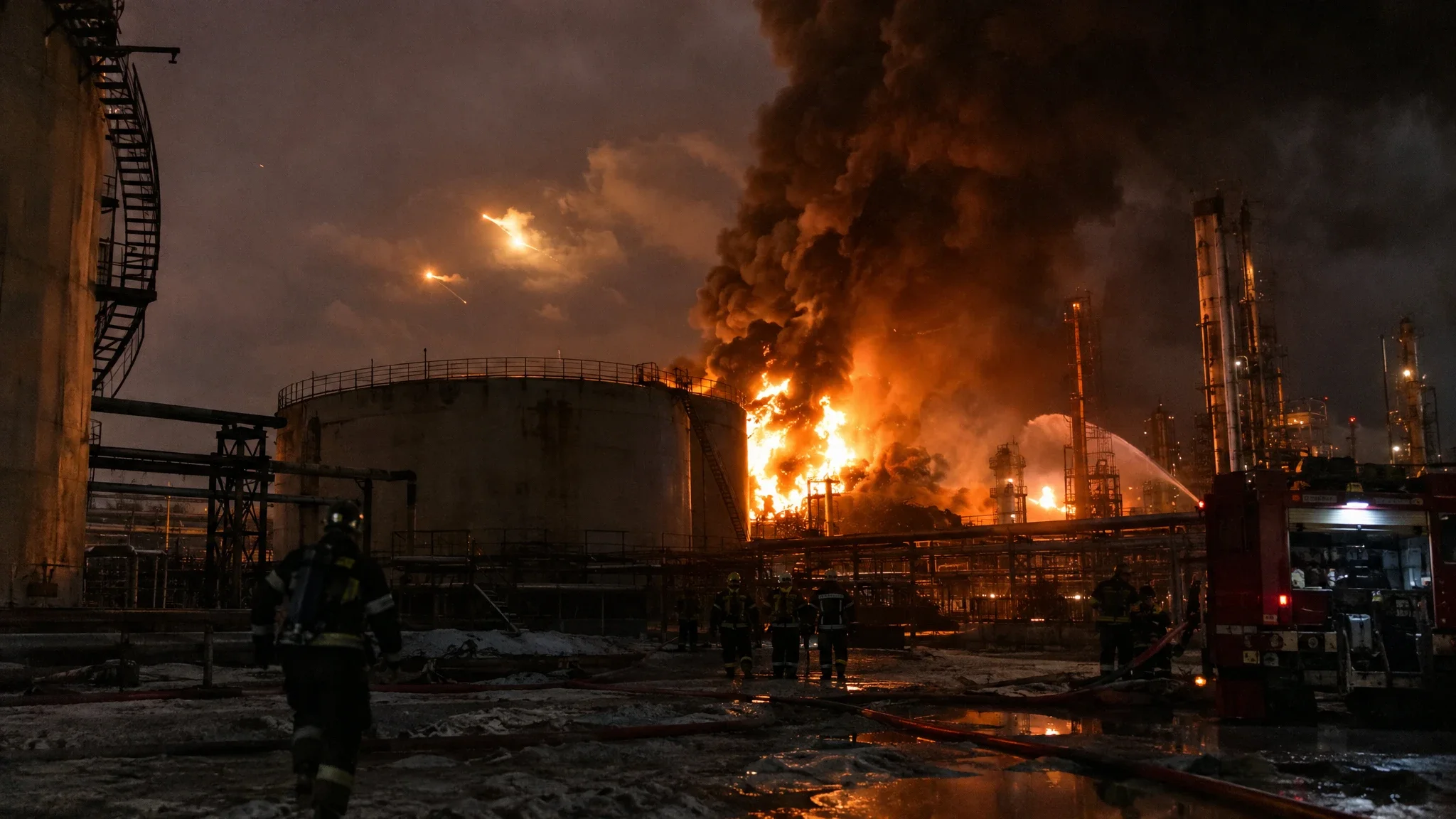
Ukraine’s operation did not invalidate the election result, nor did it threaten the Kremlin’s institutional control. But it punctured the image of a state able to choreograph public life without interruption. Ballot stations and official announcements conveyed political stability; smoke rising from Moscow’s outskirts conveyed vulnerability. For an authoritarian system that depends heavily on the projection of competence, that contrast is not trivial.
Moscow accused Kyiv of trying to disrupt the vote. The Russian defence ministry said the attacks were directed at civilian targets and vowed that Russian forces would intensify “high-accuracy” strikes against military targets in Kyiv. Such language follows a familiar pattern: Russia presents its retaliation as precise and defensive, even as previous attacks have repeatedly struck residential areas, energy systems and civilian infrastructure.
The timing may also have forced Russian officials to manage multiple audiences. Domestic viewers were told that the state remained in control. Russian military supporters were promised a harder response. Foreign governments were warned that attacks on Russia could bring wider escalation. At the same time, Moscow had to avoid acknowledging that its air-defense network had failed on a politically sensitive day.
From Kyiv’s perspective, the strike offered a way to demonstrate initiative after years in which Russia possessed the larger missile arsenal and greater industrial depth. It signaled that the war’s costs can be returned to the aggressor’s political center. That is not simply retaliatory logic. It is an attempt to alter Russian calculations about the sustainability of continued attacks on Ukraine.
Ukraine’s long-range arsenal is becoming a strategic instrument
Zelenskyy’s reference to Pelican and Flamingo points to a broader transformation in Ukraine’s military posture. Kyiv has spent the war developing an indigenous strike architecture capable of reaching targets beyond the front. That effort matters because Western restrictions, delivery schedules and political caution have often limited the range or employment of foreign-supplied systems.
Domestic production gives Ukraine greater freedom to decide when and how to use long-range weapons. It can integrate drones with cruise missiles, vary flight paths, launch repeated waves and adapt designs in response to Russian electronic warfare and air-defense tactics. The precise technical characteristics of the Pelican and Flamingo systems were not established in the source material, and claims about their employment should be treated cautiously. But Zelenskyy’s remarks indicate that Kyiv views them as part of a growing capacity to strike targets deep inside Russia.
This capability has three functions.
- Operationally, it can threaten fuel storage, refineries, logistics hubs, command facilities and defense-industrial production that support Russian operations.
- Strategically, it forces Moscow to allocate scarce air-defense systems across a much wider area and complicates the planning of future missile campaigns.
- Politically, it demonstrates to Ukrainian society and international partners that Kyiv retains the ability to impose costs rather than merely absorb them.
The Institute for the Study of War has repeatedly emphasized, in its broader analysis of the conflict, that Russia’s ability to sustain offensive operations depends on logistics, industrial output and the protection of rear-area infrastructure. RUSI’s work on modern warfare similarly highlights the growing importance of precision strike, unmanned systems and the contest between attack volume and defensive capacity. Applied to the Moscow operation, those analytical frameworks suggest that the decisive question is not whether every drone hit its target. It is whether Ukraine can sustain a campaign that makes Russia’s rear-area protection expensive and uncertain.
The answer is not yet clear. Russia has extensive air-defense assets, electronic-warfare capabilities and a large territory over which to disperse production. Ukraine, meanwhile, faces constraints in warhead production, launch platforms, intelligence support and the endurance of its own air-defense network. A single spectacular strike can produce headlines; a durable strategic effect requires repeated operations against carefully selected targets.
Moscow’s threatened retaliation exposes the escalation dilemma
Russia’s stated intention to intensify attacks on Kyiv creates an immediate danger for civilians. The threat came as Ukrainian authorities reported that a separate overnight Russian attack on the Kyiv region had killed four people, including three children. Emergency officials said a mother and her two three-year-old children died when a Russian drone struck a private home. A girl who was injured in another district later died in hospital, according to Kyiv regional governor Tymur Tkachenko. Drone attacks and falling fragments continued across Kyiv and surrounding areas during the day.
These deaths are not an abstract backdrop to the Moscow strike. They show the asymmetry of the escalation cycle. Ukraine’s long-range attacks are intended to signal that Russia is vulnerable; Russia’s response is likely to be directed at a capital and urban region that already faces sustained bombardment. The Kremlin can use civilian suffering as a tool of coercion while claiming that its campaign is an answer to Ukrainian provocation.
That pattern presents Kyiv with a difficult strategic choice. Restraint may reduce the immediate risk of retaliation but leave Russia confident that its own cities and infrastructure remain largely insulated. Continued strikes can degrade Russian capabilities and challenge domestic assumptions, but they also give Moscow a pretext for escalation and may test the patience of international supporters.
There is no neat distinction between offensive and defensive action in a war that began with Russia’s invasion and has included repeated attacks on Ukrainian cities. Ukraine’s right to defend itself under international law does not remove the obligation to take feasible precautions against civilian harm. The strongest Ukrainian strategy is therefore not simply to strike farther. It is to strike with demonstrable military purpose, transparent targeting logic and a disciplined public message.
Ukraine’s most persuasive argument is that long-range operations are part of national self-defense against the state that initiated the war—not an invitation to uncontrolled escalation.
The battlefield now extends beyond the front
The Moscow attack should be understood as part of a wider contest over depth. Russia has used missiles and drones to attack Ukrainian energy facilities, urban centers and defense-related sites far from the line of contact. Ukraine is attempting to create equivalent insecurity inside Russia, particularly around the infrastructure that supplies the invasion.
This is a classic problem of strategic depth. A state with a large territory can disperse assets, but dispersion raises costs and reduces efficiency. Facilities that once operated in concentrated clusters may need additional shelters, redundant power, guards and air-defense coverage. Rail movements may be rerouted. Refinery operations can be interrupted by fires, damage or precautionary shutdowns even when a facility is not destroyed. Military planners must account for uncertainty at every stage.
CSIS analysis of the war has underscored the importance of industrial capacity and the adaptation of unmanned systems. RAND research on deterrence and escalation offers a related warning: attacks intended to signal resolve can have unstable effects if the target interprets them as preparation for a broader campaign. The Atlantic Council has also focused extensively on Ukraine’s defense innovation and the role of Western assistance in enabling a more resilient Ukrainian force. Together, these bodies of work point to a central tension: Ukraine needs the ability to strike Russian military capacity, but the strategic value of those strikes depends on keeping escalation controlled and objectives legible.
The International Institute for Strategic Studies has long examined the relationship between force structure, air defense and industrial mobilization. In the current war, that relationship is visible in real time. Every large drone wave tests not only the attacking system but also the defender’s stock of interceptors, radar coverage, command networks and repair capacity. If Russia is compelled to use expensive interceptors against comparatively inexpensive drones, Ukraine may create an economic imbalance. If Russia can absorb the attacks while preserving offensive capacity, the advantage will be less decisive.
Russia’s election message and the politics of occupied territory
The parliamentary vote also included residents of Crimea and four Ukrainian regions that Russia claims to have annexed but does not fully control. Kyiv condemned the voting as illegitimate, while the European Union described the inclusion of occupied Ukrainian territory as a blatant violation of international law. Crimea was annexed by Russia in 2014; the four additional regions were claimed after the full-scale invasion.
The elections therefore served two purposes for Moscow. Internally, they reinforced the Kremlin’s political dominance and the supremacy of United Russia. Externally, they attempted to normalize Russia’s territorial claims by incorporating occupied areas into a national political process. The Ukrainian strike disrupted the atmosphere of control that the vote was intended to create, even though it did not alter the formal result.
That symbolic contest will persist. Russia is seeking to make occupation appear permanent through administrative integration, elections and the distribution of state services. Ukraine is seeking to show that annexation has not produced secure Russian sovereignty, whether on the ground or in the wider strategic environment. Long-range attacks are one method of communicating that the territories claimed by Moscow remain connected to an active war whose consequences reach into Russia itself.
Washington and Kyiv face a new diplomatic test
Zelenskyy said he had spoken with U.S. President Donald Trump and that the two leaders agreed to meet in New York during the UN General Assembly. Zelenskyy described the prospective discussion as one that could change much and said the agenda could include de-escalation and fundamental security questions, including energy security, food security and the protection of human life.
The meeting arrives at a moment when battlefield initiative and diplomatic pressure are inseparable. Kyiv needs continued political and material support for air defense, long-range systems, intelligence and domestic weapons production. It also needs to persuade Washington and European governments that strikes inside Russia are controlled instruments of self-defense rather than evidence that Ukraine is pursuing an open-ended war against the Russian state.
For Trump, the meeting presents a choice between treating the Moscow strike primarily as an escalation risk or recognizing it as evidence that Ukraine requires a credible means of deterrence. Any settlement effort that asks Kyiv to stop striking deep into Russia while leaving Russian forces free to bombard Ukrainian cities would risk creating an asymmetrical pause. Conversely, unconditional support for every deep strike could reduce diplomatic room and increase the danger of direct confrontation.
A workable policy would combine support for Ukraine’s defensive and precision-strike capabilities with clear expectations about target selection, civilian protection and public accountability. It would also accelerate air-defense assistance for Ukrainian cities. The source material’s casualty figures from the Kyiv region show why defensive systems remain the most urgent requirement: the immediate threat to Ukrainian civilians is not hypothetical, and Russia has already signaled that it intends to intensify it.
NATO’s vulnerability debate is widening
The war’s geography has also raised alarm among European intelligence officials. One official reportedly warned that Russia could test NATO in “months, not years.” Poland’s prime minister, Donald Tusk, told parliament that intelligence assessments suggested Moscow might launch a drone or missile attack on NATO territory in the coming months to test whether Article 5—the alliance’s collective-defense commitment—is more theoretical than practical.
Those warnings are not proof that Russia has decided to attack a NATO member. They do, however, reflect growing concern that the Kremlin may use ambiguity, deniable sabotage or limited strikes to probe alliance cohesion without immediately triggering a full-scale military response. The same technologies visible over Moscow and Kyiv—long-range drones, electronic warfare and low-cost saturation tactics—could be adapted to test air-defense coverage and political thresholds along NATO’s eastern flank.
Poland is particularly exposed to the consequences of the war because of its geography and its role as a major logistical route for support to Ukraine. A missile or drone incident on NATO territory would force governments to determine whether it was accidental, deliberate, state-directed or part of a broader hybrid operation. Delay or disagreement could encourage further testing; an overly rapid military response could produce uncontrolled escalation.
Ukraine’s ability to strike Russia may therefore contribute indirectly to NATO deterrence by demonstrating that aggression produces costs. But deterrence is credible only when paired with alliance clarity. NATO members need reliable air-defense coverage, agreed procedures for attribution, resilient communications and a shared understanding of how to respond to attacks below the threshold of conventional war.
The economic consequences reach beyond Russia and Ukraine
The conflict’s expanding strike geography is also reshaping food and energy calculations. Egypt, one of the world’s largest wheat importers, is diversifying purchases toward France and other European suppliers, according to supply minister Sherif Farouk, whose remarks were reported by television host Ahmed Moussa and later confirmed by a ministry spokesperson. The move reflects disruption and uncertainty affecting supplies from Russia and Ukraine.
Egypt’s decision illustrates how the war continues to impose costs on countries far from the battlefield. Even when grain is available, insurers, shippers and governments must price in attacks on ports, storage, transport routes and energy infrastructure. Importers may pay more for alternative suppliers to reduce exposure to a single region. That can increase fiscal pressure in countries already vulnerable to food-price volatility.
Energy infrastructure is similarly strategic. The reported fire at an oil refinery in the Moscow region highlights the vulnerability of facilities that support both civilian consumption and military logistics. A refinery does not need to be permanently destroyed to generate disruption. Damage can delay production, force repairs, complicate fuel distribution and expose the limits of emergency response. For Ukraine, such targets can have greater strategic relevance than symbolic attacks on government buildings—provided the operation is lawful and carefully planned.
Western governments should recognize that support for Ukraine is also an investment in the security of global food and energy systems. That does not mean ignoring the risks associated with deep strikes. It means addressing them through better air-defense coordination, sanctions enforcement, maritime protection, industrial support and diplomacy rather than pressuring Ukraine to accept vulnerability as the price of international comfort.
Three paths for the next phase
The immediate future is likely to be shaped by three overlapping scenarios.
- Reciprocal escalation: Ukraine sustains attacks on Russian military and energy infrastructure, while Moscow intensifies missile and drone strikes on Kyiv and other Ukrainian cities. This path would increase civilian casualties and put pressure on Western governments to expand air-defense deliveries.
- Controlled deep-strike competition: Both sides continue targeting rear-area military and industrial assets but attempt to avoid attacks that could trigger direct NATO involvement or uncontrolled regional escalation. This would still be dangerous, but clearer red lines and better communication could reduce miscalculation.
- Diplomatic exploitation of battlefield pressure: The Moscow strike and Russia’s threatened response create momentum for talks in New York. The prospect of negotiations would be meaningful only if Ukraine retains the ability to defend itself and if any pause includes verifiable limits on attacks against civilians and critical infrastructure.
The second scenario is the most manageable, but it cannot be achieved through rhetoric alone. Western governments should help Ukraine improve target verification and civilian-risk assessment, expand production of affordable interceptors, and supply systems that protect cities from the Russian retaliation already being threatened. They should also make clear that attacks on NATO territory would bring a coordinated response, while maintaining channels to prevent individual incidents from spiraling.
What Ukraine’s success does—and does not—mean
It is reasonable to describe the Moscow operation as a Ukrainian military and political success in the narrow sense that it demonstrated reach, imposed disruption and challenged Russia’s effort to present the election as an uninterrupted display of control. Ukraine has every reason to exploit that advantage. After years of Russian attacks on Ukrainian civilians, the ability to carry the fight to the aggressor’s rear is a powerful act of resistance and a reminder that terror cannot be monopolized by Moscow.
But a successful strike is not the same as a decisive campaign. Ukraine must show that its long-range arsenal can be sustained, that its targets are militarily meaningful, and that its operations do not provide Russia with an excuse to intensify indiscriminate attacks without consequence. Russia retains substantial resources, a large defense industry and the capacity to launch further waves against Ukrainian cities.
The proper measure of Ukrainian success is therefore broader than the spectacle of smoke over Moscow. It lies in whether Kyiv can make Russian aggression more costly, disrupt the machinery of invasion, preserve international backing and protect its own population. Those goals reinforce one another when strikes are precise and strategically coherent. They collide when operations become primarily symbolic or when civilian harm obscures the military objective.
A new balance of risk
The events of September 20 and 21, 2026, do not mark the end of the war or guarantee a change in Russia’s behavior. They do mark a shift in the balance of perceived vulnerability. Moscow’s election machinery produced the result the Kremlin expected, but the capital’s defenses were tested at the same time. Russia can still threaten Kyiv, yet Ukraine has shown that the threat now runs in both directions.
That is the strategic importance of the strike. Ukraine has not merely answered Russian violence; it has challenged the assumption that the Kremlin can wage war against its neighbor while insulating its own political center from consequence. The next test will be whether Kyiv and its partners can convert that demonstration into durable deterrence without allowing Moscow’s promised retaliation to fall primarily on civilians.
The war is entering a phase in which distance offers less protection, elections provide less insulation and industrial resilience matters as much as territory. Ukraine’s long-range campaign has opened a new front in the contest over Russia’s calculations. Its success will ultimately be judged not by the number of drones launched in one night, but by whether the Kremlin begins to understand that continued aggression carries unavoidable costs at home as well as abroad.


Reader discussion
No comments yet. Start the discussion.
Comments are closed for this article.