
Infrastructure rarely lies. Statements can bluff and exercises can be staged for the cameras. But concrete barracks poured in the Karelian forest are a commitment that outlasts any news cycle.
Over the past year, satellites have recorded exactly that kind of commitment along Russia's northwestern frontier. A dormant Soviet-era garrison near Petrozavodsk is being renovated. A new military complex is rising at Lupche-Savino. A base at Pechenga, close to where Russia, Norway and Finland meet, is being modernized.
Read together with a wave of sabotage across Western Europe and repeated violations of allied airspace, these developments point to an uncomfortable conclusion. As the war in Ukraine enters its fifth winter, the Kremlin may be preparing to pressure the North Atlantic Treaty Organization directly, not only Kyiv.
This argument has been put most forcefully by Andrew A. Michta, Professor of Strategic Studies at the University of Florida's Hamilton School and a Nonresident Senior Fellow at the Atlantic Council. Writing in 19FortyFive in September 2026, he warned that the coming fall and winter could prove decisive. In his view, Vladimir Putin may combine intensified operations in Ukraine with pressure on what he calls the Nordic/Baltic Northeast Corridor.
Michta's thesis does not rest on the claim that Russia can defeat NATO in a conventional war. It rests on a subtler and more dangerous proposition. Moscow may believe it can break the alliance politically by staging a crisis just below the threshold of all-out invasion. That would force Europe's capitals to choose between risk and retreat at a moment when they are poorly prepared to do either.
This article examines the evidence behind that warning, the counterarguments, and the structural weaknesses Moscow appears to be probing. Its central contention is that the most important variable is not the number of Russian brigades on Finland's border. It is the gap between Europe's rhetoric and its resolve.
A Pattern Behind the Incidents
For much of the past two years, European governments have treated Russian hybrid operations on their soil as a run of separate police matters: an arson here, a severed cable there, a suspicious drone over an airfield. Lately the incidents have come so quickly that this framing is hard to sustain. Recent cases include:
- an attempted drone attack at the airport in Leipzig, Germany;
- a foiled plot to set fire to four drone-manufacturing sites in Swindon, in the United Kingdom;
- a fire at the WB Electronics UAV components production center in Skarżysko-Kamienna, Poland, one of the firms at the heart of Europe's drone expansion;
- repeated attempts to sabotage railroads across the continent, the arteries through which military aid flows east.
The targets have something in common. Each sits on the supply chain that sustains Ukraine's defense or underpins Europe's rearmament. Drones have become the defining weapon of the war, and the factories that make them are now treated by Russian services as legitimate targets in a shadow campaign.
The rail network matters for the same reason. Any reinforcement of NATO's eastern flank in a crisis would depend heavily on European railways to move armor, ammunition and fuel.
Running alongside the sabotage is a second and more visible pattern: Russian drones, missiles and aircraft entering NATO airspace. The alliance's response to the drone incursion over Poland in September 2025, which led to the launch of Operation Eastern Sentry, showed that such violations can no longer be dismissed as navigational errors. Each incursion tests detection, response times and, above all, political will.
A Russian aircraft that crosses into allied airspace and leaves unchallenged has supplied useful information. So has a drone that provokes days of political argument before anyone decides whether to shoot it down.
Taken together, the sabotage and the airspace violations amount to reconnaissance in a broad sense. The aim is to map not only NATO's defenses but its decision-making.
Michta warns that this staccato of clandestine and semi-open activity may be a prelude to something more serious, possibly including a direct kinetic operation against allied territory. Whether or not that happens, the pattern shows a Kremlin increasingly comfortable acting inside the alliance's perimeter.
Reading the Map From Narva to Pechenga
Estonia's Front Line in Miniature
Few places capture the tension on NATO's eastern edge as well as Narva. The Estonian city sits on the river that forms the border with Russia, faces the Russian town of Ivangorod, and has a population that is overwhelmingly Russian-speaking. A nighttime curfew imposed on the border there has raised tensions in Estonia.
It reminds everyone that the friction between a NATO member and the Russian Federation runs through ordinary streets and bridges, not only through radar screens. Narva is where Kremlin narratives about protecting Russian speakers meet allied territory. Analysts have long cited it as the kind of place where an ambiguous provocation could be engineered.
Belarus and the Logistics of Pressure
Further south, the signals are logistical. Railroad construction in Belarus is expanding the network's capacity to handle military trains. At the same time, Moscow and Minsk are integrating their transportation systems more closely.
Military planners know that rail throughput is often a better guide to intentions than troop announcements. Russia's ground forces still rely heavily on rail for operational movement, and building capacity to move more military trains toward Belarus's western and southern borders improves Moscow's options against Ukraine, Poland and Lithuania. The sensitivity of the Suwałki Gap, the narrow strip of Polish-Lithuanian border between Belarus and Russia's Kaliningrad exclave, makes every improvement in Belarusian logistics a matter of concern in Warsaw and Vilnius.
The Finnish Frontier Comes Alive
The most consequential changes are happening along Russia's border with Finland. When Finland joined NATO in April 2023, abandoning decades of military non-alignment, it doubled the length of the land border between Russia and the alliance. Its frontier with Russia runs some 830 miles.
For most of the war, that border was quiet, partly because Russia had moved many units from its northwest to fight in Ukraine. That quiet now appears to be ending.
According to satellite imagery cited by Michta, Russia is preparing new facilities around Petrozavodsk, the capital of Karelia, about 150 miles from the Finnish border. The imagery shows a largely dormant Soviet-era garrison being renovated and new barracks going up. Closer still, at Lupche-Savino, only 68 miles from the border, Russia is building a new military complex to house a new artillery brigade and other elements.
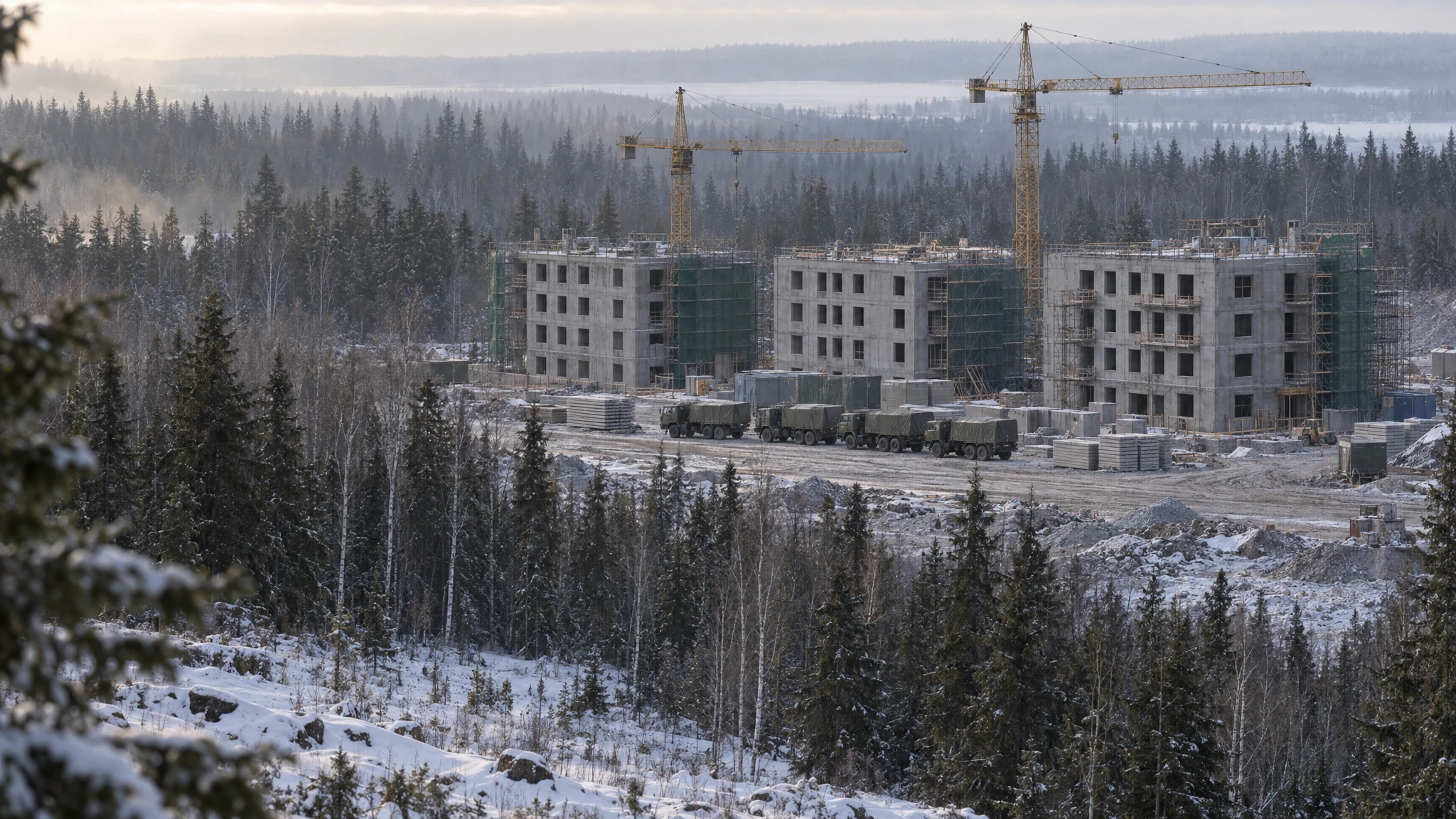
The analytical significance lies in the type of construction. Equipment moving through a region on its way to the Ukrainian front tells observers little about long-term plans. Permanent infrastructure built for additional forces tells them a good deal.
Barracks, motor pools and garrison facilities are investments meant to support a durable presence. They point to a planned reorganization of Russia's force posture in the northwest, consistent with Moscow's decision in 2024 to re-establish the Leningrad Military District in direct response to Finnish and Swedish accession.
The picture extends north and south. Russia has been modernizing its base at Pechenga, near the Norwegian and Finnish borders in the strategically vital Kola region, home to much of the Northern Fleet's infrastructure. New equipment and military activity have also been observed on the Karelian Isthmus north of St. Petersburg, the historic invasion corridor of the 1939–1940 Winter War. Michta assesses that these indicators suggest Russia is likely preparing to move roughly one hundred thousand troops into the area. Such a deployment would fundamentally change the military balance along Finland's frontier.
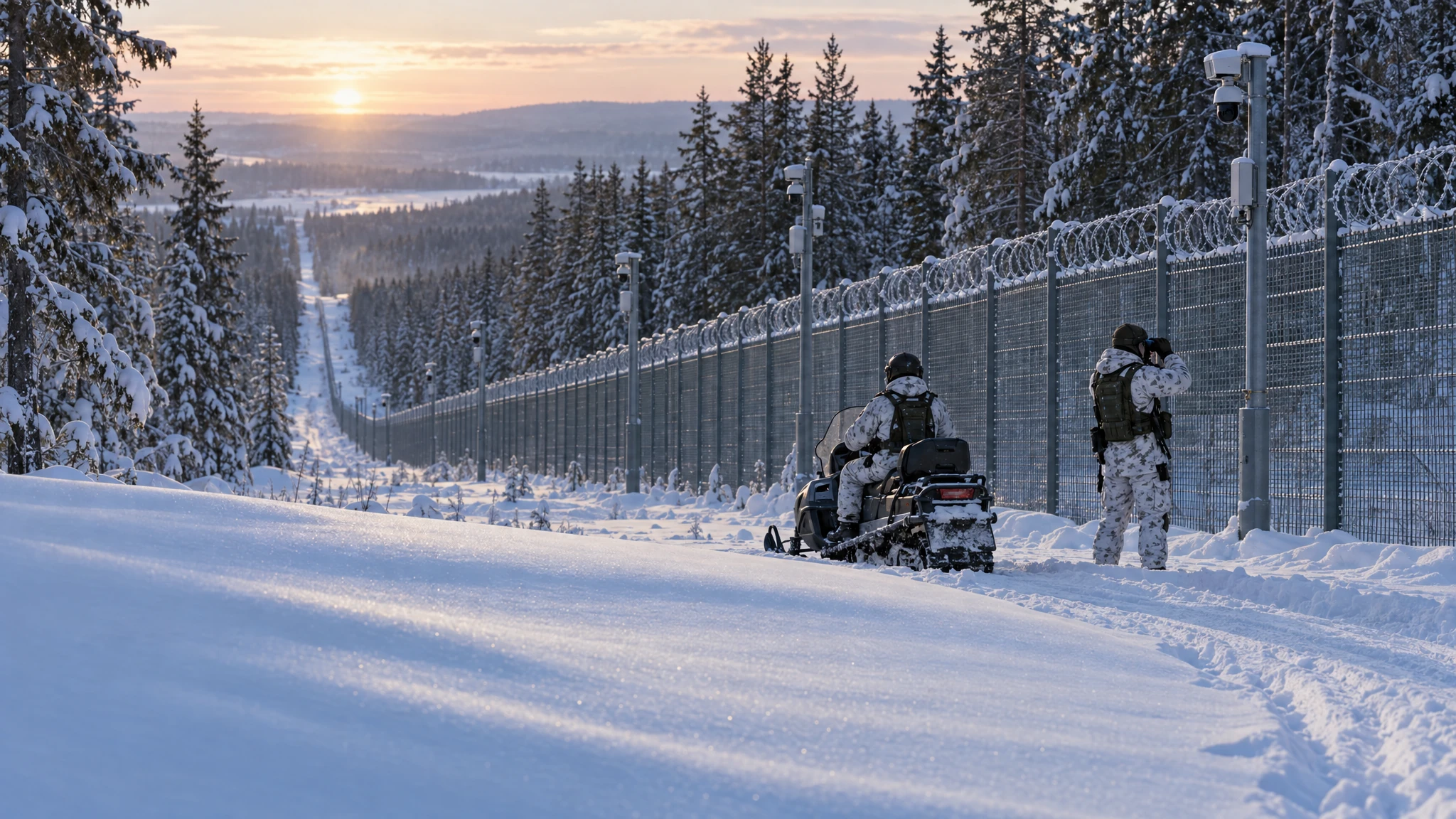
A Russian force of that size near Finland would not need to attack to achieve strategic effect. Its presence alone would tie down allied attention, complicate reinforcement of the Baltic states, and give Moscow escalation options it lacks today.
Why Not Simply Count the Divisions?
A reasonable skeptic will point to the arithmetic. NATO's combined economic output dwarfs Russia's. Its member states field far larger air forces and naval fleets, and its defense spending, even before the commitments made at the 2025 Hague summit, exceeded Russia's many times over.
Russia has spent years grinding through men and materiel in Ukraine for modest territorial gains. On this view, the idea that Moscow could open a second front against the most powerful alliance in history is fanciful. Russia lacks the capacity for horizontal escalation, and NATO collectively holds the stronger hand.
Michta accepts the arithmetic but questions the assumptions behind it. The skeptics' case holds only if two conditions are met.
- The United States is not simultaneously pulled into crises elsewhere. Washington's military planning increasingly has to account for possible contingencies on the Korean Peninsula and in the wider Indo-Pacific. If both escalate while a crisis unfolds in northeastern Europe, the American capabilities that underpin NATO's deterrent, including airlift, intelligence, missile defense and long-range strike, would be stretched across several theaters.
- European allies act in unison under pressure. Aggregate strength means little if it cannot be brought to bear quickly and collectively. Michta notes that despite tough rhetoric from Berlin, Paris and London, Europe's largest states have not built enough public consensus to defend allies on the eastern frontier in a crisis.
The second condition is the more troubling. Military power on paper is not deterrence. Deterrence is the adversary's belief that the power will actually be used. If Moscow concludes that German, French or British publics would balk at risking war over an incident near Narva or an engineered emergency in Lapland, then NATO's material superiority loses much of its weight in Russian calculations.
Geography as Destiny in European Threat Perception
Michta describes the problem as regionalized security optics. A country's view of Russian aggression depends largely on where it sits on the map. For the Baltic states, Finland and Poland, the Russian threat is existential, shaped by history, geography and living memory of occupation.
Moving west and south, that sense of urgency weakens. In those capitals, other priorities compete for attention: migration, energy prices, economic stagnation and the rise of populist movements reshaping domestic politics.
This divergence is not new, but its consequences are sharper now. During the Cold War, the Soviet threat was felt across Western Europe whether or not a country bordered the Warsaw Pact. A Soviet armored thrust through the Fulda Gap would have rolled toward the Rhine and beyond.
Nuclear targeting plans put Western European cities directly at risk, and large standing armies, conscription and civil defense made the danger concrete for ordinary citizens. Shared fear produced shared commitment.
Today's threat is more diffuse. Russia's methods, including sabotage, cyber operations, disinformation, airspace probes and pressure on infrastructure, are built to stay below the level that would galvanize distant publics. A burned warehouse in Poland or a severed cable in the Baltic Sea does not stir Lisbon or Rome the way tanks massing on a border once did.
Michta argues that this makes Cold War-style unity all but impossible. That fragmentation is exactly what Russian strategy appears designed to exploit.
The Logic of a Sub-Threshold Crisis
This is the core of the warning. Russian forces are not ready for an all-out assault on NATO. Putin may not need one. A carefully calibrated crisis on the eastern flank could serve his purposes better than a war he might lose.
Examples might include a localized incursion, a manufactured humanitarian emergency, a blockade, or an attack that can plausibly be denied. Such a crisis would be designed to:
- create ambiguity about whether Article 5 of the North Atlantic Treaty has been triggered;
- force allied governments to debate publicly how far they are prepared to go;
- expose the gap between frontline states demanding a robust response and distant allies urging caution;
- show frontline populations that the alliance's guarantee is conditional, weakening NATO's credibility from within.
Article 5 is often misunderstood as an automatic tripwire. It commits each ally to take such action as it deems necessary, including the use of armed force, in response to an armed attack on any member. That wording leaves room for interpretation and, under pressure, for hesitation.
A Russian operation designed to exploit that space would be a test of politics more than of military capability. If NATO failed it, the alliance could be gravely weakened without a single Russian division crossing a border in force.
Moscow's Window of Opportunity
Why would the Kremlin see this fall and winter as the right moment? Several factors appear to be shaping its calculations.
American Distraction
Michta suggests Moscow likely sees Washington's preoccupation with the war with Iran, together with political tensions at home ahead of the midterm congressional elections, as conditions that favor a more aggressive stance toward NATO. A United States absorbed by a Middle Eastern conflict and by bitter domestic politics may be slower to lead a collective allied response. Russian planners have long watched American electoral cycles closely. They will see an autumn of American polarization as a period of reduced bandwidth in Washington.
Europe's Empty Magazines
The second factor is industrial. For decades after the Cold War, European governments spent the peace dividend on other priorities and let ammunition stockpiles and production lines decline. The war in Ukraine exposed how far that neglect had gone.
Today, persistent bottlenecks in the production of platforms and munitions constrain both continued support for Kyiv and the restocking of Europe's own depleted arsenals. Every shell sent to Ukraine is a shell unavailable for Europe's defense until factories catch up, and they have not yet caught up.
The Closing Window
The third factor, and perhaps the most important for understanding Kremlin timing, is that time is not on Russia's side over the long run. Germany and other European states have finally started to take rearmament seriously. The new spending targets agreed at The Hague, the loosening of Germany's constitutional debt brake for defense, and the growth of European drone and munitions production all point to a continent that could be far better armed by the end of the decade.
Russia, by contrast, already runs a mobilized wartime economy. That economy currently gives it an edge in output, but it carries heavy costs in inflation, labor shortages and the diversion of resources from civilian sectors.
Moscow faces a closing window. Its relative advantage peaks now, while Russian factories run at wartime tempo and Europe's defense-industrial base remains inadequate. Each year of European rearmament erodes that edge.
This dynamic is familiar from the history of strategy. Powers that believe their relative position will decline are often most tempted to act before the balance shifts. Thucydides traced the Peloponnesian War to Sparta's fear of rising Athenian power. In the modern case, the logic is reversed but the incentive is similar: a Russia that expects European military strength to grow has reason to test the alliance before that growth matures.
What Western Analysts Are Watching
Michta's warning fits a wider body of analysis from Western research institutions. The Institute for the Study of War has documented Russia's hybrid activity against NATO states in detail, along with the Kremlin's information operations framing the alliance as an aggressor. Analysts at RUSI, the IISS and CSIS have repeatedly pointed to the fragility of European munitions production and the difficulty of moving forces quickly to the eastern flank.
RAND's wargaming of Baltic scenarios has long highlighted how fast Russian forces could create facts on the ground before allied reinforcements arrive. The common thread is that NATO's vulnerability lies less in overall capability than in speed, cohesion and political will in the first days of a crisis.
The Finnish case adds a new dimension. Finland brings one of Europe's most capable armies, built on conscription and a large trained reserve, together with a deep culture of national defense. Sweden's accession in March 2024 turned the Baltic Sea into what many commentators call a NATO lake.
Yet the expansion also lengthened the frontier the alliance must defend and created new points where Russia can apply pressure. A Russian buildup in Karelia and on the Kola Peninsula would force NATO to spread its attention and resources across a much larger northern theater, from the Arctic to the Gulf of Finland.
Scenarios for the Months Ahead
Predicting the date of a Russian move would be foolish. Michta himself stresses that the aim is to read the indicators, not to forecast a timeline. Still, a range of plausible trajectories can be sketched.
Scenario One: Intensified Gray-Zone Pressure
The most likely path is an escalation of the activity already under way: more sabotage against defense industry and infrastructure, bolder airspace violations, harassment in the Baltic Sea, and information operations aimed at Russian-speaking communities in Estonia and Latvia. This would keep pressure on allied governments while avoiding a clear trigger for collective defense. The danger is cumulative. Each unanswered provocation lowers the threshold for the next.
Scenario Two: An Engineered Flank Crisis
A more serious possibility is a deliberately staged crisis on a specific part of the eastern flank. It could be built around Narva, the Suwałki Gap or the Finnish border, and designed to provoke a moment of decision. Moscow's goal would be to split the alliance between those demanding firm action and those counseling restraint. How NATO handled the first forty-eight hours would matter more than any later military response.
Scenario Three: Open Operations Behind Allied Lines
The most dangerous scenario, which Michta explicitly raises, is Russia operating openly inside allied territory. That could mean kinetic strikes against logistics hubs or defense plants carried out with little attempt at deniability. It would be a qualitative break from the current pattern of plausibly deniable sabotage, and it would test directly whether allies regard such attacks as armed attacks under the treaty.
Scenario Four: Deterrence Holds
Escalation is not inevitable. Visible allied reinforcement, rapid and unified responses to provocations, and credible signals of resolve could persuade Moscow that the risks outweigh the rewards. Russia's own constraints, including heavy losses in Ukraine and economic strain, could also limit its appetite for a second front. This outcome depends on decisions European capitals make now, not after a crisis has started.
Closing the Credibility Gap
If the main weakness is political rather than military, the remedies must address both. Several priorities follow from the analysis.
- Treat hybrid attacks as a single campaign. Sabotage in Germany, Britain and Poland should be assessed and answered collectively, not as separate criminal cases. Attribution should be fast and public, and responses should impose real costs.
- Pre-agree responses to airspace violations. Clear, delegated rules of engagement would reduce the political hesitation Moscow appears to be probing and remove the advantage it gains from allied debate.
- Harden the northern theater. Allied presence in Finland and the Baltic states, prepositioned equipment, and improved rail and road links for reinforcement would answer Russia's buildup in Karelia and Kola directly.
- Accelerate industrial mobilization. Closing munitions and platform bottlenecks is the most direct way to shrink the window Moscow may see as favorable. Multi-year procurement contracts and joint European production can speed the process.
- Build public consensus in Western Europe. Leaders in Berlin, Paris, London and beyond need to explain to their publics why the security of Narva and Lapland is inseparable from their own. Without that groundwork, a crisis will expose the gap between official rhetoric and public willingness.
- Plan for American overstretch. European allies should assume that during a simultaneous crisis in Asia or the Middle East, American support could be slower or thinner than in the past. They should build the capabilities and command arrangements to act effectively in the meantime.
The Real Measure of Risk
The barracks rising near Petrozavodsk and Lupche-Savino, the modernization at Pechenga and the new rail capacity in Belarus are physical indicators that analysts can measure and track. Michta's deeper point is that the most important indicator cannot be seen from orbit. Major European capitals have finally recognized that a serious escalation on NATO's eastern flank is a real possibility. But their policy elites, in his assessment, appear more nervous than resolved.
That nervousness may be the strongest temptation Putin faces. An adversary that sees fear without resolve has reason to push. For more than seventy-five years, deterrence in Europe has rested on persuading Moscow that an attack on one ally would bring a response from all. The Kremlin seems to be testing whether that belief still holds, not by launching an invasion but by creating moments of ambiguity and seeing whether the alliance hesitates.
This winter, the strength of the northeast corridor will depend less on how many Russian troops gather in Karelia than on whether governments far from the front decide that the frontier's security is their own. If they do, Moscow's window may close without incident. If they do not, NATO may face its most serious test since its founding without a full-scale war ever being declared.


Reader discussion
No comments yet. Start the discussion.