
WHELFORD, Gloucestershire — The most consequential fact in the suspected bomb plot near RAF Fairford is also the least settled: nobody yet knows who, if anyone, was behind it. Five men are in custody, possible improvised explosive devices have been found in three vans, and the vehicles were reported while apparently moving towards a British airbase used by the United States. Beyond those facts, the investigation remains a contest between evidence and inference.
British counter-terrorism officers are examining a possible Iranian connection, in part because Tehran has already threatened facilities used for American military operations against Iran. But investigators have not publicly established that the suspects acted for Iran, knew one another’s purpose, or even intended to attack the base. Other explanations, including jihadist activity, criminal enterprise, political extremism or a confused and incomplete operation, remain open.
That distinction matters. A proven Iranian-directed attack on British soil would mark a sharp escalation in the confrontation between London, Washington and Tehran. An unsubstantiated attribution, by contrast, could allow the same crisis to generate its own intelligence failure: a dramatic narrative taking shape before forensic evidence, digital records and interrogation results are available.
The incident began with a civilian phone call
According to Gloucestershire police, the sequence began at approximately 12.45am on Sunday 27 September 2026, when a member of the public reported three suspicious vehicles travelling towards RAF Fairford. The caller had noticed unusual behaviour while driving home through the countryside. Armed officers responded in the Whelford area and arrested five men.
The men were initially detained on suspicion of offences under the Explosives Act. Later on Sunday, they were also arrested on suspicion of preparing a terrorist act under section 5 of the Terrorism Act. Arrest, however, is not proof of intent, and the upgraded allegation should not be mistaken for a completed assessment of the plot’s purpose. At the time of reporting, the suspects had not been charged in court and the authorities had released no detailed account of their identities, nationality, alleged affiliations or individual roles.
Army Explosive Ordnance Disposal specialists placed a 400-metre cordon around the vehicles. Bomb-disposal robots were used to examine the vans, while testing continued to determine whether the suspected devices were viable. Around 85 households in Whelford were evacuated as a precaution and residents were directed to a leisure centre in Cirencester. Emergency services established a forward operating presence at Fairford Youth Football Club, where police vehicles, ambulances, fire engines, tents and a mobile command unit were visible.
The public evidence currently demonstrates a serious security incident. It does not yet demonstrate an Iranian operation.
That is the narrow line investigators must hold. The location is strategically significant, the allegations are grave and the potential consequences are international. None of those facts removes the need to establish what the materials were, whether they could explode, who assembled them, and what the five men intended to do.
Why RAF Fairford carries unusual strategic weight
RAF Fairford is not simply another military installation in rural England. Its runway extends for almost two miles, or roughly three kilometres, and is reinforced for heavy bombers such as the B-1B Lancer and B-52. The base hosts United States Air Force personnel and has been used for operations involving aircraft capable of carrying large weapons payloads, including bunker-busting munitions.
In March 2026, after then-prime minister Sir Keir Starmer authorised what the government described as defensive American action against Iranian missile sites, four US bombers arrived at Fairford. Britain subsequently permitted the use of its bases for what officials called specific defensive operations. The policy was presented as support for the protection of shipping and allied forces, particularly amid Iranian attacks affecting vessels in and around the Strait of Hormuz.
The language of defence has not resolved the political dispute. Demonstrations have taken place near Fairford over the British decision to facilitate US strikes. For Tehran, a runway used by American bombers may look less like a shield than a launch platform. For British officials, the distinction between defensive and offensive action is legally and operationally important. For an adversary planning retaliation, it may be irrelevant.
In July, Iran’s Islamic Revolutionary Guard Corps warned that any base used for aggression against Iranian territory would be regarded as a legitimate target. That warning gives the Fairford investigation an obvious geopolitical context. It does not, by itself, identify the people arrested near Whelford as Iranian proxies. Public threats are not operational orders, and the existence of motive does not establish authorship.
The evidence problem behind the Iran theory
Counter-terrorism police and the security services are examining whether a foreign state was involved. Iran is among the possibilities because its intelligence ministry and security apparatus have previously been accused of organising or directing operations abroad. British authorities have also linked several recent incidents in the United Kingdom to Iranian activity, including the antisemitic arson attack on four Hatzola ambulances in Golders Green. The suspected Fairford operation, if the explosive material proves viable and the base was genuinely the intended target, would represent a far more serious development.
Yet motive, capability and timing must be separated from attribution. The suspects may have been acting under direction, inspired by propaganda, recruited through intermediaries, or operating without any connection to Tehran. They may have selected Fairford because it is a visible symbol of American power, because it was accessible, or because they believed the base could be approached without detection. Their reasoning is unknown.
Several basic questions remain unanswered:
- Were the materials functional explosive devices or incomplete components?
- Were the vans travelling towards the airbase, or did the caller’s interpretation overstate their direction?
- Did the suspects know the vehicles displayed false or unauthorised commercial branding?
- Was there surveillance, reconnaissance or target selection beyond the presence of the vans?
- Did any suspect communicate with a foreign handler, extremist network or criminal intermediary?
- Was the intended target RAF Fairford itself, nearby infrastructure, or something unrelated to the base?
Until investigators answer those questions, confident claims about Iranian responsibility would be premature. The most important evidence may come not from the political context but from mundane sources: residue analysis, detonator construction, purchase records, mobile-phone data, vehicle movements, CCTV, border crossings and the suspects’ financial activity.
A security operation triggered by chance
The incident also exposes an uncomfortable contradiction in the official response. Donald Trump said the suspects had been under observation for a long period and claimed they were preparing to cause major damage. British reporting, however, indicated that the operation was not intelligence-led and that police moved only after the public call about the vehicles.
Those accounts cannot both describe the same level of prior awareness. It is possible that American authorities possessed information not shared publicly, that Trump was speaking imprecisely, or that officials had monitored a broader threat without knowing that an immediate operation was under way. It is also possible that the claim of prolonged surveillance was political reassurance rather than a precise description of intelligence practice.
The distinction is not cosmetic. If the arrests resulted from a routine 999 call, the episode suggests that local vigilance, rather than covert intelligence, interrupted the suspected plot. That would be a success for public awareness and emergency preparedness, but it would also raise questions about how a potential attack near a high-value military site escaped earlier detection.
If the men were under surveillance, the public should eventually be told—at least in broad terms—why officers allowed them to reach Whelford, what threshold justified intervention and whether the vans had been tracked before the call. Premature disclosure could compromise the investigation. Permanent ambiguity, however, would permit every interested party to claim that the security services either knew everything or knew nothing.
The central institutional question is not simply whether police stopped an attack. It is whether the state understood the threat before a resident happened to see it.
What the arrests do and do not reveal
Photographs circulated on Sunday showed shirtless men being handcuffed in a dark country lane. The absence of shirts may have been a police precaution designed to rule out concealed weapons or suicide vests. Images of a dramatic arrest can shape public opinion long before forensic findings do, but they provide little reliable information about the suspects’ ideology or operational competence.
The vans themselves may prove more revealing. At least one reportedly carried the logo and telephone number of a fuel company. The number was missing a digit, and the legitimate company said it had no connection to the vehicles and that its name had been used without authorisation. False commercial markings can be intended to disguise movement, provide access or create confusion after an incident. They can also reflect opportunistic criminal deception rather than state-sponsored tradecraft.
The five men’s identities and precise relationships had not been publicly established in the source material. That absence is significant, not incidental. It means that accounts describing an organised Iranian cell, a jihadist group or a coordinated terrorist team would go beyond the known record. Investigators may eventually identify a clear hierarchy. At this stage, the responsible formulation is narrower: five men were arrested near suspected explosive devices, and authorities are investigating a possible terrorist preparation offence.
Iran’s overseas pressure campaign provides context, not a verdict
Iran has used coercive pressure beyond its borders through intelligence networks, proxy relationships, threats against dissidents and attacks attributed by Western governments to its security services. Analysts at organisations such as the Royal United Services Institute, the Center for Strategic and International Studies and the Atlantic Council have repeatedly examined Tehran’s preference for calibrated deniability: pressure can be applied while preserving room to deny direct responsibility.
That model is relevant to the Fairford case, but it must not become a template into which every suspicious event is fitted. A state seeking deniable retaliation might use criminal intermediaries, diaspora-linked operatives or individuals motivated by money. Conversely, an independent extremist actor might select an Iranian target or an American base for symbolic reasons without receiving any instruction from Tehran.
Research from RAND, the International Institute for Strategic Studies and the Institute for the Study of War also points to a broader analytical difficulty: modern conflict increasingly combines military action, influence campaigns, cyber activity, proxy violence and coercive signalling. Attribution becomes politically useful before it becomes technically certain. Governments therefore face pressure to warn the public while protecting intelligence sources, and pressure to punish an adversary before the chain of responsibility is fully documented.
Britain’s threat level remains severe, the second-highest category, meaning an attack is considered highly likely. That assessment is national rather than specific to Fairford. It should not be presented as confirmation that Iran directed the arrests. Nor should the absence of an immediate public attribution be interpreted as evidence that the authorities have found nothing. Investigations of this kind often proceed through classified channels, and the public record can remain incomplete for weeks or months.
The British government faces a double exposure
Andy Burnham, the prime minister, was briefed while attending the Labour party conference in Liverpool and cancelled an appearance in a journalists-versus-politicians football match. He described the incident as deeply concerning and said the government would take every necessary step to protect the public.
Richard Ocone, assistant chief constable of Gloucestershire Constabulary, emphasised the disruption caused by the evacuation and said officials were working to return residents to their homes as quickly as possible. Police asked the public not to speculate and to follow official updates. That is sensible advice during an unexploded-ordnance response. It is less satisfactory as a long-term communications strategy if the public is left to fill the information gap with the most alarming available theory.
The government’s exposure is political as well as operational. If the Fairford facility is being used for American missions against Iran, Britain has accepted a degree of strategic risk in exchange for alliance solidarity and military utility. The base becomes a potential target not because the surrounding community has changed, but because British policy has altered its perceived role in the conflict.
Officials cannot credibly describe the site as a purely defensive asset while ignoring how an adversary interprets the deployment of heavy bombers from British territory. At the same time, Britain cannot simply treat every threat against a military base as proof that hosting allied operations was a mistake. The issue is whether the government has accurately priced the risk, hardened the site and informed the public about the consequences.
Local communities are part of the strategic equation
For Whelford residents, the international crisis arrived as an overnight evacuation. About 85 households were displaced to Cirencester leisure centre, while emergency teams worked around white vans in a rural setting. Residents described heightened tensions in recent weeks and more frequent visible police patrols around the base, although the area had generally felt safe.
That local experience exposes the gap between national strategic language and everyday security. Statements about defensive missions, legitimate targets and escalation ladders are made in capitals. The costs are absorbed by residents asked to leave their homes, farmers whose roads are closed, local authorities managing shelters and emergency workers operating under uncertain conditions.
Community trust will depend on what happens next. Authorities should explain why the evacuation perimeter was set at 400 metres, when homes can safely be reoccupied, whether the devices were viable and what residents should do if suspicious activity recurs. They should protect operational details, but they should not allow secrecy to become a substitute for accountability.
Three plausible paths for the investigation
Scenario one: a foreign-directed operation
If forensic evidence, communications records and witness testimony establish Iranian direction, the British government would face a serious decision. Public attribution could support diplomatic expulsions, sanctions and international condemnation. A covert response might be considered, but retaliation would carry the danger of widening an already active confrontation. London would need to coordinate closely with Washington and European allies while distinguishing Iranian state responsibility from the actions of individuals operating independently.
Even then, officials should publish an evidentiary case rather than rely on anonymous briefings. The credibility of attribution would shape the legitimacy of any response. Recent conflicts have shown how quickly intelligence claims become part of military escalation, often before independent verification is possible.
Scenario two: an extremist or self-directed plot
If the suspects are linked to jihadist propaganda, domestic extremism or an autonomous network, the Fairford case would demonstrate how global wars can inspire local attacks without direct foreign control. The Iranian hypothesis would then have functioned as a powerful but misleading first frame, encouraged by Tehran’s threats and the base’s role in American operations.
This possibility would demand attention to online radicalisation, recruitment, explosives acquisition and the routes by which overseas conflict is translated into domestic violence. It would also expose the danger of treating state actors as the explanation for every politically charged security incident.
Scenario three: a serious-looking but incoherent plan
A third possibility is that the men possessed suspicious or dangerous material but lacked the capability, agreement or intent to attack RAF Fairford. The vans may have been connected to criminal activity, an improvised protest, an abandoned plan or a target other than the base. Such an outcome would not make the police response excessive: suspected explosives near a major military installation require immediate action. But it would radically change the political meaning of the arrests.
This is why the viability of the devices and the chain of intent matter. A bomb that cannot detonate is not the same operational threat as a tested device. A vehicle travelling near a base is not automatically conducting reconnaissance. Five arrests do not automatically constitute an enemy cell.
What Britain should do before drawing conclusions
First, ministers should separate confirmed facts from working hypotheses in every public statement. The government can say that explosives were found, five men were arrested and counter-terrorism police are leading the investigation without declaring a foreign sponsor.
Second, the authorities should review protection around RAF Fairford and other sites supporting allied operations. That review should include surveillance of approach roads, drone detection, vehicle screening, intelligence-sharing with local police and contingency planning for simultaneous incidents. Security cannot rely entirely on a resident noticing something unusual at midnight.
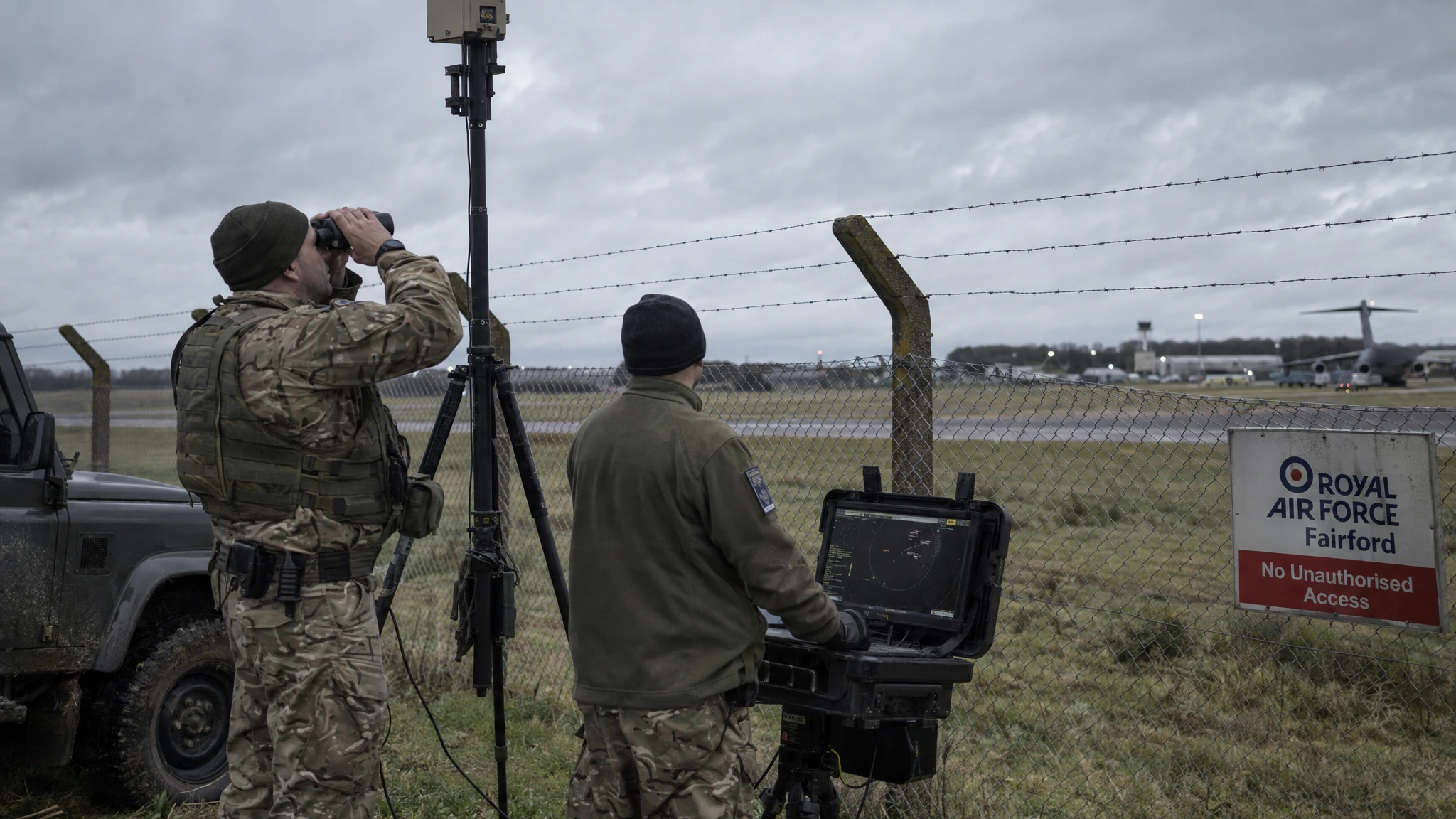
Third, London should prepare a proportionate attribution process. If evidence points to Iran, the case should be presented through coordinated intelligence assessments, allied consultation and, where possible, material that can be scrutinised publicly. If evidence does not support that conclusion, officials should say so plainly rather than allowing insinuation to harden into accepted fact.
Fourth, the government should assess the strategic bargain behind the use of British bases. Hosting American bombers may strengthen the alliance and help defend shipping, but it also makes British territory more visibly connected to US military action. Ministers owe Parliament and affected communities a candid account of that risk—not only assurances that the United Kingdom is ready to defend itself.
The unanswered question is the story
The Fairford incident may ultimately prove to be an Iranian-directed terrorist operation. It may instead reveal an extremist network, a criminal scheme, a failed attempt at violence or a group whose motives were less coherent than the initial images suggested. At present, the public does not know, and neither the government’s rhetoric nor the base’s strategic importance can fill that evidentiary gap.
What is clear is that the arrest took place in a landscape where military policy, local vulnerability and geopolitical retaliation now overlap. RAF Fairford has become a symbol in the conflict between the United States and Iran, while Whelford has become the setting for a security operation apparently triggered by civilian observation. That combination should prompt urgency, but not certainty.
The strongest British response would therefore be two-track: protect the base and the community as though the threat is real, while investigating attribution as though it remains unproven. Until the evidence establishes who these men were, what they intended and whether anyone directed them, the most accurate account is also the least dramatic one: a potentially grave plot was disrupted, but its authorship is still unknown.


Reader discussion
No comments yet. Start the discussion.
Comments are closed for this article.