
For Lithuania, a constitutional clause written to keep nuclear weapons and permanent foreign bases off its territory has become an unusually visible test of deterrence. For the Kremlin, the same provision has offered an opportunity to issue a threat before Vilnius has even decided whether to remove it.
Kremlin spokesman Dmitry Peskov said Lithuania would become a target for Russian nuclear weapons if the country’s parliament repealed its prohibition on deploying nuclear arms. His remarks, reported by Russia’s state news agency TASS, came as the Seimas prepared to examine a large autumn legislative programme dominated by security, defence, resilience and demographic policy.
The immediate issue is narrow: whether Lithuania should delete the constitutional language that bars the stationing of nuclear weapons and the construction of permanent foreign military bases. The strategic question is much larger. The debate reflects a Baltic security environment transformed by Russia’s war against Ukraine, uncertainty over the durability of American commitments to Europe and the growing importance of deterrence arrangements within NATO.
The central distinction is crucial: debating a legal change is not the same as inviting nuclear weapons onto Lithuanian soil. Yet Moscow’s response seeks to collapse those two steps into one, turning a domestic constitutional process into a warning about nuclear targeting.
A threat aimed at a decision that has not been made
Peskov presented Lithuania’s possible repeal as predictable but dangerous. In comments carried by TASS, he argued that placing nuclear weapons on Lithuanian territory would constitute a major escalation because such weapons would necessarily be directed at an adversary. He said that adversary would be Russia, and warned that Lithuanian territory would then fall within the scope of Russian nuclear targeting.
“If nuclear weapons aimed at us are located on a country’s territory, that country’s territory will correspondingly be within the targeting range of our nuclear weapons,” Peskov said, according to TASS.
The formulation is familiar in Russian strategic messaging: a hypothetical future capability is described as an immediate threat, while a retaliatory posture is framed as a defensive response. It also avoids a direct claim that Lithuania is currently preparing to host nuclear arms. The Kremlin warning instead establishes a conditional line: if the legal barrier disappears and nuclear weapons arrive, Moscow says it will respond.
That conditionality matters. Lithuania is a NATO member, and any decision concerning the alliance’s nuclear posture would involve political and military consultations far beyond Vilnius. Removing the constitutional prohibition would create legal flexibility; it would not itself transfer a warhead, authorize a foreign deployment or determine NATO policy.
Nevertheless, the threat is designed to influence the first step. Nuclear signaling is often used not only to deter military action but also to shape the political choices that precede it. By declaring that Lithuania would be targeted, Moscow is attempting to raise the domestic cost of changing the constitution and to suggest that a sovereign debate is evidence of hostile intent.
What Lithuania’s parliament is actually considering
The Seimas opened its autumn session on September 10, 2026. The proposed agenda contains more than 550 legislative initiatives, with proceedings scheduled through December 23 across 46 sittings. Three of those sittings are reserved for the agendas of opposition parliamentary groups.
Security is one part of a much broader legislative programme. The government and parliament are also addressing demographic decline, family support, migration, public administration and economic policy. The nuclear provision is therefore not being considered in isolation, even if Moscow’s reaction has placed it at the centre of international attention.
According to information published by Lithuanian public broadcaster LRT, the agenda includes more than 330 initiatives submitted by members of parliament and 127 draft laws proposed by the cabinet. The legislature is also expected to approve the 2027 state budget and consider holding the next mayoral and municipal council elections on March 7, 2027.
Among the other proposals are a public register of sex offenders, an expanded family-policy package, changes to child-care allowances and measures intended to help young families purchase homes. Lawmakers are expected to debate increasing the number of conscripts, providing universal free school meals for primary pupils and raising scientists’ salaries.
Economic and administrative measures include a proposed free economic zone in Visaginas, limits on the frequency of fuel-price increases and changes to public procurement and civil-service rules. These issues underline the political reality facing the Seimas: national security is being debated alongside the social and economic pressures that determine whether a state can sustain defence spending and military readiness.
Seimas Speaker Juozas Olekas has described security, defence and national resilience as the session’s leading priority. He has also identified demographic policy as a second major theme, including efforts to raise the birth rate, encourage the Lithuanian diaspora to return and manage migration.
Prime Minister Mindaugas Sinkevičius has summarized the government’s political objective as “a safe person in a safe state.” President Gitanas Nausėda has submitted 10 proposals for consideration during the session, including the constitutional issue that has now triggered Moscow’s warning.
Why Article 137 has returned to the strategic debate
Lithuania’s Constitution contains a provision commonly identified as Article 137. It prohibits the deployment of weapons of mass destruction, including nuclear weapons, and bars the establishment of permanent foreign military bases on Lithuanian territory. The current political discussion concerns removing the restriction on nuclear deployment, alongside a proposed update to the country’s National Security Strategy.
Nausėda said in July that the article had “lost its meaning” and should be removed entirely. His argument reflects a security landscape that looks very different from the period in which Lithuania’s post-Soviet constitutional order was consolidated. Lithuania joined NATO in 2004, and Russia’s full-scale invasion of Ukraine in 2022 has transformed the military balance on NATO’s northeastern flank.
The provision’s two elements should not be treated as identical. A ban on permanent foreign bases addresses the character and permanence of foreign military presence. A ban on nuclear deployment concerns a specific category of weapon and the legal conditions under which it could be stationed. Removing one restriction would not necessarily eliminate the other, and changing the constitution would not automatically authorize a permanent base.
The legal debate also has an institutional dimension. Constitutional amendment procedures are more demanding than ordinary legislation, and the text supplied by the source material indicates that the Seimas is expected to consider removing the nuclear restriction as part of the autumn programme. The eventual outcome, wording and implementation timetable remain political questions rather than settled facts.
That uncertainty is precisely why the Kremlin’s intervention is significant. Moscow is responding to a possible change in Lithuania’s legal posture before there is evidence of an agreed deployment plan. The statement therefore functions as preventive signaling: it seeks to define the consequences of a decision that Lithuania has not yet taken.
The Baltic geography behind the alarm
Lithuania occupies a strategically exposed position. It borders Russia’s Kaliningrad exclave to the southwest and Belarus to the east, while its northern and western approaches connect to the Baltic region and the wider NATO maritime space. The Suwałki corridor, the land link between Poland and Lithuania, is widely viewed by defence planners as a critical connection between the Baltic states and the rest of the alliance.
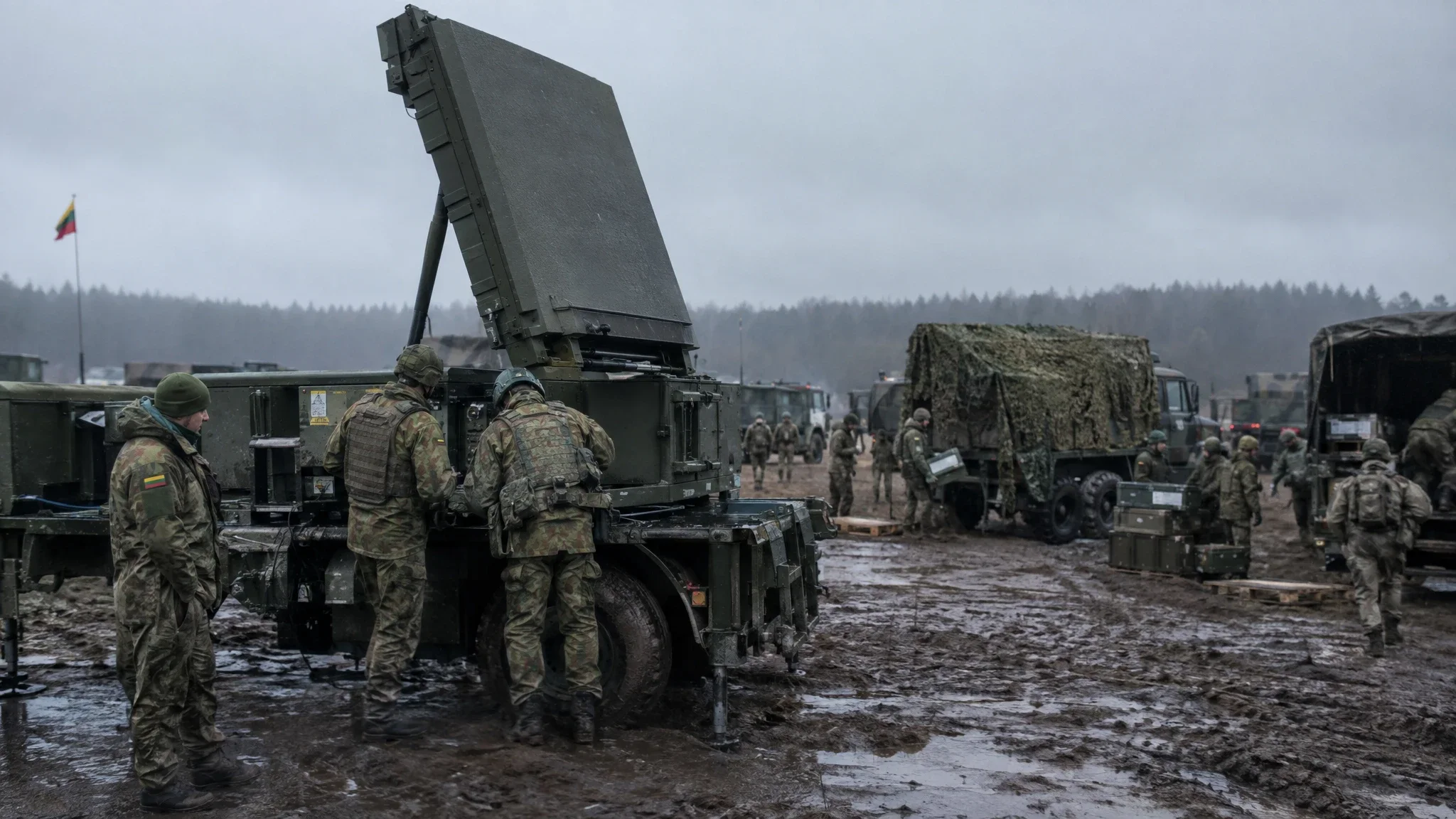
That geography has made Lithuania unusually sensitive to questions of reinforcement, air defence, long-range fires, logistics and allied presence. The country has invested heavily in national defence and has repeatedly argued that deterrence on NATO’s eastern flank must be credible before a crisis begins. For Vilnius, the issue is not simply whether a particular weapon is deployed. It is whether Russia believes that an attack on a Baltic ally would trigger a rapid and overwhelming allied response.
Research institutions such as the International Institute for Strategic Studies, the Royal United Services Institute and the Center for Strategic and International Studies have repeatedly examined the military importance of the Baltic region, including the problems created by limited strategic depth, vulnerable transport routes and Russia’s ability to combine conventional, missile and nuclear signaling. Their analyses do not establish that Lithuania is preparing to host nuclear weapons. They do help explain why even a legal discussion can attract disproportionate strategic attention.
For Lithuania, the constitutional prohibition can appear increasingly detached from the country’s alliance environment. NATO’s deterrence posture already includes nuclear forces belonging to the United States, the United Kingdom and France, although their roles and arrangements differ. NATO’s nuclear sharing system is centred principally on several Western European allies and does not mean that every member hosts nuclear weapons.
Consequently, deleting Article 137 would be a political and legal signal rather than an automatic change to NATO’s nuclear disposition. It could indicate that Lithuania wants fewer self-imposed restrictions at a time of heightened danger. It could also be interpreted by Russia as evidence that the alliance is gradually moving nuclear capabilities closer to Russian territory.
Why Moscow treats legal flexibility as escalation
Russian officials have long portrayed NATO enlargement and allied military infrastructure as a direct threat to Russia’s security. Since the invasion of Ukraine, the Kremlin has increasingly paired battlefield activity with nuclear rhetoric. The purpose is not always to announce a concrete operational step. Often, nuclear language is used to impose psychological and political costs on opponents.
The Institute for the Study of War has documented the broader role of Russian nuclear signaling in coercive messaging, particularly when Moscow seeks to deter Western military assistance or divide allied governments. RAND and the Atlantic Council have likewise examined how ambiguity, escalation threats and information operations can shape decision-making even when the underlying military balance does not change immediately.
In Lithuania’s case, Peskov’s statement has three audiences.
- Domestic Lithuanian politics: the message is intended to make constitutional reform appear physically dangerous, potentially strengthening voices that oppose removing the ban.
- NATO governments: Moscow is signaling that any movement toward a more explicit nuclear role for the Baltic region would carry escalation risks.
- Russian audiences: the statement reinforces the Kremlin’s portrayal of NATO as an advancing military bloc and Russia as responding to encirclement.
The language also reinforces a recurring Russian claim that military deployments are inherently directed at Moscow. That argument leaves little room for a defensive interpretation of NATO posture. It treats geography itself as hostile intent, allowing Russia to define the presence of capabilities near its borders as provocative while presenting its own forward deployments as compelled responses.
From a strategic communications perspective, this is a low-cost intervention. Peskov does not need to demonstrate that Lithuania has a nuclear deployment agreement. He only needs to attach a severe consequence to the prospect. A public threat of nuclear targeting can generate political friction long before a military decision is made.
Legal change is not the same as nuclear stationing
The most important analytical safeguard is to separate four distinct questions that are easily merged in public debate:
- Will the Seimas support removing the constitutional prohibition?
- Would Lithuania’s legal and political authorities approve a specific foreign deployment?
- Would NATO allies agree that such a deployment served alliance strategy?
- Would a nuclear-armed state actually choose to station weapons in Lithuania?
Each question has a different answer and a different decision-maker. The first concerns Lithuanian constitutional politics. The second concerns national policy and implementation. The third concerns alliance strategy, consultation and military planning. The fourth depends on the calculations of the nuclear power involved, including basing requirements, survivability, command arrangements, security and escalation management.
There is also a practical distinction between nuclear weapons and the infrastructure associated with nuclear deterrence. A state may seek closer integration with alliance planning, participate in consultations or host exercises without storing nuclear warheads. It may also strengthen conventional deterrence, air defence and civil resilience while retaining a legal prohibition on nuclear deployment.
That is why the proposed repeal should not be described as proof that Lithuania is about to become a nuclear host. Such a claim would go beyond the facts available. The known facts are that the Seimas is considering the issue, the president has supported removing the restriction and the Kremlin has threatened consequences if nuclear weapons were eventually placed on Lithuanian territory.
Removing a prohibition creates an option; it does not establish a deployment.
Yet options have strategic meaning. In deterrence, adversaries pay attention not only to current force levels but also to what a state might be able to do in a crisis. Lithuania’s debate could therefore affect Russian planning even if no weapons are ever stationed there.
The domestic calculation in Vilnius
The Seimas must balance strategic flexibility against the risk of turning a symbolic constitutional amendment into a permanent political liability. Repeal could give Lithuania greater freedom to respond to future NATO arrangements, but it could also invite accusations that the government is importing a nuclear confrontation into the Baltic region.
The debate will occur while lawmakers are managing a crowded agenda. The proposed programme contains more than 550 measures, and the autumn session is scheduled to run for 46 sittings until December 23. National security is being linked to resilience, demographics and state capacity rather than treated as a narrow military portfolio.
This connection is strategically important. Lithuania’s ability to withstand coercion depends on more than weapons. It includes the availability of soldiers, the resilience of critical infrastructure, public confidence, energy security, emergency planning, communications and the ability to sustain economic activity during a crisis. The proposed increase in conscription, family measures and investment in state capacity all sit within that wider concept of national resilience.
At the same time, the nuclear debate could expose political divisions over sovereignty and risk. Supporters may argue that Lithuania should not voluntarily exclude itself from future alliance options. Opponents may contend that abandoning a long-standing constitutional safeguard would gain little militarily while giving Moscow a new justification for threats.
The government’s challenge will be to explain what the amendment would do and what it would not do. Ambiguous messaging would allow the Kremlin to define the reform as an immediate nuclear deployment, while overly ambitious rhetoric could create expectations that NATO has no intention of meeting.
What the alliance should do next
NATO governments have an interest in preventing a domestic Lithuanian legal debate from becoming an uncontrolled escalation narrative. That does not require dictating the outcome of the constitutional process. It requires clarity.
First, allied officials should distinguish between legal eligibility and operational deployment. They should avoid confirming hypothetical basing plans while making clear that any change to Lithuania’s constitution would remain subject to national decisions and alliance consultation.
Second, NATO should continue strengthening conventional deterrence in the Baltic region. Credible air and missile defence, rapid reinforcement, dispersed logistics, secure communications and protection of the Suwałki corridor may do more to reduce vulnerability than a public argument over nuclear symbolism.
Third, allies should improve crisis communications. Russia’s threat demonstrates how quickly a technical legal proposal can be reframed as a strategic provocation. Public explanations should be consistent across capitals and should emphasize that NATO’s deterrence is defensive, coordinated and governed by political decision-making.
Fourth, Lithuania should pair any constitutional change with a transparent national security strategy. The Seimas is expected to consider an updated strategy during the autumn session. That document could clarify whether the purpose of repeal is legal alignment with alliance obligations, contingency planning, broader deterrence flexibility or some combination of those goals.
Fifth, the alliance should invest in resilience regardless of the nuclear outcome. Research from RUSI, IISS, CSIS and the Atlantic Council has underscored the importance of integrated defence, logistics and societal preparedness in the eastern flank. In practice, the credibility of nuclear deterrence depends partly on the survivability and cohesion of the conventional forces that support it.
Three possible paths through the autumn session
1. The provision is removed
If the Seimas approves repeal and the wider constitutional process is completed, Lithuania would acquire greater legal flexibility. Moscow would probably describe the decision as evidence of NATO militarization and could respond with additional rhetoric, military signaling or pressure against Lithuanian interests.
That response would not necessarily mean an immediate military deployment or a direct change in Russian force posture. The most likely initial effects would be political and informational: warnings, accusations and efforts to divide Lithuanian society from its allies. The practical significance of repeal would depend on what Vilnius and NATO did afterward.
2. The ban remains in place
If lawmakers reject the change or the amendment fails to complete the constitutional process, Moscow could claim that its warning influenced Lithuania. Such an outcome would preserve the existing legal restriction but would not resolve the underlying security dilemma. Lithuania would still face the same geography, Russian military pressure and questions about alliance reinforcement.
A failed amendment could also prompt a different conversation about deterrence. Vilnius might focus more heavily on conventional capabilities, allied rotations, air defence and civil preparedness rather than nuclear flexibility.
3. The debate produces a narrower compromise
A third possibility is a legal or political formulation that removes the nuclear prohibition while preserving other restrictions, or that clarifies the difference between temporary allied arrangements and permanent foreign bases. Such a compromise could give Lithuania some flexibility without presenting the change as a decision to host nuclear weapons.
However, ambiguity has costs. A formula designed to satisfy several domestic constituencies might be interpreted abroad as deliberate uncertainty. In a nuclear context, unclear language can create miscalculation as easily as it creates room for manoeuvre.
The larger lesson for European security
Lithuania’s debate shows how the strategic environment of Europe has shifted since Russia’s invasion of Ukraine. Questions once treated as constitutional principles or long-term alliance abstractions are now being examined through the lens of immediate vulnerability. The Baltic states are not merely discussing what they prefer to host. They are asking what restrictions they can afford when the security order around them is contested.
The Kremlin’s warning also illustrates the difficulty of managing deterrence in an age of persistent nuclear signaling. A state may seek to preserve options without intending to use them; an adversary may present that option as an imminent threat. The resulting gap between intention and perception is where escalation risks grow.
Strategic restraint, however, should not be confused with accepting Russian veto power. If a sovereign NATO member cannot debate its defence policy without being threatened with nuclear targeting, the threat itself becomes part of the coercion problem. Lithuania’s leaders must take the risk seriously, but they should not allow Moscow to determine the boundaries of democratic debate.
The most effective response is neither theatrical escalation nor unilateral reassurance. It is disciplined policy: explain the legal change, strengthen conventional defence, consult allies, protect critical infrastructure and maintain channels for crisis communication. A constitutional amendment cannot by itself solve Lithuania’s security dilemma. Nor can a Kremlin warning settle the question.
Conclusion
The Seimas is considering a nuclear-related constitutional change inside a legislative session that also covers the 2027 budget, municipal elections, conscription, demographic policy and national resilience. Peskov has attempted to recast that domestic agenda as a direct strategic challenge to Russia by warning that Lithuania would enter the targeting plans of Russian nuclear forces if weapons were deployed there.
The facts support a more measured conclusion. Lithuania is debating whether to remove a legal prohibition; no deployment decision has been established. The president supports repeal, parliament is examining the issue and a new National Security Strategy is expected to form part of the autumn security debate. Moscow has responded with conditional nuclear threats.
What follows will matter less as a referendum on nuclear weapons than as a test of how NATO’s eastern members manage strategic uncertainty. Lithuania will need to preserve decision-making freedom without overstating what legal reform can deliver. Its allies will need to make deterrence credible without allowing Russian rhetoric to dictate their politics. The outcome may be decided in Vilnius, but the consequences will be watched across Europe.


Reader discussion
No comments yet. Start the discussion.
Comments are closed for this article.