
The Battle for European Mobility
In the high-stakes chess game of European rearmament, while attention is often fixed on the skies with F-35 acquisitions or ballistic shields like the Arrow 3, a decisive battle is being fought on the ground. It is a contest for the backbone of NATO’s rapid reaction forces: the 8x8 wheeled armored vehicle. As the Alliance pivots back to territorial defense, the need to move infantry quickly across the continent’s highways and into the mud of the Eastern Flank has ignited a fierce industrial rivalry.
Two titans have emerged to dominate this market: the German-Dutch GTK Boxer and the Finnish Patria AMV XP. Their competition is not merely a matter of horsepower and armor thickness; it represents a clash of philosophies regarding logistics, cost, and the very nature of modern mechanized warfare.
The German Heavyweight: GTK Boxer
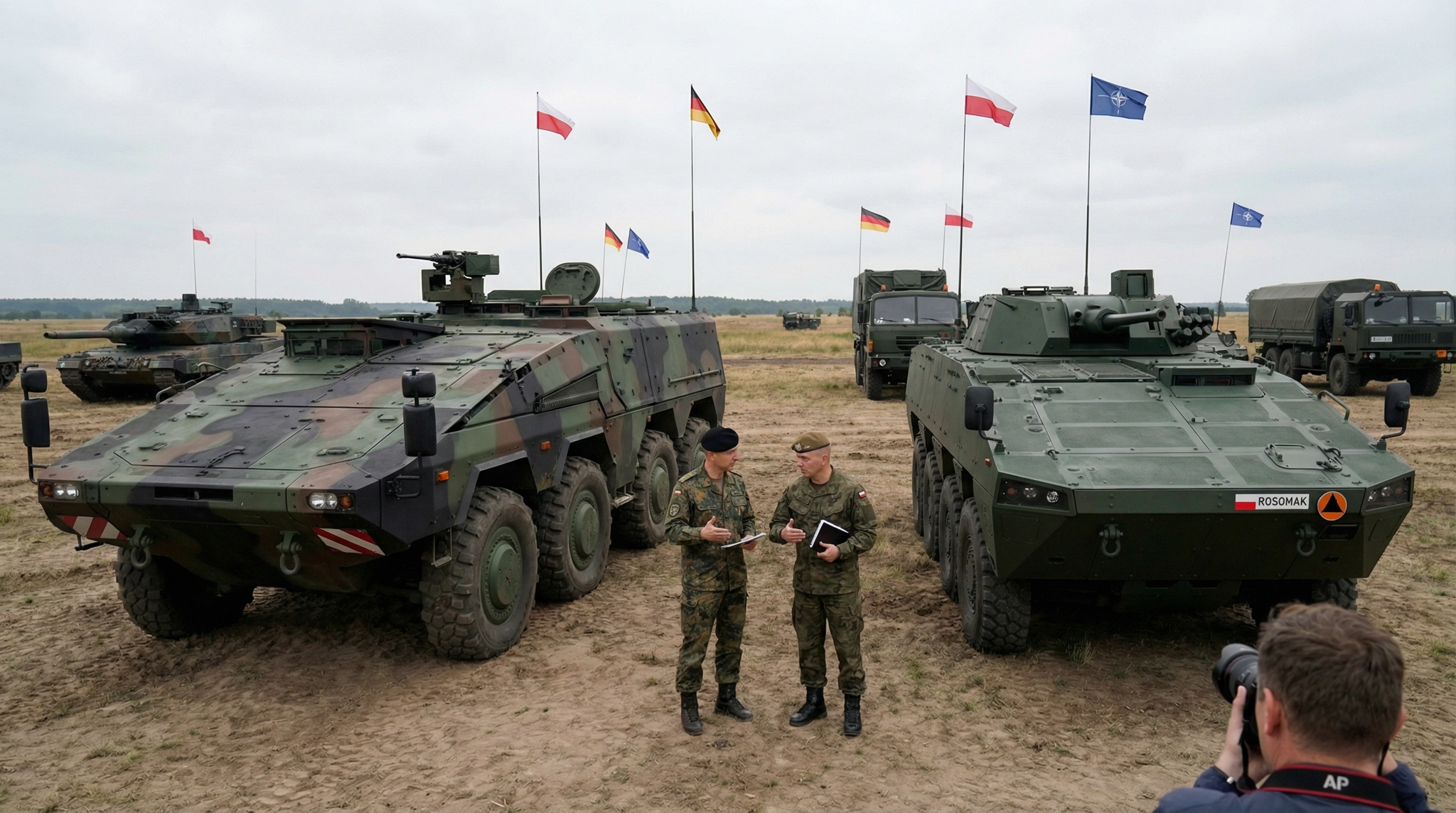
Produced by the ARTEC consortium (a joint venture involving Rheinmetall and Krauss-Maffei Wegmann), the GTK Boxer is the technological flagship of Western European armor. Its defining feature is its revolutionary modular mission architecture. The vehicle is split into two distinct parts: a standardized "drive module" (chassis) and an interchangeable "mission module" (payload).
This design allows a field commander to swap a troop transport module for a medical ambulance or a command post module in under an hour. However, this engineering marvel comes with a significant weight penalty. Weighing in at over 38 tons in combat configuration, the Boxer offers protection levels comparable to some infantry fighting vehicles (IFVs). It is designed to survive IEDs and heavy kinetic fire, reflecting the lessons learned by Western armies in Afghanistan and Iraq.
The Boxer has been adopted by the heavyweight powers of NATO—Germany, the Netherlands, and the United Kingdom—signaling a preference for maximum survivability and modularity, even at a high financial cost.
The Nordic Challenger: Patria AMV XP
Contrasting the Boxer is the Patria AMV XP (Armored Modular Vehicle - Extra Payload), hailing from Finland. If the Boxer is a complex over-engineered luxury sedan, the Patria is a high-performance rally car. Born from a nation that shares a 1,300-kilometer border with Russia, the Patria prioritizes mobility, simplicity, and volume.
The Patria design is more conventional but exceptionally refined. It is generally lighter than the Boxer, offering superior agility in soft terrain—a critical factor in the marshy geography of the Baltics and Karelia. Crucially, the Patria offers an amphibious variant, a capability the heavy Boxer lacks entirely. For nations with numerous river crossings and lakes, like Poland, this is a non-negotiable operational requirement.
Commercially, Patria has achieved massive export success by allowing local technology transfers. The Polish Rosomak, a licensed variant of the Patria, is the backbone of Poland's mechanized infantry. Slovakia and Japan have also selected the Patria, drawn by a price point that allows for the procurement of larger fleets compared to the expensive German alternative.
Strategic Trade-offs: Quality vs. Quantity
The choice between Patria and Boxer reveals a strategic divergence within NATO procurement:
- The Boxer Bloc: Nations like the UK and Germany argue that in a high-intensity conflict with Russia, soldier survivability is paramount. They are willing to sacrifice strategic air transportability and accept higher unit costs to ensure their infantry survives the first contact. The modularity also simplifies long-term upgrades, theoretically extending the service life of the chassis.
- The Patria Pragmatists: Eastern flank nations, led by Poland and Finland, argue that quantity has a quality of its own. The lower acquisition cost of the Patria allows these armies to field more battalions. Furthermore, the ability to swim across rivers provides tactical flexibility that heavy bridging equipment cannot match. In a defensive war against a Russian invasion, the ability to maneuver through difficult terrain is viewed as the best form of armor.
The Industrial Dimension
This rivalry also highlights the fragmentation of the European defense market. Despite calls for EU strategic autonomy and standardized equipment, Europe produces two direct competitors for the exact same role. The ARTEC Boxer consolidates the German-Dutch industrial base, reinforcing the Rhine-Ruhr region as the center of gravity for European defense manufacturing.
Conversely, Patria represents the resilience of the Nordic-Baltic defense ecosystem. By winning contracts in Japan and across Eastern Europe, Patria has proven that a smaller state actor can outmaneuver the giants of German industry by offering flexible licensing terms and pragmatic design choices.
Conclusion: A Bifurcated Alliance
As NATO standardizes its rapid reaction forces, the continent is effectively splitting into two camps. The "Heavy West" will roll into battle in Boxers, prioritizing protection and modular logistics. The "Agile East" will fight in Patrias, prioritizing mobility, amphibious crossing, and fleet size.
Both vehicles are world-class systems that far outstrip the capabilities of the aging Soviet-era BTR-80s they often replace. However, the inability of the alliance to coalesce around a single platform means that NATO logistics commanders will continue to grapple with parallel supply chains for decades to come. In the event of a conflict on the Eastern Flank, the performance of these two distinct philosophies will be tested not in wind tunnels, but in the mud.


Reader discussion
No comments yet. Start the discussion.
Comments are closed for this article.