
NEW DELHI — In early April 2026, the Indian Ministry of Defence quietly tabled a long-standing proposal to upgrade its vast fleet of Su-30MKI fighter jets with Russian-supplied avionics and radar systems. Instead, the contract was unceremoniously diverted to a domestic consortium backed by French and Israeli tech firms. To the untrained eye, it was a routine bureaucratic procurement shift. To geopolitical strategists, it was the final nail in the coffin of one of the 20th century's most enduring military partnerships.
End of a Six-Decade Military Partnership
For over six decades, the Soviet Union and subsequently the Russian Federation served as the undisputed armory for the Indian military. From the T-72 tanks that guard the Thar Desert to the Kilo-class submarines patrolling the Bay of Bengal, Russian engineering has been the bedrock of Indian sovereignty. But as the war in Ukraine enters its fifth grinding year, Moscow's defense industrial base has been completely consumed by its own front lines. Starved of components, hemorrhaging cash, and fundamentally compromised by its growing subservience to Beijing, Russia has forced India into an accelerated, historic pivot toward the West.
The Logistics of a Broken Promise
The unraveling of the Moscow-New Delhi defense nexus began as a logistical headache but has since metastasized into a strategic crisis. According to a recent 2026 assessment by the Stockholm International Peace Research Institute (SIPRI), Russian arms exports have plummeted by an astonishing 68% compared to pre-war levels, with India suffering the sharpest drop in deliveries.
S-400 Triumf Deliveries Halted
The most glaring casualty is the S-400 Triumf air defense system. In 2018, India braved the threat of U.S. CAATSA sanctions to sign a $5.4 billion deal for five squadrons of the advanced missile shield. While initial deliveries trickled in, the final two squadrons remain indefinitely delayed. Satellite imagery and Western intelligence confirm that manufacturer Almaz-Antey has diverted its entire production capacity to replace the catastrophic losses of air defense batteries in Crimea and along the Ukrainian front lines.
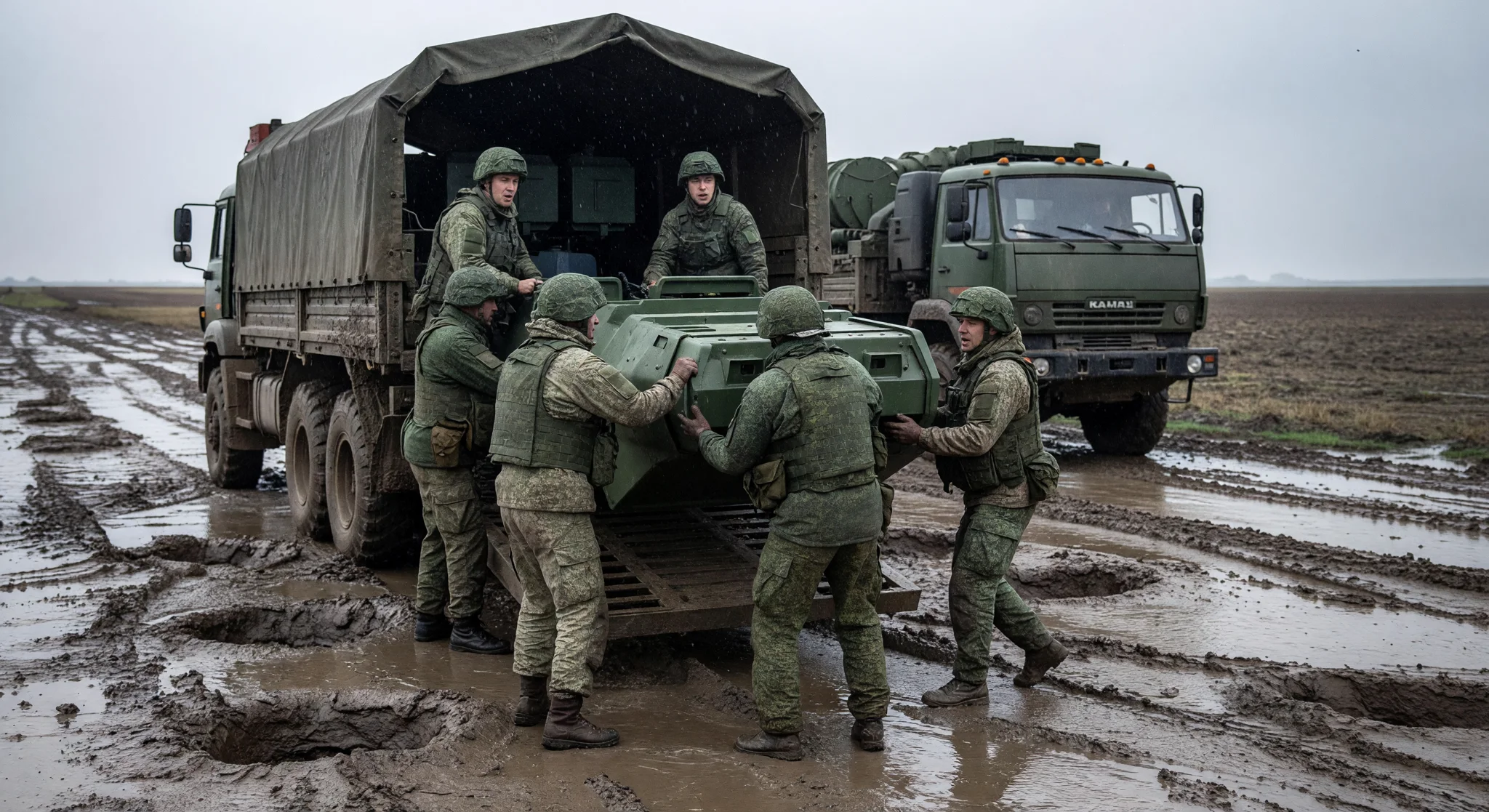
'The Russian defense industry is no longer an export enterprise; it is a dedicated life-support system for the Russian military,' notes a recent report from the Center for Strategic and International Studies (CSIS). 'Contracts signed with New Delhi are now functionally subordinate to the daily attrition rates in the Donbas.'
Armored Corps Supply Chain Collapse
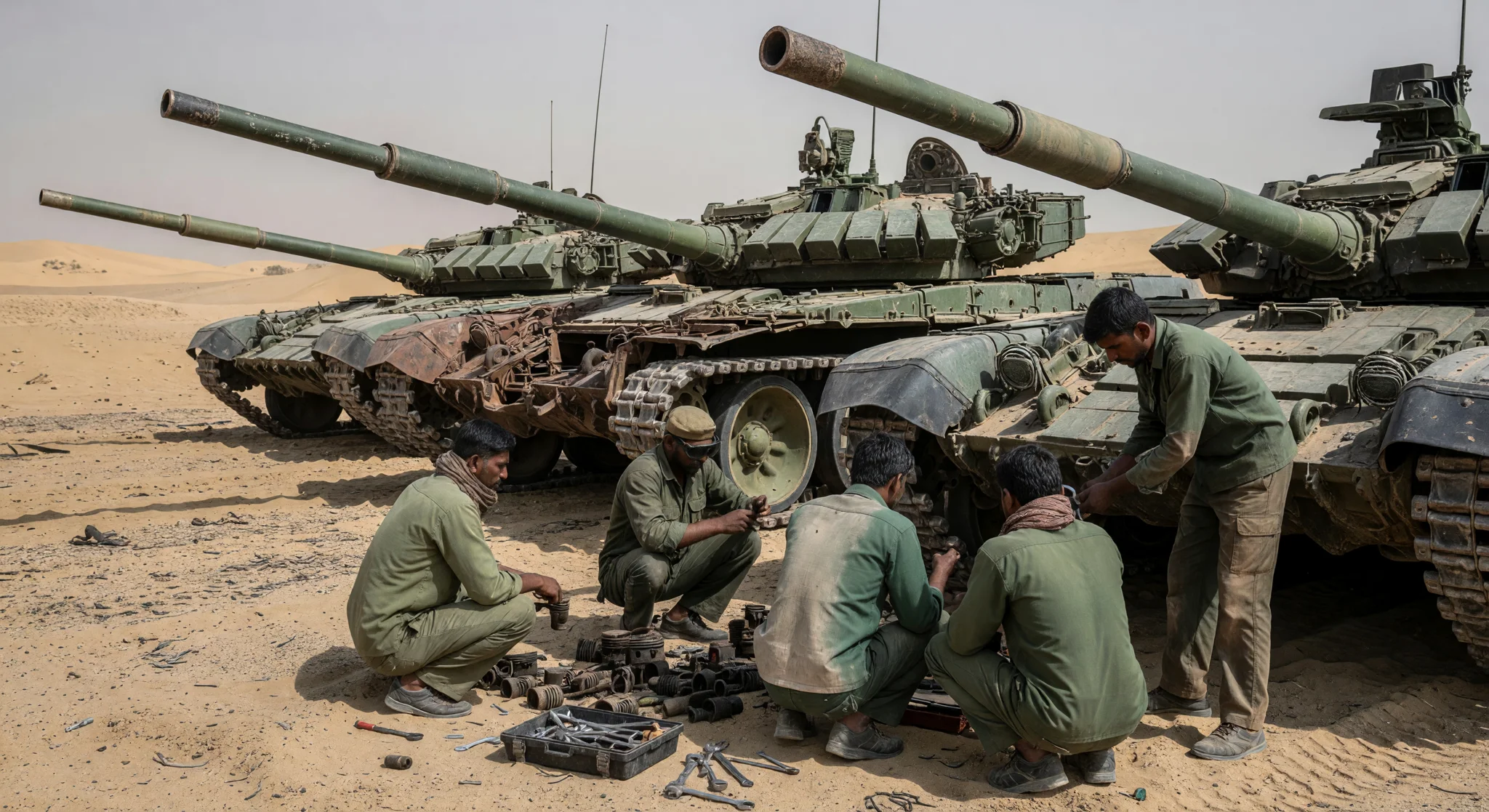
The crisis extends well beyond big-ticket items. The Indian Army's armored corps, which relies heavily on over 1,000 T-90S Bhishma tanks, has faced critical shortages of thermal imagers, engine components, and specialized 125mm ammunition. With Uralvagonzavod operating around the clock merely to refurbish decades-old Soviet armor for the Russian army, India's supply chain has run dry.
In response, New Delhi has been forced to cannibalize parts from older models and accelerate domestic manufacturing just to maintain operational readiness.
The Beijing Veto: A Geopolitical Awakening
While the logistical failures are acute, the deeper driver of India's decoupling is geopolitical. The Kremlin's deepening reliance on the People's Republic of China for economic survival, dual-use technology, and diplomatic cover has fundamentally altered the strategic calculus in New Delhi.
Since the deadly Galwan Valley clashes in 2020, India's primary security threat has definitively shifted from Pakistan to China. The heavily militarized Line of Actual Control (LAC) in the Himalayas remains a flashpoint. In the halls of India's Ministry of External Affairs, a stark realization has taken hold: in the event of a full-scale Sino-Indian conflict, Moscow can no longer be trusted to remain neutral, let alone supply India with munitions.
Western defense analysts point to an unspoken 'Beijing Veto' over Russian arms exports. As Moscow becomes economically vassalized by China, the likelihood that Beijing could pressure the Kremlin to embargo emergency spare parts to India during a border crisis has reached unacceptable levels.
- Intelligence Sharing Risks: Indian military planners have raised alarms about the integration of Chinese software and electronic components into modern Russian export weapons, fearing potential backdoors.
- Strategic Realignment: Russia's vocal criticism of the Quad (the strategic security dialogue between Australia, India, Japan, and the U.S.) has alienated Indian policymakers who view the alliance as vital to containing Chinese maritime expansion.
- Technology Transfer Halt: Joint ventures, such as the BrahMos aerospace program, are increasingly leaning entirely on Indian R&D as Russian engineering talent is drafted or redirected to the war effort.
The Western and Indigenous Renaissance
Nature and geopolitics abhor a vacuum. As Russia retreats, the United States, France, and India's own domestic defense sector are rapidly filling the void. The shift is most visible in the aerospace and maritime domains, where technological superiority is paramount.
France has emerged as the premier beneficiary of Russia's decline. Following the successful induction of the Dassault Rafale fighter jet into the Indian Air Force, the Indian Navy recently rejected Russian MiG-29K upgrades in favor of the Rafale-M for its aircraft carriers. Furthermore, Naval Group's partnership with Mumbai's Mazagon Dock is poised to expand, developing the next generation of conventional attack submarines equipped with air-independent propulsion (AIP)—technology Russia promised but failed to deliver for over a decade.
Simultaneously, Washington has capitalized on the moment to deepen defense-industrial ties. In a landmark move, the U.S. approved the joint production of General Electric F414 jet engines on Indian soil to power the indigenous Tejas Mk2 fighters. Alongside the acquisition of MQ-9B SeaGuardian drones for Indian Ocean surveillance, the U.S. is integrating India into a broader, interoperable Indo-Pacific security architecture.
However, the ultimate winner of this geopolitical rupture is India's 'Atmanirbhar Bharat' (Self-Reliant India) initiative. The shock of the Russian supply chain collapse provided the necessary political capital to force the traditionally sluggish Defence Research and Development Organisation (DRDO) and private sector players like Tata and Larsen & Toubro into high gear. Indigenous artillery systems, light combat helicopters, and naval radars are rapidly displacing Russian legacy systems.
The Death of Rosoboronexport
The strategic consequences for Moscow are catastrophic. For decades, India was the financial anchor of Russia's defense industry, routinely accounting for over 30% of all Russian arms exports. This inflow of hard currency subsidized the research and development of Russia's domestic military programs.
Without Indian capital, the economic viability of Russia's next-generation weapons is collapsing. The highly publicized Su-75 'Checkmate' fifth-generation stealth fighter, designed explicitly for the export market and desperately seeking foreign investment, is now widely considered vaporware by defense analysts. Similarly, plans for advanced export variants of the Lada-class submarine have been quietly shelved.
Russia's state arms exporter, Rosoboronexport, is facing institutional ruin. Relegated to bartering basic munitions with pariah states like North Korea and Iran, the agency has permanently lost its foothold in the lucrative high-tech defense market. Even traditional secondary clients in Southeast Asia and Africa are watching India's pivot and re-evaluating their reliance on Russian hardware.
Conclusion: A New Indo-Pacific Paradigm
The severing of the Russia-India arms pipeline is not merely an economic footnote; it is a seismic shift in the global balance of power. By dismantling its historic reliance on Moscow, New Delhi has freed itself from a strategic vulnerability that threatened to compromise its defense against a rising China.
For the Kremlin, the loss of India signals the end of its status as a premier global arms supplier, reducing its defense sector to an insular, technologically stagnant arm of the state consumed entirely by the war in Ukraine. For the West, it represents a historic opportunity to firmly anchor the world's largest democracy within the democratic security architecture of the Indo-Pacific.
As Indian pilots prepare to train on Western simulators and Indian shipyards lay the keels for indigenous, Western-integrated submarines, the legacy of Russian military dominance in South Asia fades into history. In its quest to conquer Kyiv, Moscow has lost New Delhi, fundamentally rewriting the geopolitical map of the 21st century.


Reader discussion
No comments yet. Start the discussion.
Comments are closed for this article.