
In the churning black soil of the Donbas and the waterlogged forests of the Baltic frontier, high-tech sensors and satellite uplinks often matter less than a century-old mechanical concept: torque and traction.
As the war in Ukraine drags through the winter of 2025, a clear lesson has emerged from the mud. While standard commercial trucks modified for military use have faltered, sinking axle-deep into the rasputitsa, one distinct silhouette keeps moving.
The Czech-made Tatra truck, with its inward-cambered wheels and tubular backbone, has quietly become one of the most vital strategic assets on NATO’s Eastern Flank. No longer just a relic of the Cold War era, the Kopřivnice-based manufacturer is driving a logistical renaissance that is reshaping how European armies move men, munitions, and massive artillery pieces across broken terrain.
The Backbone Tube: An Engineering Marvel
To understand Tatra's geopolitical significance, one must understand its engineering. Unlike the rigid ladder frames used by Mercedes-Benz, MAN, or Oshkosh—which twist and suffer stress fractures under extreme off-road loads—the Tatra design relies on a central backbone tube.
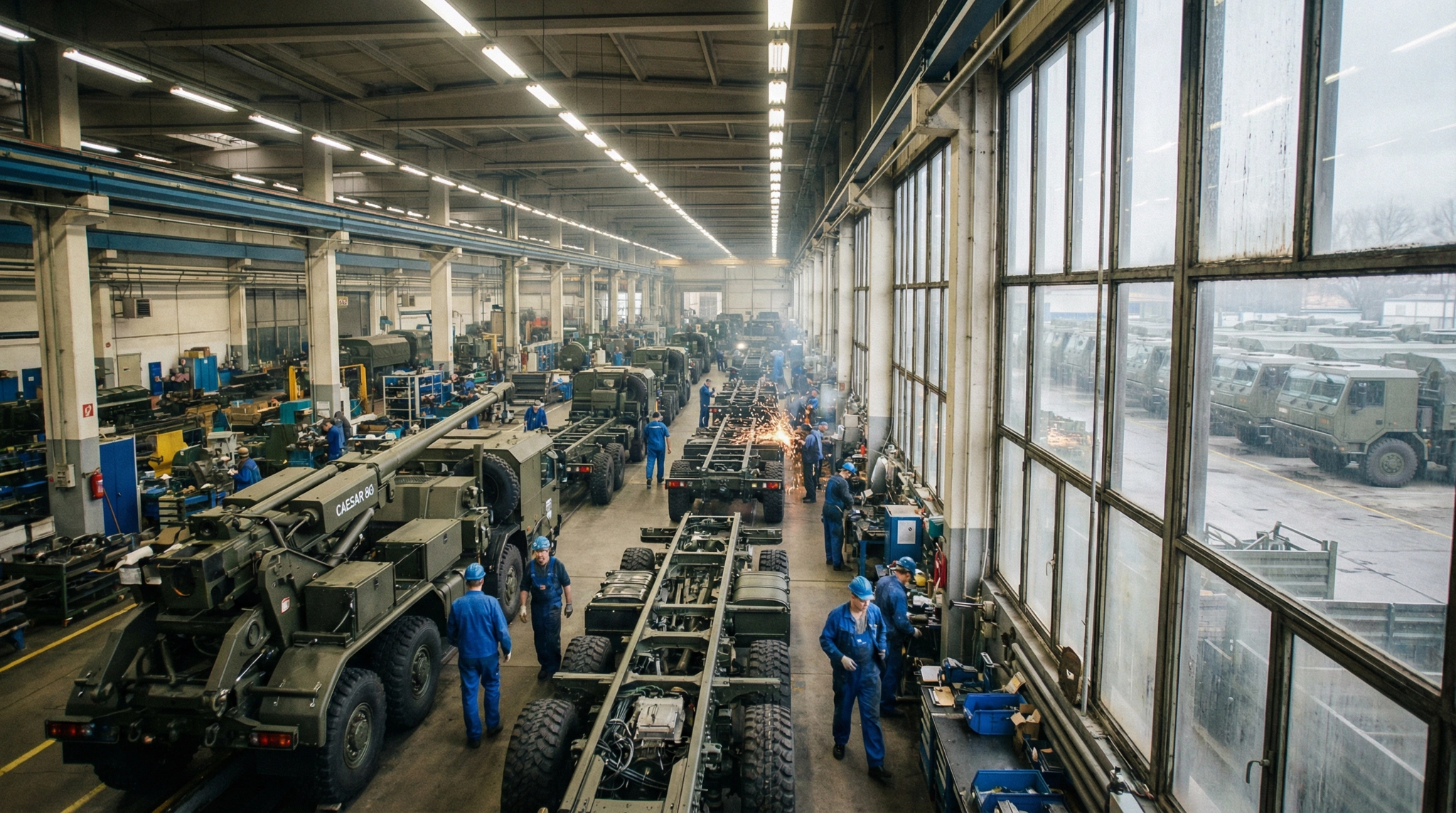
Invented by Hans Ledwinka in the 1920s, this rigid tube protects the driveshaft and differentials, allowing for independently swinging half-axles. This unique architecture offers three decisive advantages for modern warfare:
- Extreme Mobility: Each wheel moves independently, maintaining traction on uneven ground where rigid-axle trucks would lose contact or tip.
- Durability: The drivetrain is fully enclosed within the tube, protected from mud, dust, mines, and debris—the exact conditions of the Ukrainian front.
- Modularity: The chassis is essentially a LEGO set. Militaries can add axles (4x4, 6x6, 8x8, 10x10, or even 12x12) to carry heavier payloads without redesigning the entire vehicle.
Western defense analysts note that during the muddy transitions of spring and autumn, logistics units operating Tatras maintained supply throughput rates 30% to 40% higher than units relying on standard commercial-derived military trucks.
The Platform of Choice for NATO Artillery
Tatra’s resurgence is not merely about hauling crates of ammunition. The company has successfully positioned itself as the premier carrier for NATO’s next-generation mobile artillery.
As the era of towed howitzers ends—due to their vulnerability to counter-battery fire—shoot-and-scoot capability is paramount. The Czech manufacturer, now part of the industrial conglomerate Czechoslovak Group (CSG), supplies the chassis for an impressive array of European firepower:
- The French CAESAR 8x8: When Nexter needed a heavier, armored platform for its legendary gun, it chose Tatra over domestic French options for export markets and heavy configurations.
- The Slovak Zuzana 2 and EVA: Self-propelled howitzers that have seen active combat service.
- The Czech DITA and Morana: Next-generation automated heavy artillery systems.
- The Ukrainian Bohdana: Kyiv's indigenous 155mm howitzer has been successfully mounted on Tatra 8x8 chassis to improve survivability and mobility.
By standardizing on the Tatra chassis, these diverse systems gain commonality in spare parts and maintenance. A mechanic trained to fix the drivetrain of a cargo truck can effectively service the mobility section of a multimillion-dollar howitzer. In a high-attrition war, this logistical simplification is a strategic force multiplier.
Industrial Renaissance in the Heart of Europe
The rise of Tatra mirrors the broader revival of the Central European defense industry. For decades, Western European powers downsized their land forces, assuming that heavy logistics were a thing of the past. Germany's Rheinmetall and France's Arquus dominated the high end, but production volumes remained low.
The Czech Republic, leveraging its deep industrial heritage, has stepped into the breach. CSG has invested heavily in modernizing Tatra’s production lines, aiming to double output to meet insatiable demand from Ukraine and NATO members replenishing their stocks.
The factory in Kopřivnice has become a hub of activity, drawing in workers and engineers to sustain a 24/7 production cycle. Furthermore, Tatra is breaking into markets previously dominated by American and German giants. Contracts with Belgium and Germany for logistics fleets signal a shift in perception: Eastern European hardware is no longer seen as a "budget" alternative, but as a rugged, battle-tested superior option.
Strategic Implications for NATO
The "Tatra-ization" of Eastern European logistics creates a resilient belt of mobility from the Baltic to the Black Sea. As NATO plans for the defense of the Suwalki Gap or operations in the Carpathian Mountains, the ability to operate off-road is critical. The reliance on paved roads was a fatal flaw in the initial Russian invasion of 2022; NATO is keen not to repeat that mistake.
"Logistics is the ball and chain of armored warfare," noted a senior logistical officer at a recent NATO summit in Brussels. "Tatra cuts that chain. It gives commanders the confidence that fuel and shells will arrive, regardless of whether the bridge is out or the road is a river of mud."
Supply Chain Challenges
However, challenges remain. The company faces supply chain bottlenecks for sub-components, particularly specialized steel and electronics. Additionally, scaling the workforce in a tight Czech labor market requires strategic coordination with the government.
A Logistical Spine for Collective Defense
While F-35s and HIMARS capture the headlines, the humble Tatra truck represents the industrial endurance required to win a long war. By blending a century-old mechanical genius with modern manufacturing, the Czech Republic has provided NATO with a logistical spine capable of bearing the heavy burden of collective defense.
As the alliance fortifies its Eastern Flank, the roar of air-cooled Tatra engines will be the sound of a Europe that is finally, seriously, rearming.


Reader discussion
No comments yet. Start the discussion.
Comments are closed for this article.