
The Hollow Tower: An Empire Built on Gas Begins to Crumble
The Lakhta Center in St. Petersburg, a soaring 462-meter needle of glass and steel, stands as Europe's tallest building and a glittering monument to a bygone era. Built to serve as the global headquarters for Gazprom, the skyscraper was meant to project the invincibility of Russia's state-owned energy champion.
But in April 2026, the tower casts a long, dark shadow over the Russian economy. Once the ultimate instrument of Kremlin statecraft and the primary engine of the national budget, Gazprom has officially transitioned from a geopolitical weapon into a catastrophic financial liability.
A Widening Structural Deficit
Recent financial disclosures paint a grim picture. Following its historic $6.9 billion net loss in 2023—its first annual deficit since 1999—the company's financial hemorrhage has only accelerated.
Western defense analysts and energy economists now project that Gazprom's structural deficit will widen dramatically by the end of 2026. The permanent severing of European pipeline arteries, combined with the exorbitant costs of pivoting infrastructure toward Asia, has destroyed the company's traditional business model.
This is not merely a corporate failure; it is a profound national security crisis for the Russian Federation. For over two decades, Vladimir Putin's social contract with the Russian populace—and his ability to fund massive military modernization—relied heavily on the exorbitant rents extracted from European gas markets.
As the war in Ukraine enters its fifth year, the Kremlin is discovering that while oil can be smuggled on shadow fleets, pipelines cannot be moved. We analyze the anatomy of Gazprom's collapse, the geopolitical trap set by Beijing, and how this financial implosion threatens to starve the Russian war machine of its most critical resource: domestic capital.
The Permanence of Europe's Strategic Decoupling
The root of Gazprom's demise lies in a fundamental geopolitical miscalculation made in Moscow in 2022. The Kremlin operated on the assumption that Europe's dependence on cheap Russian natural gas was absolute, and that the threat of a freezing winter would fracture NATO's resolve and force Kyiv to capitulate.
Instead, the weaponization of energy catalyzed the fastest infrastructure pivot in modern European history.
Re-engineering the Energy Architecture
By 2026, the continent has fundamentally re-engineered its energy architecture. According to data from the International Energy Agency (IEA), Russian pipeline gas, which once accounted for over 40% of the European Union's total supply, now hovers near absolute zero.
The infrastructure that once bound Berlin to Moscow—the Nord Stream corridors, the Yamal-Europe pipeline, and the Brotherhood network—either lies ruptured at the bottom of the Baltic Sea or sits empty and corroding.
Europe survived the transition by executing a multipronged strategy that Moscow deemed impossible. The rapid deployment of Floating Storage and Regasification Units (FSRUs) along the German and Dutch coasts opened the floodgates for American and Qatari Liquefied Natural Gas (LNG).
Meanwhile, the completion of the Baltic Pipe effectively integrated Norwegian gas reserves directly into Central Europe, permanently displacing Gazprom's historical dominance in Poland and the Baltics.
"The loss of the European market is not a cyclical downturn for Gazprom; it is a permanent structural amputation," notes a recent comprehensive report by the Oxford Institute for Energy Studies. "The high-margin revenue that subsidized both Russia's domestic energy grid and its foreign reserves simply no longer exists, and no amount of political rhetoric can replace the physical pipelines pointing West."
Gazprom's attempts to pivot to the global LNG market have been systematically suffocated by targeted Western sanctions. Initiatives like the Arctic LNG 2 project, operated in conjunction with Novatek, have faced crippling delays due to embargoes on Western cryogenic technology and specialized ice-breaking LNG carriers.
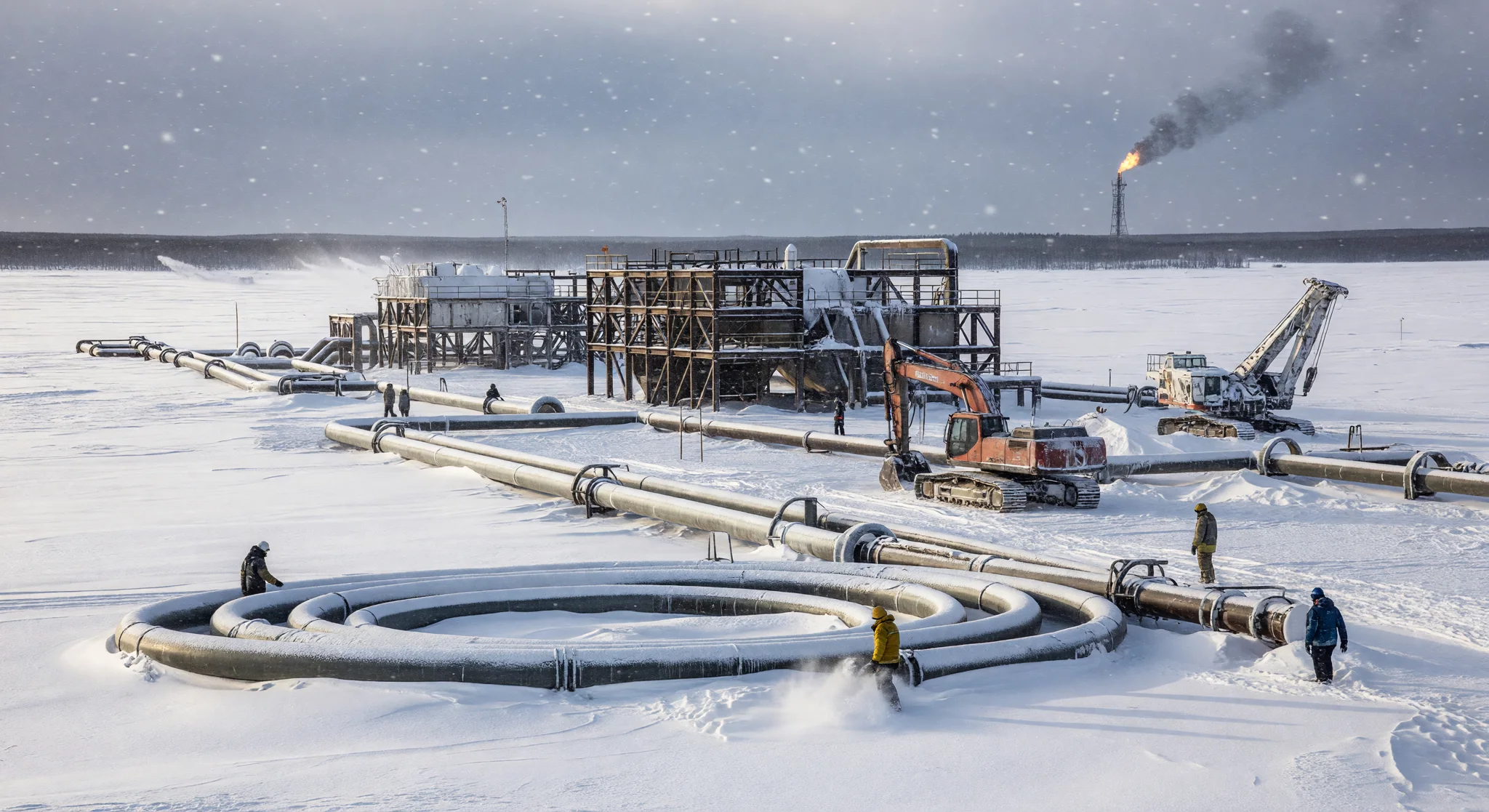
Consequently, Gazprom is left with massive, stranded reserves in the Yamal Peninsula with no viable vector for high-volume export.
The Beijing Trap: The Monopsony of Power of Siberia 2
Faced with the collapse of its Western markets, the Kremlin's singular strategic imperative has been to execute an "Asian Pivot." The centerpiece of this pivot is the proposed Power of Siberia 2 pipeline, a megaproject designed to transport 50 billion cubic meters (bcm) of gas annually from the Yamal fields—through Mongolia—directly to northern China.
Russian state media has continually heralded this pipeline as the ultimate geopolitical counterweight to Western sanctions.
China's Overwhelming Leverage
However, Beijing understands its overwhelming leverage, and Chinese President Xi Jinping has proven to be a ruthless negotiator. Unlike the fragmented European market of the 2010s, China operates as a monopsony—a single, dominant buyer dictating terms to a desperate seller.
Through 2025 and into 2026, negotiations over Power of Siberia 2 have repeatedly stalled over pricing disputes that strike at the heart of Gazprom's profitability.
- Pricing Parity Demands: China National Petroleum Corporation (CNPC) has reportedly demanded that gas delivered via Power of Siberia 2 be priced near Russian heavily subsidized domestic rates, completely stripping Gazprom of any export premium.
- Infrastructure Burden: Beijing has refused to commit any capital expenditure to the pipeline's construction on Russian or Mongolian soil, demanding that Gazprom bear the entirety of the multi-billion-dollar financial risk.
- Volume Flexibility: Wary of repeating Europe's mistake of over-reliance, China insists on strict limits to Russian imports, preferring to balance its energy portfolio with domestic coal, renewables, and maritime LNG from the Middle East and Australia.
Experts at the Carnegie Russia Eurasia Center highlight that even if an agreement is signed tomorrow, the pipeline would take nearly a decade to construct and would generate a fraction of the revenue previously extracted from Europe.
In the immediate term, the existing Power of Siberia 1 pipeline—which draws from different, eastern Siberian fields—cannot physically replace the lost European volumes or the lost margins. Gazprom is trapped: it desperately needs China, but China is perfectly content to wait.
From Cash Cow to Fiscal Black Hole: Cannibalizing the Domestic Economy
The geopolitical impasse in the East and the physical barriers in the West have resulted in a devastating domestic reality: Gazprom is now bleeding money, and the Russian state is stepping in to keep it afloat.
This represents a complete inversion of the Russian economic model. For decades, Gazprom subsidized the Russian state; today, the Russian populace must subsidize Gazprom.
Plugging the National Budget
To plug the gaping holes in the national budget and sustain the exorbitant costs of the Ukraine war, the Ministry of Finance has drastically altered the tax regime. The Kremlin has continuously hiked the Mineral Extraction Tax (MET), squeezing maximum immediate revenue out of its energy sector regardless of long-term corporate health.
Gazprom, fundamentally unable to pass these costs onto non-existent European buyers, has been forced to absorb the blows directly.
The consequences for the Russian civilian economy are severe and accelerating in 2026:
- Domestic Tariff Spikes: To compensate for lost export revenues, the Kremlin has authorized unprecedented hikes in wholesale gas tariffs for domestic consumers. Russian citizens, long accustomed to ultra-cheap, state-subsidized heating and electricity, are facing utility bills that are rising significantly faster than official inflation rates.
- Infrastructure Decay: Gazprom has drastically slashed its capital expenditures (CAPEX). Plans for expanding the domestic gasification grid to impoverished rural regions have been quietly shelved. More alarmingly, maintenance on existing Soviet-era infrastructure is being deferred, raising the risk of catastrophic winter failures across the Russian interior.
- Asset Liquidations: Reports from financial analysts indicate that Gazprom is quietly attempting to divest from its sprawling portfolio of non-core assets, including real estate, media holdings, and regional banking subsidiaries, in a desperate bid to raise liquidity.
This internal cannibalization threatens the bedrock of Putin's domestic stability. The implicit bargain of modern Russia—political compliance in exchange for economic stability and cheap basic services—is actively fracturing under the weight of Gazprom's balance sheet.
Strategic Implications for the Russian War Machine
The financial implosion of Russia's gas monopoly has profound and immediate implications for the battlefield in Eastern Europe. The Russian military-industrial complex, running at maximum capacity to replace staggering materiel losses, requires constant injections of state capital.
The collapse of Gazprom's revenue directly constrains the Kremlin's fiscal maneuverability.
Depletion of State Reserves
First, the depletion of the National Wealth Fund (NWF) is accelerating. The NWF, originally built on surplus energy revenues, has been the Kremlin's primary shock absorber against Western financial sanctions.
With Gazprom turning into a net drain on state resources, and oil revenues volatile due to tightening shadow-fleet embargoes, the Ministry of Finance is burning through its liquid reserves at an unsustainable rate. Western defense analysts estimate that without the historical influx of gas rents, the NWF's liquid assets could reach critically low levels by late 2026.
Social Cohesion and Mobilization
Second, the fiscal squeeze limits the state's ability to maintain social cohesion while mobilizing manpower. The Russian Ministry of Defense has relied heavily on massive, upfront cash bonuses to recruit contract soldiers from impoverished regions.
As domestic tariffs rise and state budgets tighten, the Kremlin's ability to buy its way out of a deeply unpopular general mobilization diminishes. The financial friction is forcing hard choices between funding Uralvagonzavod's tank production lines and subsidizing heating for Siberian cities.
Finally, the weakness of Gazprom diminishes Russia's broader geopolitical leverage in the Global South. A financially crippled state enterprise cannot fund the massive infrastructure diplomacy—such as nuclear power plants or regional pipeline networks—that Moscow has historically used to bind neutral states in Central Asia, Africa, and Latin America into its sphere of influence.
Conclusion: The End of an Era
The ongoing collapse of Gazprom is not a temporary casualty of a localized conflict; it is the terminal decline of the economic engine that built modern Russia. By fundamentally misunderstanding the resilience of European energy markets and overestimating its leverage in Beijing, the Kremlin has destroyed an enterprise that took half a century to build.
As the conflict grinds on through 2026, the towering Lakhta Center serves as a stark reminder of a fatal strategic hubris. The weaponization of natural gas has ultimately misfired, crippling the wielder rather than the target.
As the Russian state is forced to cannibalize its own civilian economy to cover Gazprom's mounting deficits and sustain the war effort, the true long-term cost of the Ukraine invasion becomes unavoidably clear. Moscow may still be able to produce artillery shells, but it is financing them by mortgaging the very economic foundation of the Russian state—a transaction that history suggests cannot be sustained indefinitely.


Reader discussion
No comments yet. Start the discussion.
Comments are closed for this article.