
Introduction: The Hollow Coast
In the spring of 2026, the streets of Vladivostok present a striking geopolitical juxtaposition. While recruitment billboards for the Russian Ministry of Defense loom over major intersections, urging young men to fight NATO proxies in the Donbas, the ground reality below tells a different story of conquest.
Commercial signage is increasingly printed in Mandarin. At the commercial ports, Chinese logistical conglomerates orchestrate the loading and unloading of bulk carriers, managing a transit network that now completely bypasses traditional Russian federal oversight.
The Eastern Military District's garrisons are largely hollowed out, their heavy armor and experienced personnel shipped 6,000 kilometers west to feed the grinding war in Ukraine.
Moscow's strategic obsession with its western borders has created an unprecedented vacuum in its east. As recent satellite intelligence confirms the quiet emptying of garrisons across the Kuril Islands and the Amur basin, a different kind of invasion is underway.
It is not kinetic, nor is it overtly hostile. Instead, it is a quiet, asymmetric, and deeply systemic geoeconomic annexation by the People's Republic of China. Beijing is systematically transforming the Russian Far East into an extractive vassal state, leveraging Moscow's wartime desperation, demographic collapse, and economic isolation to reverse centuries of historical power dynamics.
For decades, the Kremlin jealously guarded its Pacific territories, viewing Chinese investment with deep suspicion and actively blocking infrastructure projects that might integrate the Russian Far East too closely with Manchuria. Today, that calculus has been destroyed by necessity.
Stripped of European markets and bleeding capital, Vladimir Putin's regime has surrendered its strategic autonomy in the Pacific, offering Beijing unrestricted access to land, resources, and logistical nodes that it once fiercely protected.
The Infrastructural Surrender
The turning point in this regional capitulation began subtly in 2023 when Beijing officially declared Vladivostok a transit port for its domestic trade. This allowed goods from landlocked Jilin province to flow through Russian territory to the East China Sea without international customs tariffs. By 2026, this arrangement has blossomed into near-total infrastructural capture.
According to recent analysis from the Center for Strategic and International Studies (CSIS), Chinese state-owned enterprises (SOEs) now control or finance over 65 percent of new capital expenditure in Primorsky Krai's maritime infrastructure.
The Zarubino port expansion, long stalled due to Russian fears of Chinese encirclement, has been greenlit and entirely underwritten by the China Communications Construction Company (CCCC). This effectively grants Beijing a deep-water commercial beachhead just kilometers from the North Korean border, linking the Sea of Japan directly to China's Belt and Road Initiative (BRI).
"Moscow is no longer setting the terms of engagement in the Far East," notes Alexander Gabuev, director of the Carnegie Russia Eurasia Center. "Before the war, Russia played hard to get, demanding technology transfers and joint ownership. Today, they are selling the strategic furniture just to keep the lights on in Moscow. China is writing the contracts, providing the capital, and bringing the labor."
Furthermore, the long-dormant Tumen River access negotiations have been quietly resurrected. For over a century, Russia and North Korea restricted Chinese access down the Tumen to the Sea of Japan to contain Beijing's naval and commercial expansion.
In late 2025, desperate for dual-use technology and financial lifelines, Moscow reportedly signed a memorandum of understanding allowing Chinese dredging operations in the lower Tumen. This effectively grants China a new strategic outlet to the Pacific—a historic concession that previous Russian administrations would have considered treasonous.
Demographic Collapse Meets Chinese Expansion
The economic absorption of the Russian Far East is drastically accelerated by Russia's catastrophic demographic crisis. As previously reported, a nationwide deficit of nearly 4.8 million workers has crippled the Russian domestic economy.
This crisis is magnified tenfold in the Far East, a region that has suffered steady depopulation since the collapse of the Soviet Union. The mobilization of hundreds of thousands of men, disproportionately drawn from poor, remote regions like Buryatia and Primorsky Krai, has left local industries critically uncrewed.
To keep the region's extractive industries functioning, Moscow has quietly relaxed labor and visa restrictions for Chinese nationals. Across the Amur River, the contrast is stark: the Russian Far East holds barely 6 million people spread across a landmass larger than India, while China's three bordering northeastern provinces are home to over 100 million.
Nature abhors a vacuum, and economics is no different.
- Agriculture: Chinese agribusinesses now lease an estimated 1.2 million hectares of arable land in the Russian Far East. With Russian agricultural workers drafted or fleeing mobilization, Chinese firms have imported proprietary automated farming technology and thousands of temporary workers to cultivate soybeans and wheat, 90 percent of which is exported directly back to China to ensure Beijing's food security.
- Timber and Mining: In Khabarovsk Krai, the lucrative timber export market operates almost entirely on Chinese capital. Raw logs are shipped south, while the value-added manufacturing remains firmly on the Chinese side of the border. Similar dynamics dominate the extraction of coal and rare earth metals in the region.
- Retail and Real Estate: Chinese commercial syndicates have rapidly acquired prime real estate in Blagoveshchensk and Khabarovsk, establishing logistical hubs that bypass Russian middle-men entirely.
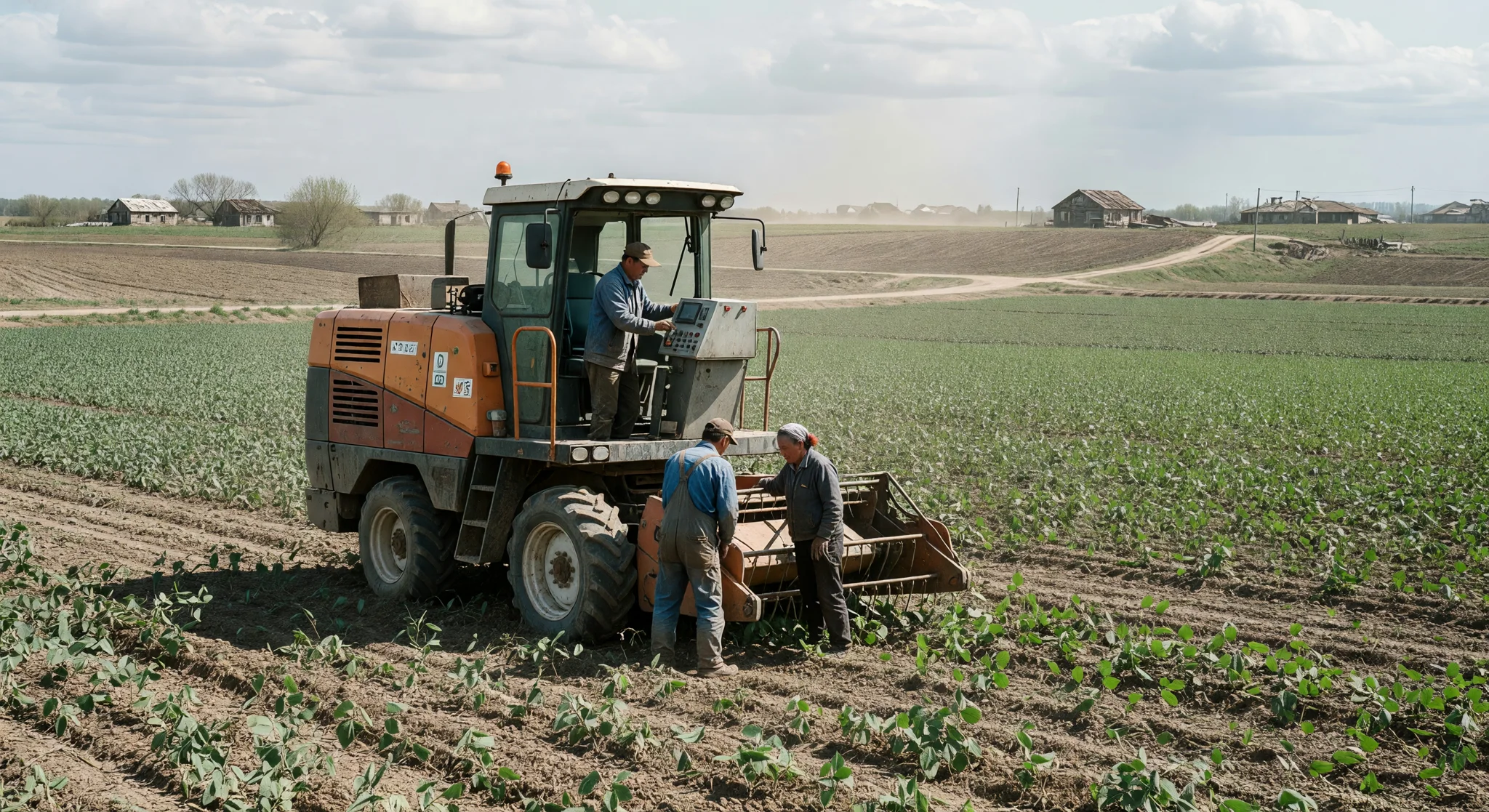
The Kremlin's traditional fear of a "creeping demographic invasion"—a staple of Russian nationalist paranoia in the 1990s and 2000s—has been forcefully silenced by state media. Discussing Chinese encroachment in the Far East is now effectively censored, categorized by the FSB as undermining the "no-limits" partnership essential to the war effort.
Reversing the Unequal Treaties
To understand the depth of this geopolitical shift, one must look at the historical context. The borders of the Russian Far East were drawn in the mid-19th century through the Treaties of Aigun (1858) and Beijing (1860).
During the Qing Dynasty's "Century of Humiliation," the Russian Empire annexed over 1 million square kilometers of Manchurian territory. This included the coastline where Vladivostok (literally "Ruler of the East") now stands.
While the Chinese Communist Party officially recognizes the current border, the historical grievance remains a potent force in Chinese domestic nationalism. Maps approved by the Chinese Ministry of Natural Resources in recent years subtly mandate the inclusion of former Chinese names alongside their Russian equivalents. Vladivostok is labeled Haishenwai, Khabarovsk is Boli, and Sakhalin Island is Kuyedao.
Analysts at the Atlantic Council suggest that Beijing has no need for a kinetic military reconquest of these "lost territories." The 21st-century model of annexation does not require tanks crossing the Amur River. Instead, it relies on creating a state of irreversible economic dependency.
By integrating Primorsky Krai into the Manchurian power grid, financing its port infrastructure, dominating its agricultural output, and monopolizing its export markets, China is effectively reclaiming the region in all but name.
The Strategic Threat to Russia's Sovereignty
The long-term implications for Russian sovereignty are dire. By tying the survival of the Russian Far East to Chinese economic goodwill, Putin has granted Xi Jinping massive leverage over Moscow's domestic and foreign policy.
If Beijing were to suddenly halt its infrastructure investments or restrict cross-border trade, the economy of eastern Russia would collapse within months.
This dependency heavily restricts Russia's diplomatic maneuvering in the Indo-Pacific. Historically, Moscow sought to balance its relations in Asia by maintaining strong ties with India, Vietnam, and Japan.
Today, Russia's ability to act as an independent pole in Asian security is functionally dead. When Chinese and Indian troops clashed in the Himalayas, Moscow was forced into a humiliating silence.
As China aggressively expands its footprint in the South China Sea, Russia's Pacific Fleet—now largely stripped of its modern assets and marines—remains confined to port. It exists mostly as a ceremonial guard for Chinese shipping lanes.
The Financial Noose: The Yuanization of the East
Further cementing this vassalage is the complete "yuanization" of the Far Eastern economy. With Russian banks excised from the SWIFT system, cross-border trade is now settled almost exclusively in Renminbi.
Local businesses in Vladivostok report that securing loans in rubles is increasingly difficult. This is due to hyper-inflated interest rates set by the Russian Central Bank to combat wartime inflation.
In contrast, Chinese state banks offer highly favorable credit lines to Russian firms—provided they use Chinese suppliers, hire Chinese logistics firms, and settle their debts in yuan.
This financial architecture ensures that the wealth generated in the Russian Far East flows in one direction: south. It structurally prevents Russia from developing indigenous industries that could compete with Chinese imports, locking the region into a permanent status as a resource colony.
Conclusion: Winning the Battle, Losing the East
As the conflict in Ukraine grinds through its fifth year, the ultimate irony of Vladimir Putin's grand imperial project is coming into sharp focus. In his obsessive quest to conquer the Donbas and redraw the security architecture of Eastern Europe, he has hollowed out the foundations of his own empire in Asia.
The demilitarization of the Pacific coast, combined with the desperate firesale of geopolitical assets to Beijing, marks the end of Russia's era as a genuine Eurasian superpower.
The Russian Far East is quietly transitioning into an economic appendage of Manchuria. While Russian state television broadcasts triumphant narratives of holding the line in Donetsk, the maps in Beijing tell a different story—one of a patient, bloodless, and absolute victory over the "Ruler of the East."


Reader discussion
No comments yet. Start the discussion.
Comments are closed for this article.