
The Evaporation of a Russian Empire in the Caucasus
As the war in Ukraine grinds into its fifth year in early 2026, the geopolitical tectonic plates of the post-Soviet space are fracturing in ways that will outlast the conflict itself. While international attention remains fixated on NATO's eastern flank and the militarization of the Suwalki Gap, a quieter but equally historic strategic realignment is unfolding in the South Caucasus. Armenia, traditionally Moscow's most reliable anchor in the region, is systematically dismantling its reliance on the Russian security umbrella and aggressively rearming with advanced platforms from France and India.
For decades, the presence of the Russian 102nd Military Base in Gyumri and Russian FSB border guards at Zvartnots International Airport served as the ultimate deterrent against Turkish and Azerbaijani expansionism. But the geopolitical calculus has fundamentally shifted. The Kremlin's disastrous performance in Ukraine, coupled with its tacit complicity in the 2023 ethnic cleansing of Nagorno-Karabakh, has shattered the illusion of Russian protection.
Today, Yerevan is undertaking a high-stakes geopolitical tightrope walk: pivoting toward Western and Asian democratic powers to rebuild its shattered military, while attempting to avoid a fatal retaliation from an increasingly paranoid Kremlin.
"The strategic decoupling of Yerevan from Moscow is the most significant geopolitical realignment in the South Caucasus since the fall of the Soviet Union," notes a recent situational report from the International Institute for Strategic Studies (IISS). "Armenia is no longer waiting for a Russian rescue that will never come; it is actively rewriting its defense doctrine."
This analysis examines the mechanics of Armenia's military diversification, the specific technological capabilities being introduced to the South Caucasus by Paris and New Delhi, and the strategic implications for a region where the traditional hegemon is in terminal decline.
The Catalyst: The Death of the CSTO Guarantee
To understand the speed and scale of Armenia's pivot, one must examine the systematic failure of the Collective Security Treaty Organization (CSTO)—Putin's nominal counterweight to NATO. When Azerbaijani forces launched incursions into sovereign Armenian territory in 2021 and 2022, Yerevan invoked Article 4 of the CSTO treaty, which mandates collective defense in the event of aggression against a member state. The response from Moscow was a deafening silence, followed by offers to send unarmed "observers."
According to analysts at the Institute for the Study of War (ISW), Russia's inaction was not merely a result of military overstretch in Ukraine, but a calculated geopolitical concession. Moscow sought to maintain its lucrative economic and energy ties with Baku and Ankara, sacrificing Armenian security on the altar of sanctions evasion.
The final rupture occurred in September 2023, when Russian "peacekeepers" stepped aside to allow Azerbaijan's lightning offensive in Nagorno-Karabakh, resulting in the exodus of over 100,000 ethnic Armenians.
Recognizing that dependency on Russia was no longer a security guarantee but a profound vulnerability, Prime Minister Nikol Pashinyan initiated a radical course correction. In late 2024 and throughout 2025, Armenia essentially froze its participation in the CSTO, demanded the withdrawal of Russian border guards from key transit nodes, and began seeking alternative military suppliers capable of delivering modern, NATO-interoperable technology.
The Paris-Yerevan Axis: France Enters the Caucasus
The most visible and strategically sensitive component of Armenia's rearmament is its deepening defense relationship with France. Paris, leveraging its large Armenian diaspora and its broader geopolitical rivalry with Turkey in the Mediterranean, has stepped into the South Caucasus security vacuum with unprecedented assertiveness.
Unlike previous European engagement, which focused on soft power and economic aid, the current French approach is explicitly militarized. In a historic breach of the traditional post-Soviet spheres of influence, a major NATO power is now directly arming a nation that technically remains a member of a Russian-led military alliance.
Critical Procurements
- Thales Ground Master 200 (GM200) Radars: Armenia's air defense network was fundamentally compromised during the 2020 war, heavily reliant on outdated Soviet-era systems that proved highly vulnerable to modern loitering munitions. The acquisition of three GM200 radar systems provides Yerevan with highly mobile, multi-mission capabilities capable of simultaneously tracking drones, cruise missiles, and combat aircraft at ranges up to 250 kilometers.
- Mistral Short-Range Air Defense Systems: To complement the radar network, France has supplied Mistral missiles, offering point defense against low-altitude threats. This combination forms the nucleus of a modernized, layered air defense network independent of Russian IFF (Identify Friend or Foe) codes.
- Bastion Armored Personnel Carriers: The delivery of Arquus-manufactured Bastion APCs addresses a critical deficiency in Armenian troop mobility, providing mine-resistant protection in the rugged, mountainous terrain of the border regions.
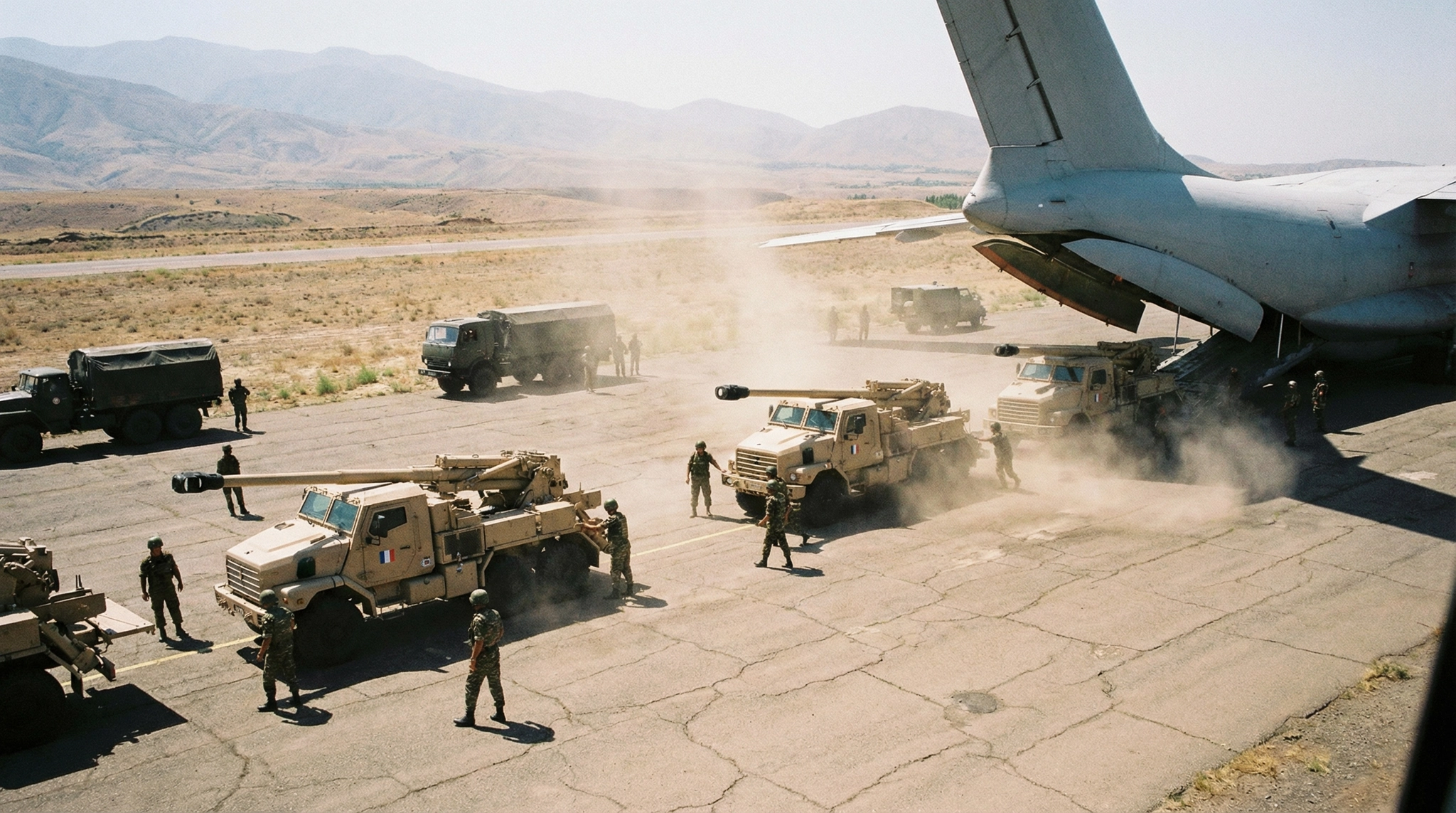
- CAESAR Artillery Systems: In a major escalation of the defense pact signed in late 2024, France agreed to supply its highly regarded CAESAR 155mm self-propelled howitzers. This system, which has proven devastatingly effective in Ukraine, offers shoot-and-scoot capabilities that severely complicate enemy counter-battery fire.
Western defense analysts emphasize that these acquisitions are not merely tactical upgrades; they represent a fundamental doctrinal shift. By integrating NATO-standard equipment, Armenia is slowly aligning its command-and-control structures with Western militaries, laying the groundwork for deeper interoperability in the coming decade.
The New Silk Road of Arms: India's Strategic Play
While French involvement has captured Western headlines, an equally significant defense partnership has blossomed between Yerevan and New Delhi. India's emergence as a primary arms supplier to Armenia represents a fascinating convergence of regional security dilemmas and global multipolarity.
For New Delhi, the calculus is driven by the tightening "Three Brothers" alliance between Pakistan, Turkey, and Azerbaijan. During the 2020 Nagorno-Karabakh war, Pakistani forces reportedly provided logistical and tactical support to Baku. In response, India recognized Armenia as a vital geostrategic counterbalance in the Caucasus—a region critical to the International North-South Transport Corridor (INSTC).
Between 2023 and 2026, the volume of Indian military exports to Armenia exploded, totaling over $1.5 billion. This procurement pipeline targets specific vulnerabilities exposed in recent conflicts.
The Indian Arsenal
- Pinaka Multi-Barrel Rocket Launchers (MBRL): Serving as a direct replacement for Russian BM-21 Grads and Smerch systems, the Pinaka Mk-I and Mk-II provide Armenia with devastating area-denial capabilities. The system's high mobility and rapid salvo rate make it ideal for mountain warfare.
- ATAGS (Advanced Towed Artillery Gun System): India's 155mm/52 caliber howitzer has become the new backbone of Armenian field artillery. With a range exceeding 48 kilometers using extended-range ammunition, the ATAGS allows Armenian forces to strike deep into staging areas while remaining outside the range of older Soviet systems.
- Swathi Weapon Locating Radars: One of the critical failures of the Armenian military in 2020 was the inability to suppress enemy artillery. The Swathi phased array radar can detect and track incoming artillery shells, mortars, and rockets, providing immediate coordinates for counter-battery fire.
- Zen Anti-Drone Systems (ZADS): Addressing the traumatic lessons of the Bayraktar TB2 and Harop drone swarms, India has supplied hard-kill and soft-kill counter-UAS platforms designed to blind and disable localized drone operations.
Crucially, the Indian defense industry has proven willing to customize these platforms for the specific atmospheric and topological conditions of the Armenian highlands, demonstrating a level of localized support that Moscow rarely provided to its client states.
The Strategic Vacuum and the Geopolitical Friction
Armenia's diversification strategy is not without severe risks. The delivery of Western and Indian arms faces a profound logistical bottleneck. With hostile borders to the east (Azerbaijan) and west (Turkey), and the primary northern route (Georgia) heavily influenced by Russian soft power and economic leverage, the physical transit of these weapons has forced creative geopolitical solutions.
Navigating the Logistical Bottleneck
Iran, sharing a southern border with Armenia, has emerged as the reluctant conduit for these deliveries. Tehran views the potential establishment of the "Zangezur Corridor"—a proposed extraterritorial route cutting through southern Armenia to connect Azerbaijan with its Nakhchivan exclave—as a direct threat to Iranian national security, as it would sever Iran's land bridge to Europe and the Caucasus.
Consequently, despite the irony of the Islamic Republic facilitating the transit of French NATO-standard weaponry, Tehran has allowed the Iranian port of Bandar Abbas to serve as the entry point for Indian arms destined for Yerevan.
Moscow's Asymmetric Retaliation
Meanwhile, the Kremlin's reaction has transitioned from dismissive rhetoric to active hybrid coercion. Analysts at the Atlantic Council suggest that while Russia cannot currently afford a kinetic intervention in the South Caucasus, it retains significant asymmetric leverage. The Russian state corporation Gazprom controls Armenia's natural gas supply, and the Russian FSB retains deep networks within the Armenian opposition and oligarchic structures.
Throughout 2025, Moscow repeatedly weaponized this leverage, temporarily suspending agricultural imports at the Upper Lars border crossing under dubious phytosanitary pretenses, and utilizing disinformation networks to stoke domestic unrest against the Pashinyan government. The Kremlin's message is clear: the physical withdrawal of troops does not equate to a surrender of the geopolitical battlespace.
Conclusion: Multipolarity Arrives at Russia's Doorstep
The transformation of Armenia's defense architecture from a wholly owned subsidiary of the Russian military-industrial complex to a diversified, multi-vector force represents a watershed moment in the geopolitics of Eurasia. It is the ultimate proof of concept that the post-Soviet space is permanently fragmenting.
As we observe the contrasting fates of Russia's neighbors in 2026—with Belarus entirely subsumed into the Russian command structure, and Armenia actively tearing up its defense treaties—a new reality emerges. Moscow can no longer maintain its empire through inertia or the threat of force alone. By failing to honor its security guarantees, Russia has inadvertently invited the world's middle and great powers into its most sensitive strategic backyard.
The influx of French radars and Indian artillery into the Caucasus is not merely an arms transfer; it is the physical manifestation of multipolarity arriving at Russia's borders. For NATO planners and Western policymakers, the lesson of Armenia is profound: the most effective way to roll back Russian influence is not always through direct confrontation, but by providing viable, high-quality security alternatives to the states Moscow has taken for granted.


Reader discussion
No comments yet. Start the discussion.
Comments are closed for this article.